

20
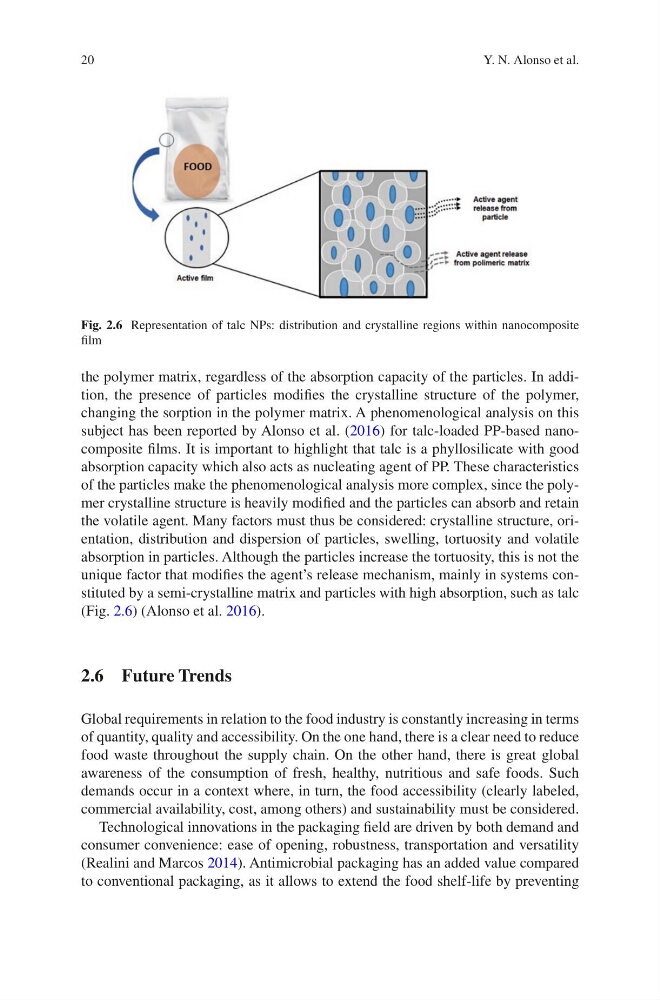
the polymer matrix, regardless of the absorption capacity of the particles. In addition, the presence of particles modifies the crystalline structure of the polymer,
changing the sorption in the polymer matrix. A phenomenological analysis on this
subject has been reported by Alonso et al. (2016) for talc-loaded PP-based nanocomposite films. It is important to highlight that talc is a phyllosilicate with good
absorption capacity which also acts as nucleating agent of PP. These characteristics
of the particles make the phenomenological analysis more complex, since the polymer crystalline structure is heavily modified and the particles can absorb and retain
the volatile agent. Many factors must thus be considered: crystalline structure, orientation, distribution and dispersion of particles, swelling, tortuosity and volatile
absorption in particles. Although the particles increase the tortuosity, this is not the
unique factor that modifies the agent’s release mechanism, mainly in systems constituted by a semi-crystalline matrix and particles with high absorption, such as talc
(Fig. 2.6) (Alonso et al. 2016).
2.6 Future Trends
Global requirements in relation to the food industry is constantly increasing in terms
of quantity, quality and accessibility. On the one hand, there is a clear need to reduce
food waste throughout the supply chain. On the other hand, there is great global
awareness of the consumption of fresh, healthy, nutritious and safe foods. Such
demands occur in a context where, in turn, the food accessibility (clearly labeled,
commercial availability, cost, among others) and sustainability must be considered.
Technological innovations in the packaging field are driven by both demand and
consumer convenience: ease of opening, robustness, transportation and versatility
(Realini and Marcos 2014). Antimicrobial packaging has an added value compared
to conventional packaging, as it allows to extend the food shelf-life by preventing
Fig. 2.6 Representation of talc NPs: distribution and crystalline regions within nanocomposite
film
Y. N. Alonso et al.
the polymer matrix, regardless of the absorption capacity of the particles. In addition, the presence of particles modifies the crystalline structure of the polymer,
changing the sorption in the polymer matrix. A phenomenological analysis on this
subject has been reported by Alonso et al. (2016) for talc-loaded PP-based nanocomposite films. It is important to highlight that talc is a phyllosilicate with good
absorption capacity which also acts as nucleating agent of PP. These characteristics
of the particles make the phenomenological analysis more complex, since the polymer crystalline structure is heavily modified and the particles can absorb and retain
the volatile agent. Many factors must thus be considered: crystalline structure, orientation, distribution and dispersion of particles, swelling, tortuosity and volatile
absorption in particles. Although the particles increase the tortuosity, this is not the
unique factor that modifies the agent’s release mechanism, mainly in systems constituted by a semi-crystalline matrix and particles with high absorption, such as talc
(Fig. 2.6) (Alonso et al. 2016).
2.6 Future Trends
Global requirements in relation to the food industry is constantly increasing in terms
of quantity, quality and accessibility. On the one hand, there is a clear need to reduce
food waste throughout the supply chain. On the other hand, there is great global
awareness of the consumption of fresh, healthy, nutritious and safe foods. Such
demands occur in a context where, in turn, the food accessibility (clearly labeled,
commercial availability, cost, among others) and sustainability must be considered.
Technological innovations in the packaging field are driven by both demand and
consumer convenience: ease of opening, robustness, transportation and versatility
(Realini and Marcos 2014). Antimicrobial packaging has an added value compared
to conventional packaging, as it allows to extend the food shelf-life by preventing
Fig. 2.6 Representation of talc NPs: distribution and crystalline regions within nanocomposite
film
Y. N. Alonso et al.