

18
metal is necessary for the metabolism of aerobic microorganisms, a high Cu concentration can inhibit cell growth. The antimicrobial property of Cu NPs is related
to the ability to donate and accept electrons, thus interacting with membrane cells,
nucleic acids and enzymes, which induce the death of microorganisms (Lejon et al.
2010; Beigmohammadi et al. 2016). It is important to highlight that the biocidal
efficiency of Cu NPs is influenced by concentration, morphology, particle size, production method and type of microorganism (Hoseinnejad et al. 2018). Zinc oxide
(ZnO) is an inorganic NP with antimicrobial activity and UV protective capacity
used to develop packaging materials (Huang et al. 2018). These attributes are mainly
determined by ZnO concentration and surface area, together with shape and crystalline structure of the particles (Sirelkhatim et al. 2015). Its biocidal activity can be
associated to: (1) the generation of hydrogen peroxide (H 2 O 2 ) from the surface of
particles and (2) the positive electricity of the ion (Zn
2+
), which penetrates the cell
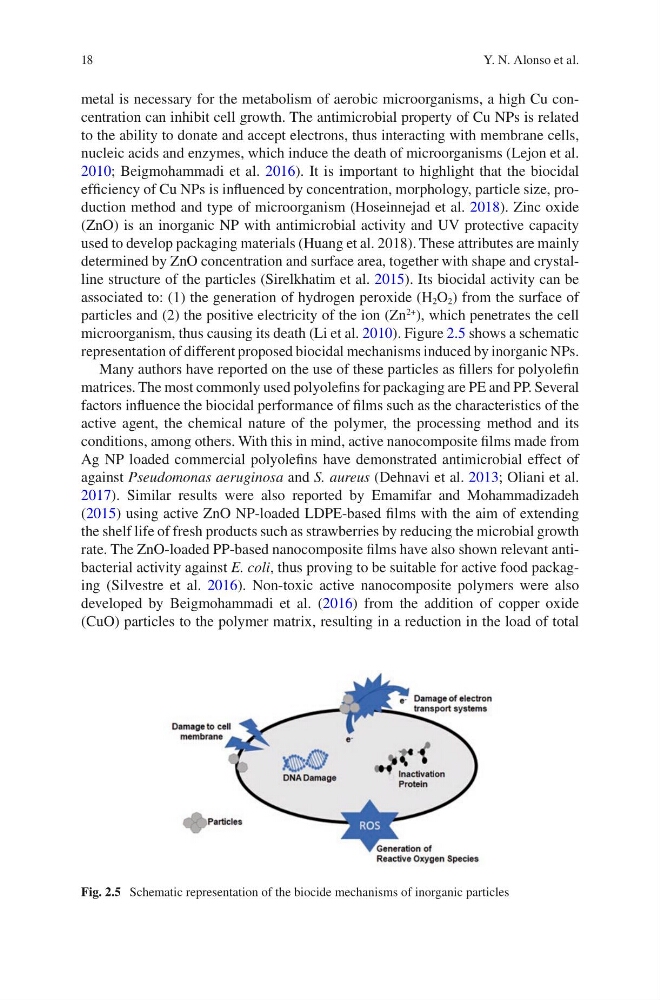
microorganism, thus causing its death (Li et al. 2010). Figure 2.5 shows a schematic
representation of different proposed biocidal mechanisms induced by inorganic NPs.
Many authors have reported on the use of these particles as fillers for polyolefin
matrices. The most commonly used polyolefins for packaging are PE and PP. Several
factors influence the biocidal performance of films such as the characteristics of the
active agent, the chemical nature of the polymer, the processing method and its
conditions, among others. With this in mind, active nanocomposite films made from
Ag NP loaded commercial polyolefins have demonstrated antimicrobial effect of
against Pseudomonas aeruginosa and S. aureus (Dehnavi et al. 2013; Oliani et al.
2017). Similar results were also reported by Emamifar and Mohammadizadeh
(2015) using active ZnO NP-loaded LDPE-based films with the aim of extending
the shelf life of fresh products such as strawberries by reducing the microbial growth
rate. The ZnO-loaded PP-based nanocomposite films have also shown relevant antibacterial activity against E. coli, thus proving to be suitable for active food packaging (Silvestre et al. 2016). Non-toxic active nanocomposite polymers were also
developed by Beigmohammadi et al. (2016) from the addition of copper oxide
(CuO) particles to the polymer matrix, resulting in a reduction in the load of total
Fig. 2.5 Schematic representation of the biocide mechanisms of inorganic particles
Y. N. Alonso et al.
metal is necessary for the metabolism of aerobic microorganisms, a high Cu concentration can inhibit cell growth. The antimicrobial property of Cu NPs is related
to the ability to donate and accept electrons, thus interacting with membrane cells,
nucleic acids and enzymes, which induce the death of microorganisms (Lejon et al.
2010; Beigmohammadi et al. 2016). It is important to highlight that the biocidal
efficiency of Cu NPs is influenced by concentration, morphology, particle size, production method and type of microorganism (Hoseinnejad et al. 2018). Zinc oxide
(ZnO) is an inorganic NP with antimicrobial activity and UV protective capacity
used to develop packaging materials (Huang et al. 2018). These attributes are mainly
determined by ZnO concentration and surface area, together with shape and crystalline structure of the particles (Sirelkhatim et al. 2015). Its biocidal activity can be
associated to: (1) the generation of hydrogen peroxide (H 2 O 2 ) from the surface of
particles and (2) the positive electricity of the ion (Zn
2+
), which penetrates the cell
microorganism, thus causing its death (Li et al. 2010). Figure 2.5 shows a schematic
representation of different proposed biocidal mechanisms induced by inorganic NPs.
Many authors have reported on the use of these particles as fillers for polyolefin
matrices. The most commonly used polyolefins for packaging are PE and PP. Several
factors influence the biocidal performance of films such as the characteristics of the
active agent, the chemical nature of the polymer, the processing method and its
conditions, among others. With this in mind, active nanocomposite films made from
Ag NP loaded commercial polyolefins have demonstrated antimicrobial effect of
against Pseudomonas aeruginosa and S. aureus (Dehnavi et al. 2013; Oliani et al.
2017). Similar results were also reported by Emamifar and Mohammadizadeh
(2015) using active ZnO NP-loaded LDPE-based films with the aim of extending
the shelf life of fresh products such as strawberries by reducing the microbial growth
rate. The ZnO-loaded PP-based nanocomposite films have also shown relevant antibacterial activity against E. coli, thus proving to be suitable for active food packaging (Silvestre et al. 2016). Non-toxic active nanocomposite polymers were also
developed by Beigmohammadi et al. (2016) from the addition of copper oxide
(CuO) particles to the polymer matrix, resulting in a reduction in the load of total
Fig. 2.5 Schematic representation of the biocide mechanisms of inorganic particles
Y. N. Alonso et al.