

16
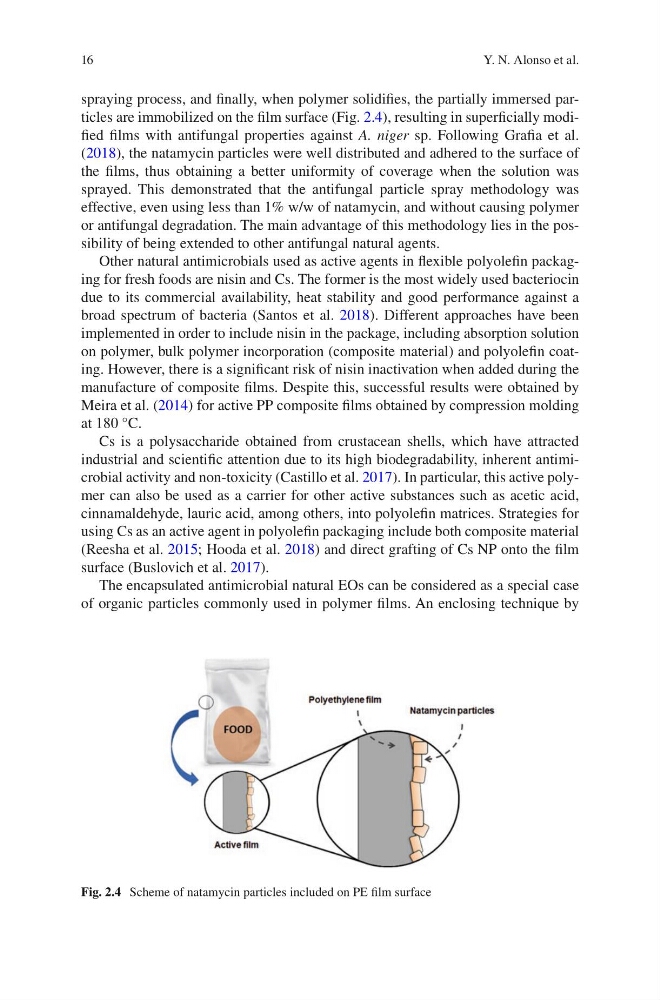
spraying process, and finally, when polymer solidifies, the partially immersed particles are immobilized on the film surface (Fig. 2.4), resulting in superficially modified films with antifungal properties against A. niger sp. Following Grafia et al.
(2018), the natamycin particles were well distributed and adhered to the surface of
the films, thus obtaining a better uniformity of coverage when the solution was
sprayed. This demonstrated that the antifungal particle spray methodology was
effective, even using less than 1% w/w of natamycin, and without causing polymer
or antifungal degradation. The main advantage of this methodology lies in the possibility of being extended to other antifungal natural agents.
Other natural antimicrobials used as active agents in flexible polyolefin packaging for fresh foods are nisin and Cs. The former is the most widely used bacteriocin
due to its commercial availability, heat stability and good performance against a
broad spectrum of bacteria (Santos et al. 2018). Different approaches have been
implemented in order to include nisin in the package, including absorption solution
on polymer, bulk polymer incorporation (composite material) and polyolefin coating. However, there is a significant risk of nisin inactivation when added during the
manufacture of composite films. Despite this, successful results were obtained by
Meira et al. (2014) for active PP composite films obtained by compression molding
at 180 °C.
Cs is a polysaccharide obtained from crustacean shells, which have attracted
industrial and scientific attention due to its high biodegradability, inherent antimicrobial activity and non-toxicity (Castillo et al. 2017). In particular, this active polymer can also be used as a carrier for other active substances such as acetic acid,
cinnamaldehyde, lauric acid, among others, into polyolefin matrices. Strategies for
using Cs as an active agent in polyolefin packaging include both composite material
(Reesha et al. 2015; Hooda et al. 2018) and direct grafting of Cs NP onto the film
surface (Buslovich et al. 2017).
The encapsulated antimicrobial natural EOs can be considered as a special case
of organic particles commonly used in polymer films. An enclosing technique by
Fig. 2.4 Scheme of natamycin particles included on PE film surface
Y. N. Alonso et al.
spraying process, and finally, when polymer solidifies, the partially immersed particles are immobilized on the film surface (Fig. 2.4), resulting in superficially modified films with antifungal properties against A. niger sp. Following Grafia et al.
(2018), the natamycin particles were well distributed and adhered to the surface of
the films, thus obtaining a better uniformity of coverage when the solution was
sprayed. This demonstrated that the antifungal particle spray methodology was
effective, even using less than 1% w/w of natamycin, and without causing polymer
or antifungal degradation. The main advantage of this methodology lies in the possibility of being extended to other antifungal natural agents.
Other natural antimicrobials used as active agents in flexible polyolefin packaging for fresh foods are nisin and Cs. The former is the most widely used bacteriocin
due to its commercial availability, heat stability and good performance against a
broad spectrum of bacteria (Santos et al. 2018). Different approaches have been
implemented in order to include nisin in the package, including absorption solution
on polymer, bulk polymer incorporation (composite material) and polyolefin coating. However, there is a significant risk of nisin inactivation when added during the
manufacture of composite films. Despite this, successful results were obtained by
Meira et al. (2014) for active PP composite films obtained by compression molding
at 180 °C.
Cs is a polysaccharide obtained from crustacean shells, which have attracted
industrial and scientific attention due to its high biodegradability, inherent antimicrobial activity and non-toxicity (Castillo et al. 2017). In particular, this active polymer can also be used as a carrier for other active substances such as acetic acid,
cinnamaldehyde, lauric acid, among others, into polyolefin matrices. Strategies for
using Cs as an active agent in polyolefin packaging include both composite material
(Reesha et al. 2015; Hooda et al. 2018) and direct grafting of Cs NP onto the film
surface (Buslovich et al. 2017).
The encapsulated antimicrobial natural EOs can be considered as a special case
of organic particles commonly used in polymer films. An enclosing technique by
Fig. 2.4 Scheme of natamycin particles included on PE film surface
Y. N. Alonso et al.