

12
2.4 AP Technologies
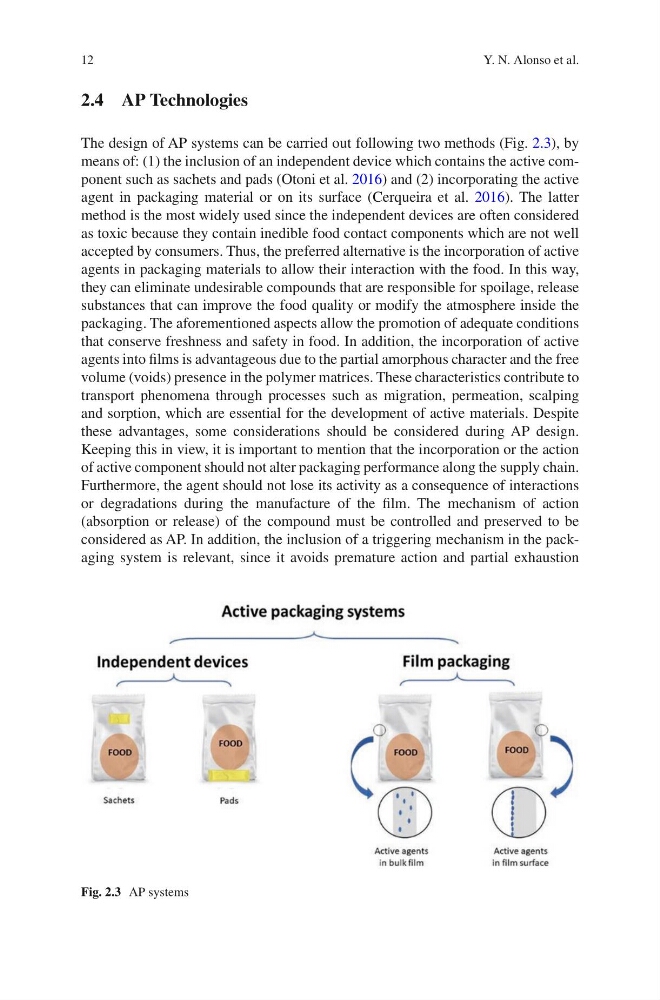
The design of AP systems can be carried out following two methods (Fig. 2.3), by
means of: (1) the inclusion of an independent device which contains the active component such as sachets and pads (Otoni et al. 2016) and (2) incorporating the active
agent in packaging material or on its surface (Cerqueira et al. 2016). The latter
method is the most widely used since the independent devices are often considered
as toxic because they contain inedible food contact components which are not well
accepted by consumers. Thus, the preferred alternative is the incorporation of active
agents in packaging materials to allow their interaction with the food. In this way,
they can eliminate undesirable compounds that are responsible for spoilage, release
substances that can improve the food quality or modify the atmosphere inside the
packaging. The aforementioned aspects allow the promotion of adequate conditions
that conserve freshness and safety in food. In addition, the incorporation of active
agents into films is advantageous due to the partial amorphous character and the free
volume (voids) presence in the polymer matrices. These characteristics contribute to
transport phenomena through processes such as migration, permeation, scalping
and sorption, which are essential for the development of active materials. Despite
these advantages, some considerations should be considered during AP design.
Keeping this in view, it is important to mention that the incorporation or the action
of active component should not alter packaging performance along the supply chain.
Furthermore, the agent should not lose its activity as a consequence of interactions
or degradations during the manufacture of the film. The mechanism of action
(absorption or release) of the compound must be controlled and preserved to be
considered as AP. In addition, the inclusion of a triggering mechanism in the packaging system is relevant, since it avoids premature action and partial exhaustion
Fig. 2.3 AP systems
Y. N. Alonso et al.
2.4 AP Technologies
The design of AP systems can be carried out following two methods (Fig. 2.3), by
means of: (1) the inclusion of an independent device which contains the active component such as sachets and pads (Otoni et al. 2016) and (2) incorporating the active
agent in packaging material or on its surface (Cerqueira et al. 2016). The latter
method is the most widely used since the independent devices are often considered
as toxic because they contain inedible food contact components which are not well
accepted by consumers. Thus, the preferred alternative is the incorporation of active
agents in packaging materials to allow their interaction with the food. In this way,
they can eliminate undesirable compounds that are responsible for spoilage, release
substances that can improve the food quality or modify the atmosphere inside the
packaging. The aforementioned aspects allow the promotion of adequate conditions
that conserve freshness and safety in food. In addition, the incorporation of active
agents into films is advantageous due to the partial amorphous character and the free
volume (voids) presence in the polymer matrices. These characteristics contribute to
transport phenomena through processes such as migration, permeation, scalping
and sorption, which are essential for the development of active materials. Despite
these advantages, some considerations should be considered during AP design.
Keeping this in view, it is important to mention that the incorporation or the action
of active component should not alter packaging performance along the supply chain.
Furthermore, the agent should not lose its activity as a consequence of interactions
or degradations during the manufacture of the film. The mechanism of action
(absorption or release) of the compound must be controlled and preserved to be
considered as AP. In addition, the inclusion of a triggering mechanism in the packaging system is relevant, since it avoids premature action and partial exhaustion
Fig. 2.3 AP systems
Y. N. Alonso et al.