

175
of aforementioned biobased oils and nitrogen, phosphorus or thiol containing
molecules. The polyol obtained is then used for PU synthesis. Some of the polyols used are presented in Table 8.3. Bhoyate et al. (2018a, b, 2019) studied the
effect of using a biobased polyol which was obtained from the reaction of mercaptanized castor oil and diethyl allyl phosphonate, in flame retardancy of
PU. The cone calorimetry test showed that PU containing 1.5 wt.% phosphorus
greatly increased the flame retardancy of PU by reducing approx. 50% in peak
heat release rate (pHRR) and total heat release (THR) with respect to pure
PU. Heinen et al. (2014) synthesized a biobased polyol by reacting epoxidized
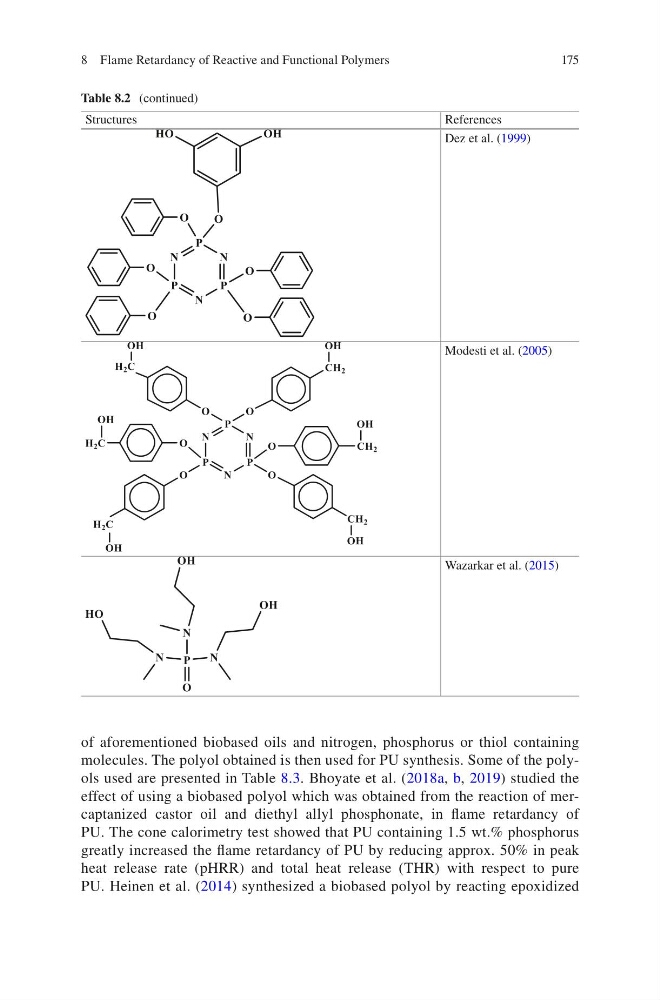
Table 8.2 (continued)
Structures
References
Dez et al. (1999)
Modesti et al. (2005)
Wazarkar et al. (2015)
8 Flame Retardancy of Reactive and Functional Polymers
of aforementioned biobased oils and nitrogen, phosphorus or thiol containing
molecules. The polyol obtained is then used for PU synthesis. Some of the polyols used are presented in Table 8.3. Bhoyate et al. (2018a, b, 2019) studied the
effect of using a biobased polyol which was obtained from the reaction of mercaptanized castor oil and diethyl allyl phosphonate, in flame retardancy of
PU. The cone calorimetry test showed that PU containing 1.5 wt.% phosphorus
greatly increased the flame retardancy of PU by reducing approx. 50% in peak
heat release rate (pHRR) and total heat release (THR) with respect to pure
PU. Heinen et al. (2014) synthesized a biobased polyol by reacting epoxidized
Table 8.2 (continued)
Structures
References
Dez et al. (1999)
Modesti et al. (2005)
Wazarkar et al. (2015)
8 Flame Retardancy of Reactive and Functional Polymers