

144
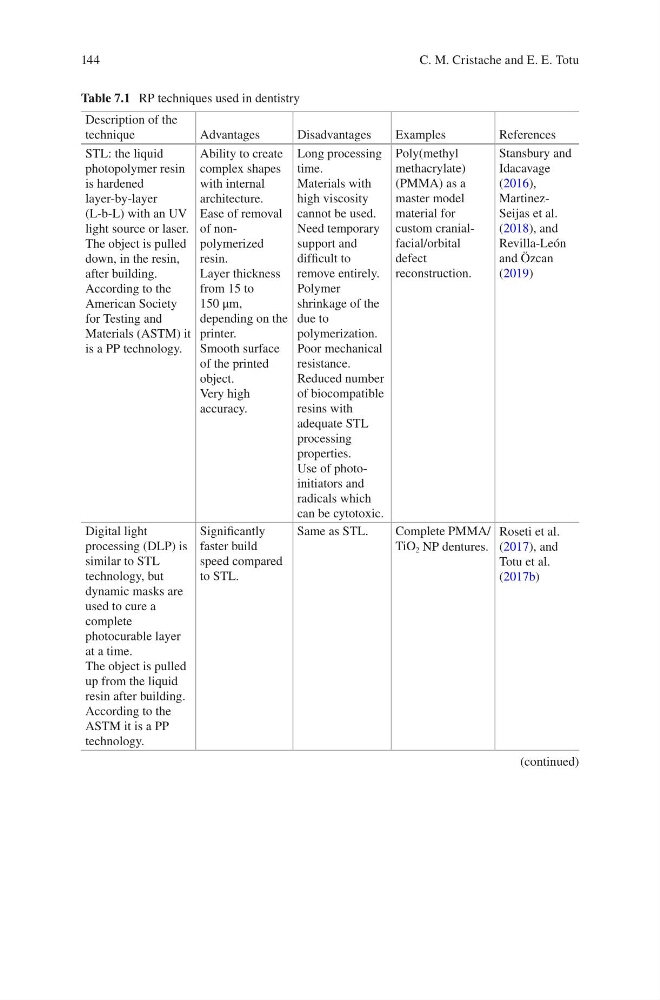
Table 7.1 RP techniques used in dentistry
Description of the
technique
Advantages
Disadvantages
Examples
References
STL: the liquid
photopolymer resin
is hardened
layer-by-layer
(L-b-L) with an UV
light source or laser.
The object is pulled
down, in the resin,
after building.
According to the
American Society
for Testing and
Materials (ASTM) it
is a PP technology.
Ability to create
complex shapes
with internal
architecture.
Ease of removal
of nonpolymerized
resin.
Layer thickness
from 15 to
150 μm,
depending on the
printer.
Smooth surface
of the printed
object.
Very high
accuracy.
Long processing
time.
Materials with
high viscosity
cannot be used.
Need temporary
support and
difficult to
remove entirely.
Polymer
shrinkage of the
due to
polymerization.
Poor mechanical
resistance.
Reduced number
of biocompatible
resins with
adequate STL
processing
properties.
Use of photoinitiators and
radicals which
can be cytotoxic.
Poly(methyl
methacrylate)
(PMMA) as a
master model
material for
custom cranialfacial/orbital
defect
reconstruction.
Stansbury and
Idacavage
(2016),
MartinezSeijas et al.
(2018), and
Revilla-León
and Özcan
(2019)
Digital light
processing (DLP) is
similar to STL
technology, but
dynamic masks are
used to cure a
complete
photocurable layer
at a time.
The object is pulled
up from the liquid
resin after building.
According to the
ASTM it is a PP
technology.
Significantly
faster build
speed compared
to STL.
Same as STL.
Complete PMMA/
TiO 2 NP dentures.
Roseti et al.
(2017), and
Totu et al.
(2017b)
(continued)
C. M. Cristache and E. E. Totu
Table 7.1 RP techniques used in dentistry
Description of the
technique
Advantages
Disadvantages
Examples
References
STL: the liquid
photopolymer resin
is hardened
layer-by-layer
(L-b-L) with an UV
light source or laser.
The object is pulled
down, in the resin,
after building.
According to the
American Society
for Testing and
Materials (ASTM) it
is a PP technology.
Ability to create
complex shapes
with internal
architecture.
Ease of removal
of nonpolymerized
resin.
Layer thickness
from 15 to
150 μm,
depending on the
printer.
Smooth surface
of the printed
object.
Very high
accuracy.
Long processing
time.
Materials with
high viscosity
cannot be used.
Need temporary
support and
difficult to
remove entirely.
Polymer
shrinkage of the
due to
polymerization.
Poor mechanical
resistance.
Reduced number
of biocompatible
resins with
adequate STL
processing
properties.
Use of photoinitiators and
radicals which
can be cytotoxic.
Poly(methyl
methacrylate)
(PMMA) as a
master model
material for
custom cranialfacial/orbital
defect
reconstruction.
Stansbury and
Idacavage
(2016),
MartinezSeijas et al.
(2018), and
Revilla-León
and Özcan
(2019)
Digital light
processing (DLP) is
similar to STL
technology, but
dynamic masks are
used to cure a
complete
photocurable layer
at a time.
The object is pulled
up from the liquid
resin after building.
According to the
ASTM it is a PP
technology.
Significantly
faster build
speed compared
to STL.
Same as STL.
Complete PMMA/
TiO 2 NP dentures.
Roseti et al.
(2017), and
Totu et al.
(2017b)
(continued)
C. M. Cristache and E. E. Totu