

136
∼53% at room temperature. This important factor contributed to the high g CPL value,
due to an efficient photoexcited energy confinement effect of slow CP light in the
chiral aggregates.
In the case of 1-S, the (-)-sign of the first cotton ORD band corresponds at
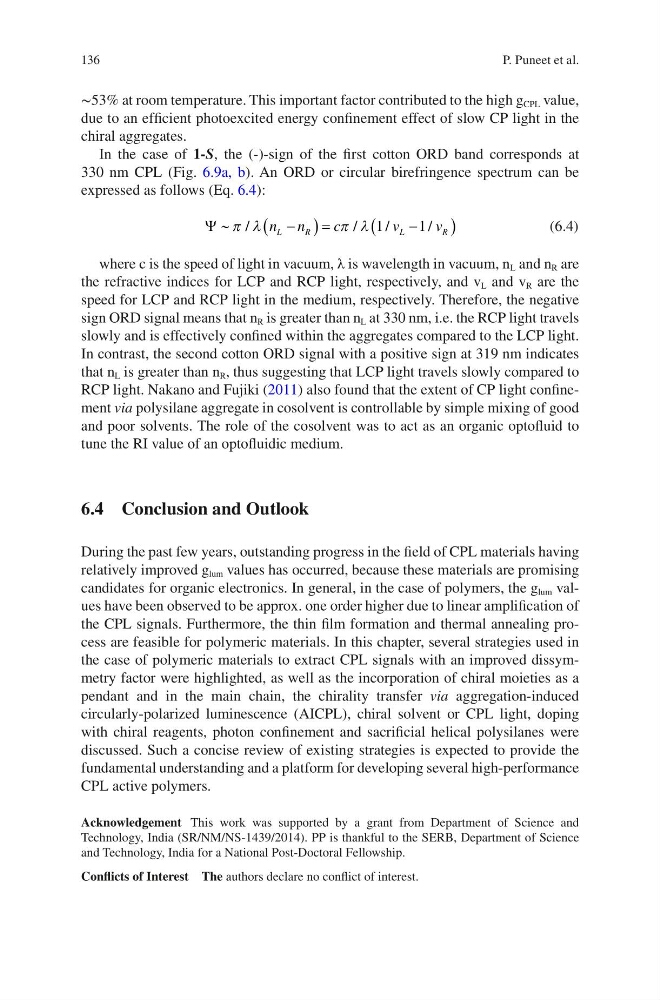
330 nm CPL (Fig. 6.9a, b). An ORD or circular birefringence spectrum can be
expressed as follows (Eq. 6.4):
Y ~
-
(
)=
-
(
)
p l
p l
/
/
/
/
n n
c
v
v
L
R
L
R
1
1
(6.4)
where c is the speed of light in vacuum, λ is wavelength in vacuum, n L and n R are
the refractive indices for LCP and RCP light, respectively, and v L and v R are the
speed for LCP and RCP light in the medium, respectively. Therefore, the negative
sign ORD signal means that n R is greater than n L at 330 nm, i.e. the RCP light travels
slowly and is effectively confined within the aggregates compared to the LCP light.
In contrast, the second cotton ORD signal with a positive sign at 319 nm indicates
that n L is greater than n R , thus suggesting that LCP light travels slowly compared to
RCP light. Nakano and Fujiki (2011) also found that the extent of CP light confinement via polysilane aggregate in cosolvent is controllable by simple mixing of good
and poor solvents. The role of the cosolvent was to act as an organic optofluid to
tune the RI value of an optofluidic medium.
6.4 Conclusion and Outlook
During the past few years, outstanding progress in the field of CPL materials having
relatively improved g lum values has occurred, because these materials are promising
candidates for organic electronics. In general, in the case of polymers, the g lum values have been observed to be approx. one order higher due to linear amplification of
the CPL signals. Furthermore, the thin film formation and thermal annealing process are feasible for polymeric materials. In this chapter, several strategies used in
the case of polymeric materials to extract CPL signals with an improved dissymmetry factor were highlighted, as well as the incorporation of chiral moieties as a
pendant and in the main chain, the chirality transfer via aggregation-induced
circularly- polarized luminescence (AICPL), chiral solvent or CPL light, doping
with chiral reagents, photon confinement and sacrificial helical polysilanes were
discussed. Such a concise review of existing strategies is expected to provide the
fundamental understanding and a platform for developing several high-performance
CPL active polymers.
Acknowledgement This work was supported by a grant from Department of Science and
Technology, India (SR/NM/NS-1439/2014). PP is thankful to the SERB, Department of Science
and Technology, India for a National Post-Doctoral Fellowship.
Conflicts of Interest The authors declare no conflict of interest.
P. Puneet et al.
∼53% at room temperature. This important factor contributed to the high g CPL value,
due to an efficient photoexcited energy confinement effect of slow CP light in the
chiral aggregates.
In the case of 1-S, the (-)-sign of the first cotton ORD band corresponds at
330 nm CPL (Fig. 6.9a, b). An ORD or circular birefringence spectrum can be
expressed as follows (Eq. 6.4):
Y ~
-
(
)=
-
(
)
p l
p l
/
/
/
/
n n
c
v
v
L
R
L
R
1
1
(6.4)
where c is the speed of light in vacuum, λ is wavelength in vacuum, n L and n R are
the refractive indices for LCP and RCP light, respectively, and v L and v R are the
speed for LCP and RCP light in the medium, respectively. Therefore, the negative
sign ORD signal means that n R is greater than n L at 330 nm, i.e. the RCP light travels
slowly and is effectively confined within the aggregates compared to the LCP light.
In contrast, the second cotton ORD signal with a positive sign at 319 nm indicates
that n L is greater than n R , thus suggesting that LCP light travels slowly compared to
RCP light. Nakano and Fujiki (2011) also found that the extent of CP light confinement via polysilane aggregate in cosolvent is controllable by simple mixing of good
and poor solvents. The role of the cosolvent was to act as an organic optofluid to
tune the RI value of an optofluidic medium.
6.4 Conclusion and Outlook
During the past few years, outstanding progress in the field of CPL materials having
relatively improved g lum values has occurred, because these materials are promising
candidates for organic electronics. In general, in the case of polymers, the g lum values have been observed to be approx. one order higher due to linear amplification of
the CPL signals. Furthermore, the thin film formation and thermal annealing process are feasible for polymeric materials. In this chapter, several strategies used in
the case of polymeric materials to extract CPL signals with an improved dissymmetry factor were highlighted, as well as the incorporation of chiral moieties as a
pendant and in the main chain, the chirality transfer via aggregation-induced
circularly- polarized luminescence (AICPL), chiral solvent or CPL light, doping
with chiral reagents, photon confinement and sacrificial helical polysilanes were
discussed. Such a concise review of existing strategies is expected to provide the
fundamental understanding and a platform for developing several high-performance
CPL active polymers.
Acknowledgement This work was supported by a grant from Department of Science and
Technology, India (SR/NM/NS-1439/2014). PP is thankful to the SERB, Department of Science
and Technology, India for a National Post-Doctoral Fellowship.
Conflicts of Interest The authors declare no conflict of interest.
P. Puneet et al.