

134
toscissoring of PSi-S and PSi-R at 313 nm for 60 s. A time-dependent growth behavior was observed in the hetero-aggregate (initially ~400 nm; reached ~2000 nm in 1
day), and was characterized using dynamic light scattering (DLS).
On the other hand, Fujiki and Yoshimoto (2017) acquired the CD/UV-Vis-near
infrared reflectance (NIR) spectrum of PF8DBT by dilution in CHCl 3 at 20 °C,
while the spectra from homo-aggregates (PF8DBT-PSi-S – Fig. 6.8a and PF8DBTPSi- R – Fig. 6.8c) were obtained in chloroform/MeOH (2/1 (v/v)) at 20 °C. The
intense bisignate CD bands at 305 and 322 nm, were associated with a narrow UV
band at 320 nm, which was attributed to the exciton couplet of the Sis-Sis* transition which arose from the helically assorted PSi-S and PSi-R aggregates, respectively
(Nakano et al. 2012, Fujiki et al. 2015, Rahim and Fujiki 2016). The intense negative and positive CD bands associated with two main Vis-NIR bands at 400 and
600 nm were attributed to the S0-S2 and S0-S1 π-π* transitions from PF8DBT main
chain, respectively. The two λ max values at 400 and 600 nm frequently red shift, and
their UV-Vis intensities were weakened as the aging time increased (1, 3, 6 and
24 h). These time-evolved CD/UV-Vis-NIR characteristics were synchronized with
the corresponding CPL/PL characteristics. Figure 6.8b, d show the CPL/PL spectra
of the PF8DBT-PSi-S and PF8DBT-PSi-R hetero-aggregates excited at 400 nm,
respectively (Fujiki and Yoshimoto 2017). Obviously, the initial CPL-/PL-bands at
approx. 680–700 nm, arose from the S0-S1 band of the PF8DBT-PSi-S and PF8DBTPSi- R hetero-aggregates, thus increasing progressively with the aging time. Fujiki
and Yoshimoto (2017) also observed that almost 24 h were required to increase the
CD/CPL amplitudes and reach constant CD/CPL magnitudes. Nonetheless, significant time-evolved alterations were reported on the order of several hours in several
molecular aggregates and molecular stacks, which were confirmed by CD and
Raman optical activity (ROA), the marked time-evolved changes in the CPL and
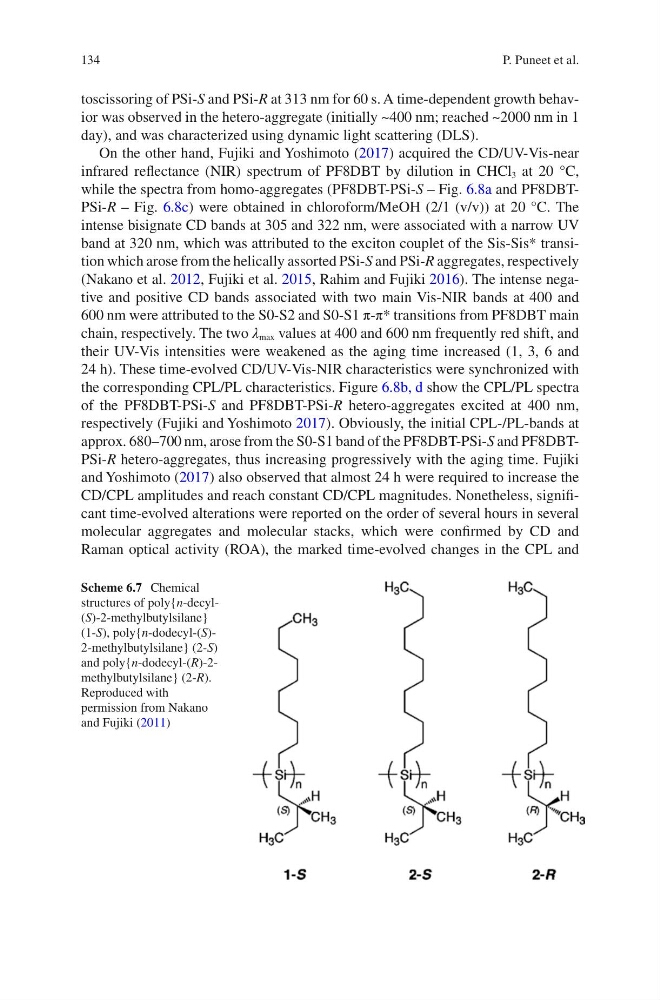
Scheme 6.7 Chemical
structures of poly{n-decyl(S)-2-methylbutylsilane}
(1-S), poly{n-dodecyl-(S)2-methylbutylsilane} (2-S)
and poly{n-dodecyl-(R)-2methylbutylsilane} (2-R).
Reproduced with
permission from Nakano
and Fujiki (2011)
P. Puneet et al.
toscissoring of PSi-S and PSi-R at 313 nm for 60 s. A time-dependent growth behavior was observed in the hetero-aggregate (initially ~400 nm; reached ~2000 nm in 1
day), and was characterized using dynamic light scattering (DLS).
On the other hand, Fujiki and Yoshimoto (2017) acquired the CD/UV-Vis-near
infrared reflectance (NIR) spectrum of PF8DBT by dilution in CHCl 3 at 20 °C,
while the spectra from homo-aggregates (PF8DBT-PSi-S – Fig. 6.8a and PF8DBTPSi- R – Fig. 6.8c) were obtained in chloroform/MeOH (2/1 (v/v)) at 20 °C. The
intense bisignate CD bands at 305 and 322 nm, were associated with a narrow UV
band at 320 nm, which was attributed to the exciton couplet of the Sis-Sis* transition which arose from the helically assorted PSi-S and PSi-R aggregates, respectively
(Nakano et al. 2012, Fujiki et al. 2015, Rahim and Fujiki 2016). The intense negative and positive CD bands associated with two main Vis-NIR bands at 400 and
600 nm were attributed to the S0-S2 and S0-S1 π-π* transitions from PF8DBT main
chain, respectively. The two λ max values at 400 and 600 nm frequently red shift, and
their UV-Vis intensities were weakened as the aging time increased (1, 3, 6 and
24 h). These time-evolved CD/UV-Vis-NIR characteristics were synchronized with
the corresponding CPL/PL characteristics. Figure 6.8b, d show the CPL/PL spectra
of the PF8DBT-PSi-S and PF8DBT-PSi-R hetero-aggregates excited at 400 nm,
respectively (Fujiki and Yoshimoto 2017). Obviously, the initial CPL-/PL-bands at
approx. 680–700 nm, arose from the S0-S1 band of the PF8DBT-PSi-S and PF8DBTPSi- R hetero-aggregates, thus increasing progressively with the aging time. Fujiki
and Yoshimoto (2017) also observed that almost 24 h were required to increase the
CD/CPL amplitudes and reach constant CD/CPL magnitudes. Nonetheless, significant time-evolved alterations were reported on the order of several hours in several
molecular aggregates and molecular stacks, which were confirmed by CD and
Raman optical activity (ROA), the marked time-evolved changes in the CPL and
Scheme 6.7 Chemical
structures of poly{n-decyl(S)-2-methylbutylsilane}
(1-S), poly{n-dodecyl-(S)2-methylbutylsilane} (2-S)
and poly{n-dodecyl-(R)-2methylbutylsilane} (2-R).
Reproduced with
permission from Nakano
and Fujiki (2011)
P. Puneet et al.