

132
CPL (AICPL and CPL by supramolecular polymerization), while the magnitudes in
their CPL signals in CHCl 3 solution were apparently weak. The absolute magnitudes
of AICPL couplet (|g CPL |) were also affected by the CHCl 3 /MeOH volume ratios.
Some CPL signals, attributed to AICPL, were observed by Yamada et al. (2018)
in the aggregates prepared in situ by slowly pouring MeOH into the THF solution
with specific ratios (v/v), while the magnitudes in some CPL signals in the THF
solution were weak. The g lum values were affected by the THF/MeOH volume ratios.
The g lum value was also affected by the chiral side chains in the 9-position and the
g lum value increased in the order of 5mhep, 4mhex < dmo. As observed in the CD
spectra in THF/MeOH, the magnitude of PFV aggregates containing the 6mcot side
chain showed the highest g CPL value in CHCl 3 /MeOH (Fig. 6.2a). According to
Yamada et al. (2018) there is no clear reason to explain the difference at this moment.
Furthermore, in CHCl 3 /MeOH, their relative intensities of the λ max values (emission
peaks at approx. 440, 465 and 496 nm) in the PL spectra were affected by nature of
alkyl side chains employed, while no significant differences were observed in its PL
spectra in the THF solution.
6.3.8 CPL Active Polymer Aggregates Endowed with Sacrificial
Si-Si Bonds
Optically active scaffolds have been shown to be efficient in inducing helical architecture to organic, polymeric and inorganic building blocks (Sato et al. 2003;
Kawasaki et al. 2005; Fujiki et al. 2015). For example, Fujiki and Yoshimoto (2017)
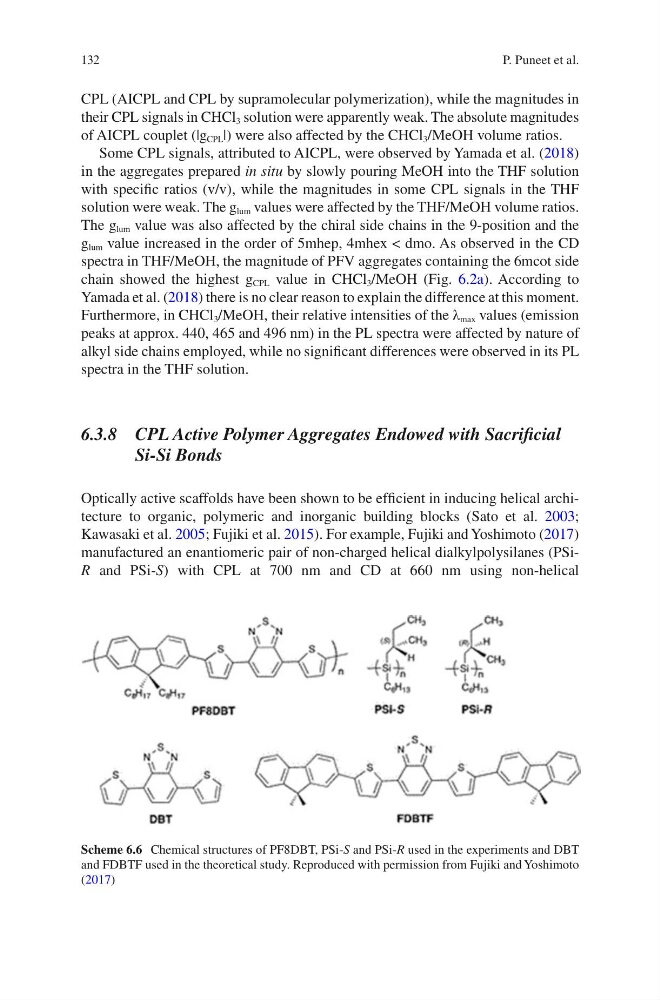
manufactured an enantiomeric pair of non-charged helical dialkylpolysilanes (PSiR and PSi-S) with CPL at 700 nm and CD at 660 nm using non-helical
Scheme 6.6 Chemical structures of PF8DBT, PSi-S and PSi-R used in the experiments and DBT
and FDBTF used in the theoretical study. Reproduced with permission from Fujiki and Yoshimoto
(2017)
P. Puneet et al.
CPL (AICPL and CPL by supramolecular polymerization), while the magnitudes in
their CPL signals in CHCl 3 solution were apparently weak. The absolute magnitudes
of AICPL couplet (|g CPL |) were also affected by the CHCl 3 /MeOH volume ratios.
Some CPL signals, attributed to AICPL, were observed by Yamada et al. (2018)
in the aggregates prepared in situ by slowly pouring MeOH into the THF solution
with specific ratios (v/v), while the magnitudes in some CPL signals in the THF
solution were weak. The g lum values were affected by the THF/MeOH volume ratios.
The g lum value was also affected by the chiral side chains in the 9-position and the
g lum value increased in the order of 5mhep, 4mhex < dmo. As observed in the CD
spectra in THF/MeOH, the magnitude of PFV aggregates containing the 6mcot side
chain showed the highest g CPL value in CHCl 3 /MeOH (Fig. 6.2a). According to
Yamada et al. (2018) there is no clear reason to explain the difference at this moment.
Furthermore, in CHCl 3 /MeOH, their relative intensities of the λ max values (emission
peaks at approx. 440, 465 and 496 nm) in the PL spectra were affected by nature of
alkyl side chains employed, while no significant differences were observed in its PL
spectra in the THF solution.
6.3.8 CPL Active Polymer Aggregates Endowed with Sacrificial
Si-Si Bonds
Optically active scaffolds have been shown to be efficient in inducing helical architecture to organic, polymeric and inorganic building blocks (Sato et al. 2003;
Kawasaki et al. 2005; Fujiki et al. 2015). For example, Fujiki and Yoshimoto (2017)
manufactured an enantiomeric pair of non-charged helical dialkylpolysilanes (PSiR and PSi-S) with CPL at 700 nm and CD at 660 nm using non-helical
Scheme 6.6 Chemical structures of PF8DBT, PSi-S and PSi-R used in the experiments and DBT
and FDBTF used in the theoretical study. Reproduced with permission from Fujiki and Yoshimoto
(2017)
P. Puneet et al.