

127
to as photon chirality transfer to induce the chirality in molecules, photochemically.
It has also been shown from the literature that by using CP photons as a chiral
physical source, achiral non-photochromic π-conjugated polyfluorene, poly(1substituted phenylacetylene), diacetylene monomers and Cu(II) coordinated with
succinate and 4,4′-bipyridine can provide the corresponding optically active polymers (Wang et al. 2012; Nakano 2014; Wu et al. 2014). However, these CP-driven
AAS experiments have been conducted primarily on a single photon energy source
because it has long been assumed that the chirality of the product is governed solely
by the role of the r- or l-hand of the CP-photon and not it is significantly influenced
by CP-photon energy. Bernstein et al. (1972) reported on the first CP-photon energy
dependent ring-closure reaction of a cis-1,2-diarylethyele rotamer in the presence
of iodine to produce non-racemic octahelicene in toluene. The preference of the
optical activity directed by l-CP sources at 290 nm was opposite to that led by l-CP
sources in the range of 310–410 nm and vice versa, reflecting the bisignate CD signal
of octahelicene. Recently, Meinert et al. (2014) reported CP photon energy dependent photodegradation of racemic
13
C-alanine films. The preference of the product chirality in the film was inverted by CP-photon energy sources. This inversion
arises from sign characteristics of bisignate CD in the irradiation region [6.19 eV
(200 nm) or 6.74 eV (184 nm)] (Meinert et al. 2014). Similarly, Fujiki et al. (2013)
reported that CP irradiation photon-dependent chiroptical inversion takes place in
a photochromic azobenzene-di-n-octylfluorene alternating copolymer (PF8AZO,
Scheme 6.5) when the same sources of r- and l-CP-photons were applied. An open
question is whether photon chirality transfer to achiral non-photochromic colloidal
particles dispersed in the optofluidic medium is possible? i.e. photophysically and
photochemically under controlled conditions with reversibility. This system is a
model of prebiotic evolution of non-photochromic biological polymers under heterogeneous conditions and under the far-from-equilibrium open system, thus allowing a continuous CP-photon energy flow in daytime. Is an optically active generated
substance considered to be a dissipated structure? To answer these questions, Fujiki
et al. (2015) selected micro-sized poly[(9,9-di-n-octylfluoren-2,7- diyl)-alt-2,2′-bithiophene] (PF8T2) particles. The optically inactive PF8T2 is nonphotochromic but
is highly photoluminescent with a high Φ F . The particles (0.6–0.7 μm in diameter)
provided ultra-small microreactors to efficiently confine the CP-photons by tuning
the refractive index (RI) of the chloroform/methanol (CHCl 3 /MeOH) cosolvent,
acting as an optofluidic medium. It should be noted that the wavelength of the
incident light in a vacuum decreased markedly and proportionally to the inverse RI
in the particle, i.e. the incident light (λ 0 = 500 nm in a vacuum) was estimated at
approx. 250 nm in the polymer particle, thus allowing the confinement of photons
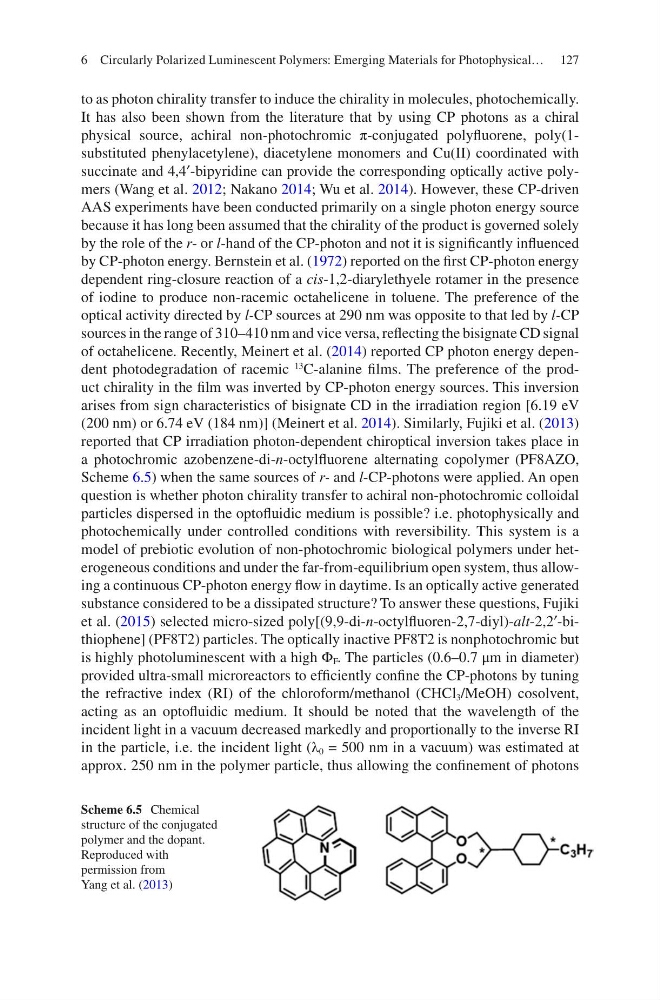
Scheme 6.5 Chemical
structure of the conjugated
polymer and the dopant.
Reproduced with
permission from
Yang et al. (2013)
6 Circularly Polarized Luminescent Polymers: Emerging Materials for Photophysical…
to as photon chirality transfer to induce the chirality in molecules, photochemically.
It has also been shown from the literature that by using CP photons as a chiral
physical source, achiral non-photochromic π-conjugated polyfluorene, poly(1substituted phenylacetylene), diacetylene monomers and Cu(II) coordinated with
succinate and 4,4′-bipyridine can provide the corresponding optically active polymers (Wang et al. 2012; Nakano 2014; Wu et al. 2014). However, these CP-driven
AAS experiments have been conducted primarily on a single photon energy source
because it has long been assumed that the chirality of the product is governed solely
by the role of the r- or l-hand of the CP-photon and not it is significantly influenced
by CP-photon energy. Bernstein et al. (1972) reported on the first CP-photon energy
dependent ring-closure reaction of a cis-1,2-diarylethyele rotamer in the presence
of iodine to produce non-racemic octahelicene in toluene. The preference of the
optical activity directed by l-CP sources at 290 nm was opposite to that led by l-CP
sources in the range of 310–410 nm and vice versa, reflecting the bisignate CD signal
of octahelicene. Recently, Meinert et al. (2014) reported CP photon energy dependent photodegradation of racemic
13
C-alanine films. The preference of the product chirality in the film was inverted by CP-photon energy sources. This inversion
arises from sign characteristics of bisignate CD in the irradiation region [6.19 eV
(200 nm) or 6.74 eV (184 nm)] (Meinert et al. 2014). Similarly, Fujiki et al. (2013)
reported that CP irradiation photon-dependent chiroptical inversion takes place in
a photochromic azobenzene-di-n-octylfluorene alternating copolymer (PF8AZO,
Scheme 6.5) when the same sources of r- and l-CP-photons were applied. An open
question is whether photon chirality transfer to achiral non-photochromic colloidal
particles dispersed in the optofluidic medium is possible? i.e. photophysically and
photochemically under controlled conditions with reversibility. This system is a
model of prebiotic evolution of non-photochromic biological polymers under heterogeneous conditions and under the far-from-equilibrium open system, thus allowing a continuous CP-photon energy flow in daytime. Is an optically active generated
substance considered to be a dissipated structure? To answer these questions, Fujiki
et al. (2015) selected micro-sized poly[(9,9-di-n-octylfluoren-2,7- diyl)-alt-2,2′-bithiophene] (PF8T2) particles. The optically inactive PF8T2 is nonphotochromic but
is highly photoluminescent with a high Φ F . The particles (0.6–0.7 μm in diameter)
provided ultra-small microreactors to efficiently confine the CP-photons by tuning
the refractive index (RI) of the chloroform/methanol (CHCl 3 /MeOH) cosolvent,
acting as an optofluidic medium. It should be noted that the wavelength of the
incident light in a vacuum decreased markedly and proportionally to the inverse RI
in the particle, i.e. the incident light (λ 0 = 500 nm in a vacuum) was estimated at
approx. 250 nm in the polymer particle, thus allowing the confinement of photons
Scheme 6.5 Chemical
structure of the conjugated
polymer and the dopant.
Reproduced with
permission from
Yang et al. (2013)
6 Circularly Polarized Luminescent Polymers: Emerging Materials for Photophysical…