

2
R. Das
a
b
c
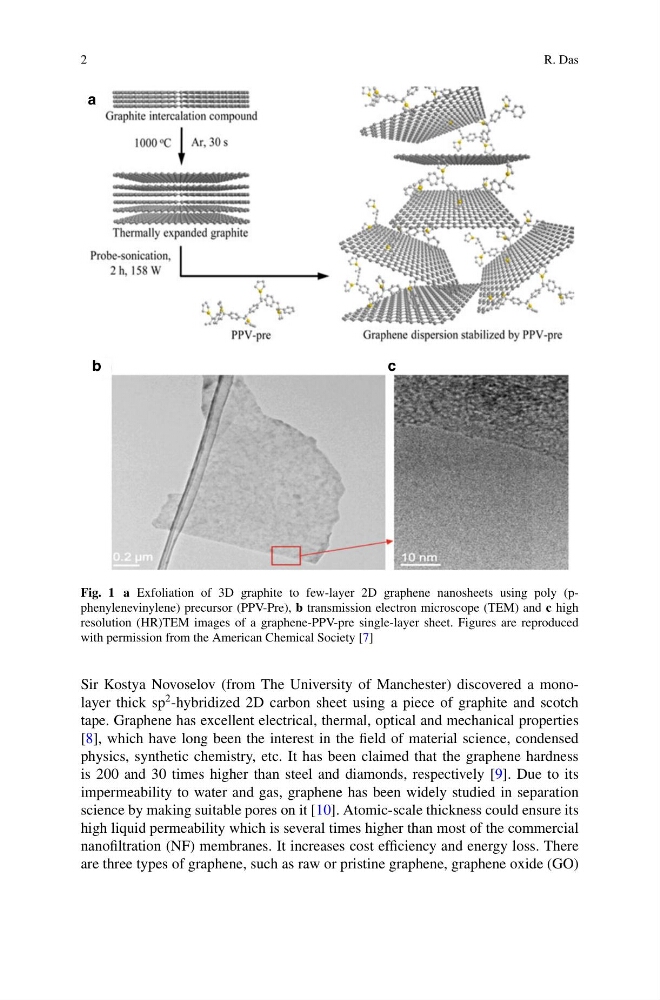
Fig. 1 a Exfoliation of 3D graphite to few-layer 2D graphene nanosheets using poly (pphenylenevinylene) precursor (PPV-Pre), b transmission electron microscope (TEM) and c high
resolution (HR)TEM images of a graphene-PPV-pre single-layer sheet. Figures are reproduced
with permission from the American Chemical Society [7]
Sir Kostya Novoselov (from The University of Manchester) discovered a monolayer thick sp
2 -hybridized 2D carbon sheet using a piece of graphite and scotch
tape. Graphene has excellent electrical, thermal, optical and mechanical properties
[8], which have long been the interest in the field of material science, condensed
physics, synthetic chemistry, etc. It has been claimed that the graphene hardness
is 200 and 30 times higher than steel and diamonds, respectively [9]. Due to its
impermeability to water and gas, graphene has been widely studied in separation
science by making suitable pores on it [10]. Atomic-scale thickness could ensure its
high liquid permeability which is several times higher than most of the commercial
nanofiltration (NF) membranes. It increases cost efficiency and energy loss. There
are three types of graphene, such as raw or pristine graphene, graphene oxide (GO)
R. Das
a
b
c
Fig. 1 a Exfoliation of 3D graphite to few-layer 2D graphene nanosheets using poly (pphenylenevinylene) precursor (PPV-Pre), b transmission electron microscope (TEM) and c high
resolution (HR)TEM images of a graphene-PPV-pre single-layer sheet. Figures are reproduced
with permission from the American Chemical Society [7]
Sir Kostya Novoselov (from The University of Manchester) discovered a monolayer thick sp
2 -hybridized 2D carbon sheet using a piece of graphite and scotch
tape. Graphene has excellent electrical, thermal, optical and mechanical properties
[8], which have long been the interest in the field of material science, condensed
physics, synthetic chemistry, etc. It has been claimed that the graphene hardness
is 200 and 30 times higher than steel and diamonds, respectively [9]. Due to its
impermeability to water and gas, graphene has been widely studied in separation
science by making suitable pores on it [10]. Atomic-scale thickness could ensure its
high liquid permeability which is several times higher than most of the commercial
nanofiltration (NF) membranes. It increases cost efficiency and energy loss. There
are three types of graphene, such as raw or pristine graphene, graphene oxide (GO)