

50
A. S. Kazemi and M. A. Abdol
non-porous. Even for a porous active layer, regarding the thickness of the polyamide
layer, the solution diffusion process would accompany the size exclusion. Now let
us compare the performance of the two structures when pressurized salty water
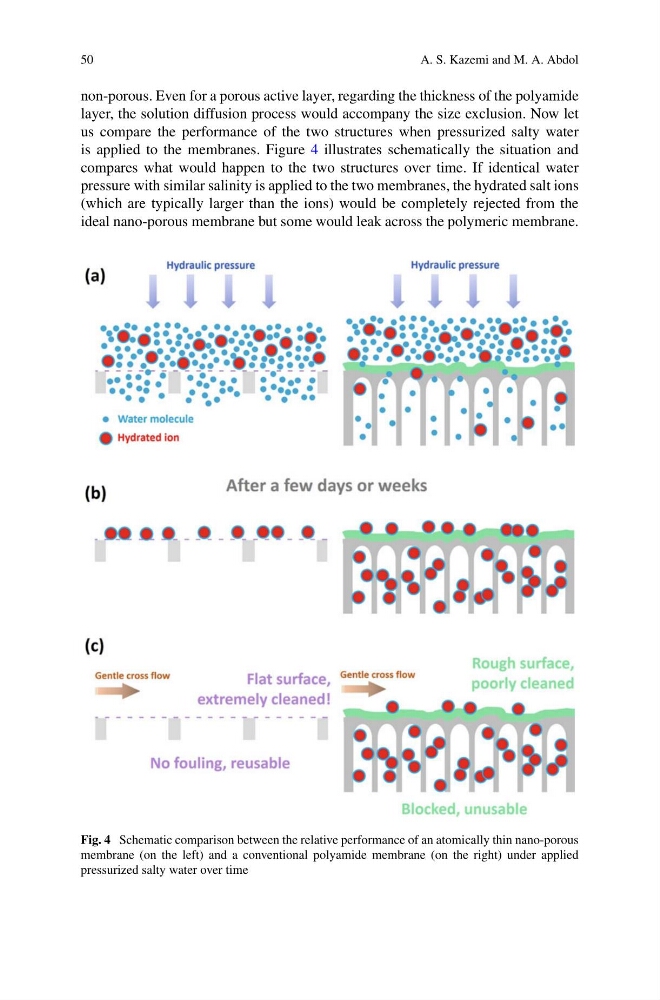
is applied to the membranes. Figure 4 illustrates schematically the situation and
compares what would happen to the two structures over time. If identical water
pressure with similar salinity is applied to the two membranes, the hydrated salt ions
(which are typically larger than the ions) would be completely rejected from the
ideal nano-porous membrane but some would leak across the polymeric membrane.
Fig. 4 Schematic comparison between the relative performance of an atomically thin nano-porous
membrane (on the left) and a conventional polyamide membrane (on the right) under applied
pressurized salty water over time
A. S. Kazemi and M. A. Abdol
non-porous. Even for a porous active layer, regarding the thickness of the polyamide
layer, the solution diffusion process would accompany the size exclusion. Now let
us compare the performance of the two structures when pressurized salty water
is applied to the membranes. Figure 4 illustrates schematically the situation and
compares what would happen to the two structures over time. If identical water
pressure with similar salinity is applied to the two membranes, the hydrated salt ions
(which are typically larger than the ions) would be completely rejected from the
ideal nano-porous membrane but some would leak across the polymeric membrane.
Fig. 4 Schematic comparison between the relative performance of an atomically thin nano-porous
membrane (on the left) and a conventional polyamide membrane (on the right) under applied
pressurized salty water over time