

46
A. S. Kazemi and M. A. Abdol
An ideal membrane combines high water permeability and high selectivity. This
combination has proven difficult to accomplish and therefore referred as permeability–selectivity trade-off [66, 67]. Investigations on novel active layers for desalination membranes pursue to improve the water permeability and water–solute selectivity [15]. Process modeling for seawater RO desalination shows that increased
water permeability above currently achievable levels (2–3 Lm
−2 h
−1 bar
−1 ); would
negligibly decrease energy requirements and capital costs [68, 69], opposing the
previous claim of Cohen-Tanugi and Grossman [68]. Such a conflict, irrespective of
the membrane permeability, is mainly due to current RO system designs that desalinate seawater using a single membrane stage fed by a high-pressure pump [14, 19].
Note that the use of hydraulic pressure is the main element of the energy consumption by the RO stage. Therefore, instead of realizing higher water permeability, a
more effective goal for novel desalination membrane materials research would be to
achieve improved selectivity for water over all dissolved solutes [15].
2.2 Modules for Current RO Membrane Testing
A typical RO set-up has a simple layout, consisting of feed water input, feed
pre-treatment unit, high-pressure pump, modules for the RO membrane and, in
some configurations, post-treatment stages [70]. There are four different types of
RO membrane modules that are used for desalination processes: plate and frame,
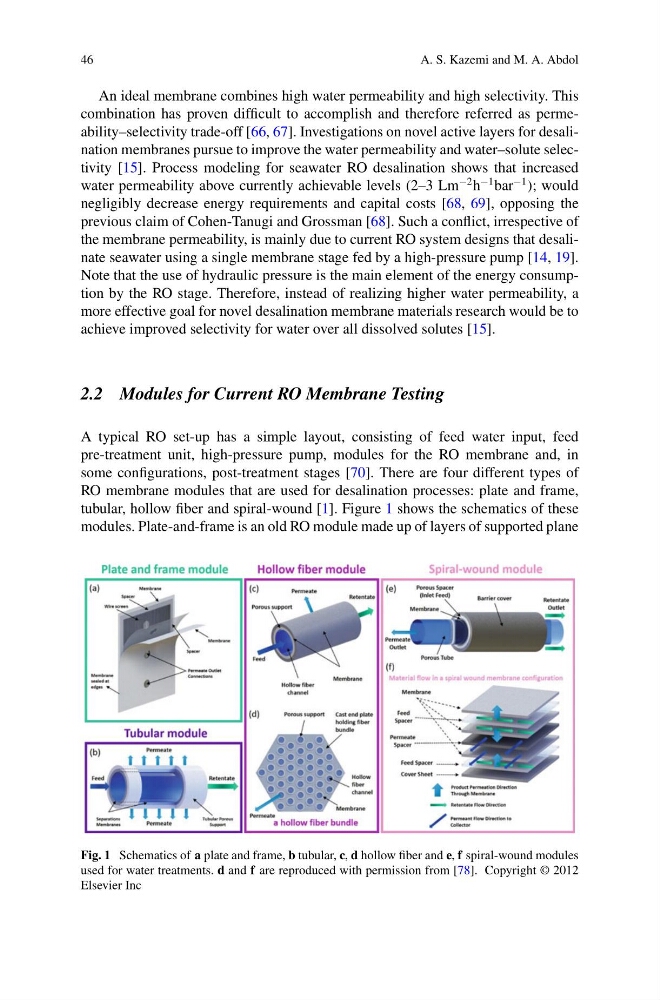
tubular, hollow fiber and spiral-wound [1]. Figure 1 shows the schematics of these
modules. Plate-and-frame is an old RO module made up of layers of supported plane
Fig. 1 Schematics of a plate and frame, b tubular, c, d hollow fiber and e, f spiral-wound modules
used for water treatments. d and f are reproduced with permission from [78]. Copyright © 2012
Elsevier Inc
A. S. Kazemi and M. A. Abdol
An ideal membrane combines high water permeability and high selectivity. This
combination has proven difficult to accomplish and therefore referred as permeability–selectivity trade-off [66, 67]. Investigations on novel active layers for desalination membranes pursue to improve the water permeability and water–solute selectivity [15]. Process modeling for seawater RO desalination shows that increased
water permeability above currently achievable levels (2–3 Lm
−2 h
−1 bar
−1 ); would
negligibly decrease energy requirements and capital costs [68, 69], opposing the
previous claim of Cohen-Tanugi and Grossman [68]. Such a conflict, irrespective of
the membrane permeability, is mainly due to current RO system designs that desalinate seawater using a single membrane stage fed by a high-pressure pump [14, 19].
Note that the use of hydraulic pressure is the main element of the energy consumption by the RO stage. Therefore, instead of realizing higher water permeability, a
more effective goal for novel desalination membrane materials research would be to
achieve improved selectivity for water over all dissolved solutes [15].
2.2 Modules for Current RO Membrane Testing
A typical RO set-up has a simple layout, consisting of feed water input, feed
pre-treatment unit, high-pressure pump, modules for the RO membrane and, in
some configurations, post-treatment stages [70]. There are four different types of
RO membrane modules that are used for desalination processes: plate and frame,
tubular, hollow fiber and spiral-wound [1]. Figure 1 shows the schematics of these
modules. Plate-and-frame is an old RO module made up of layers of supported plane
Fig. 1 Schematics of a plate and frame, b tubular, c, d hollow fiber and e, f spiral-wound modules
used for water treatments. d and f are reproduced with permission from [78]. Copyright © 2012
Elsevier Inc