

Newly Emerging Metal–Organic Frameworks (MOF), MXenes and Zeolite …
227
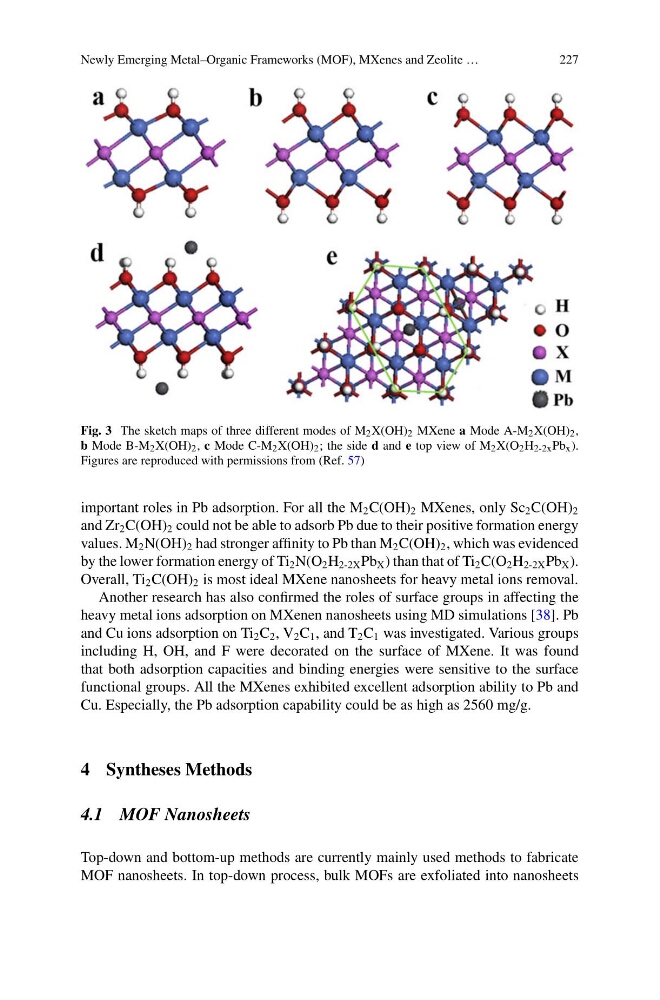
Fig. 3 The sketch maps of three different modes of M 2 X(OH) 2 MXene a Mode A-M 2 X(OH) 2 ,
b Mode B-M 2 X(OH) 2 , c Mode C-M 2 X(OH) 2 ; the side d and e top view of M 2 X(O 2 H 2-2x Pb x ).
Figures are reproduced with permissions from (Ref. 57)
important roles in Pb adsorption. For all the M 2 C(OH) 2 MXenes, only Sc 2 C(OH) 2
and Zr 2 C(OH) 2 could not be able to adsorb Pb due to their positive formation energy
values. M 2 N(OH) 2 had stronger affinity to Pb than M 2 C(OH) 2 , which was evidenced
by the lower formation energy of Ti 2 N(O 2 H 2-2X Pb X ) than that of Ti 2 C(O 2 H 2-2X Pb X ).
Overall, Ti 2 C(OH) 2 is most ideal MXene nanosheets for heavy metal ions removal.
Another research has also confirmed the roles of surface groups in affecting the
heavy metal ions adsorption on MXenen nanosheets using MD simulations [38]. Pb
and Cu ions adsorption on Ti 2 C 2 , V 2 C 1 , and T 2 C 1 was investigated. Various groups
including H, OH, and F were decorated on the surface of MXene. It was found
that both adsorption capacities and binding energies were sensitive to the surface
functional groups. All the MXenes exhibited excellent adsorption ability to Pb and
Cu. Especially, the Pb adsorption capability could be as high as 2560 mg/g.
4 Syntheses Methods
4.1 MOF Nanosheets
Top-down and bottom-up methods are currently mainly used methods to fabricate
MOF nanosheets. In top-down process, bulk MOFs are exfoliated into nanosheets
227
Fig. 3 The sketch maps of three different modes of M 2 X(OH) 2 MXene a Mode A-M 2 X(OH) 2 ,
b Mode B-M 2 X(OH) 2 , c Mode C-M 2 X(OH) 2 ; the side d and e top view of M 2 X(O 2 H 2-2x Pb x ).
Figures are reproduced with permissions from (Ref. 57)
important roles in Pb adsorption. For all the M 2 C(OH) 2 MXenes, only Sc 2 C(OH) 2
and Zr 2 C(OH) 2 could not be able to adsorb Pb due to their positive formation energy
values. M 2 N(OH) 2 had stronger affinity to Pb than M 2 C(OH) 2 , which was evidenced
by the lower formation energy of Ti 2 N(O 2 H 2-2X Pb X ) than that of Ti 2 C(O 2 H 2-2X Pb X ).
Overall, Ti 2 C(OH) 2 is most ideal MXene nanosheets for heavy metal ions removal.
Another research has also confirmed the roles of surface groups in affecting the
heavy metal ions adsorption on MXenen nanosheets using MD simulations [38]. Pb
and Cu ions adsorption on Ti 2 C 2 , V 2 C 1 , and T 2 C 1 was investigated. Various groups
including H, OH, and F were decorated on the surface of MXene. It was found
that both adsorption capacities and binding energies were sensitive to the surface
functional groups. All the MXenes exhibited excellent adsorption ability to Pb and
Cu. Especially, the Pb adsorption capability could be as high as 2560 mg/g.
4 Syntheses Methods
4.1 MOF Nanosheets
Top-down and bottom-up methods are currently mainly used methods to fabricate
MOF nanosheets. In top-down process, bulk MOFs are exfoliated into nanosheets