

Newly Emerging Metal–Organic Frameworks (MOF), MXenes and Zeolite …
223
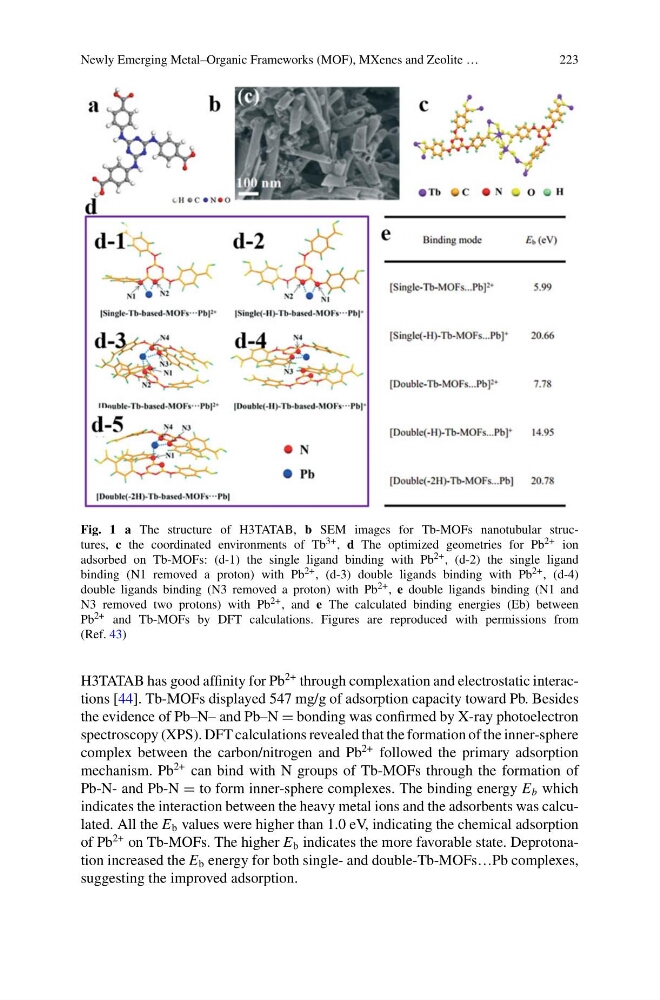
Fig. 1 a The structure of H3TATAB, b SEM images for Tb-MOFs nanotubular structures, c the coordinated environments of Tb 3+ , d The optimized geometries for Pb 2+ ion
adsorbed on Tb-MOFs: (d-1) the single ligand binding with Pb 2+ , (d-2) the single ligand
binding (N1 removed a proton) with Pb 2+ , (d-3) double ligands binding with Pb 2+ , (d-4)
double ligands binding (N3 removed a proton) with Pb 2+ , e double ligands binding (N1 and
N3 removed two protons) with Pb 2+ , and e The calculated binding energies (Eb) between
Pb 2+ and Tb-MOFs by DFT calculations. Figures are reproduced with permissions from
(Ref. 43)
H3TATAB has good affinity for Pb
2+ through complexation and electrostatic interactions [44]. Tb-MOFs displayed 547 mg/g of adsorption capacity toward Pb. Besides
the evidence of Pb–N– and Pb–N = bonding was confirmed by X-ray photoelectron
spectroscopy (XPS). DFT calculations revealed that the formation of the inner-sphere
complex between the carbon/nitrogen and Pb
2+ followed the primary adsorption
mechanism. Pb
2+ can bind with N groups of Tb-MOFs through the formation of
Pb-N- and Pb-N = to form inner-sphere complexes. The binding energy E b which
indicates the interaction between the heavy metal ions and the adsorbents was calculated. All the E b values were higher than 1.0 eV, indicating the chemical adsorption
of Pb
2+ on Tb-MOFs. The higher E b indicates the more favorable state. Deprotonation increased the E b energy for both single- and double-Tb-MOFs…Pb complexes,
suggesting the improved adsorption.
223
Fig. 1 a The structure of H3TATAB, b SEM images for Tb-MOFs nanotubular structures, c the coordinated environments of Tb 3+ , d The optimized geometries for Pb 2+ ion
adsorbed on Tb-MOFs: (d-1) the single ligand binding with Pb 2+ , (d-2) the single ligand
binding (N1 removed a proton) with Pb 2+ , (d-3) double ligands binding with Pb 2+ , (d-4)
double ligands binding (N3 removed a proton) with Pb 2+ , e double ligands binding (N1 and
N3 removed two protons) with Pb 2+ , and e The calculated binding energies (Eb) between
Pb 2+ and Tb-MOFs by DFT calculations. Figures are reproduced with permissions from
(Ref. 43)
H3TATAB has good affinity for Pb
2+ through complexation and electrostatic interactions [44]. Tb-MOFs displayed 547 mg/g of adsorption capacity toward Pb. Besides
the evidence of Pb–N– and Pb–N = bonding was confirmed by X-ray photoelectron
spectroscopy (XPS). DFT calculations revealed that the formation of the inner-sphere
complex between the carbon/nitrogen and Pb
2+ followed the primary adsorption
mechanism. Pb
2+ can bind with N groups of Tb-MOFs through the formation of
Pb-N- and Pb-N = to form inner-sphere complexes. The binding energy E b which
indicates the interaction between the heavy metal ions and the adsorbents was calculated. All the E b values were higher than 1.0 eV, indicating the chemical adsorption
of Pb
2+ on Tb-MOFs. The higher E b indicates the more favorable state. Deprotonation increased the E b energy for both single- and double-Tb-MOFs…Pb complexes,
suggesting the improved adsorption.