

208
M. H. Köhler et al.
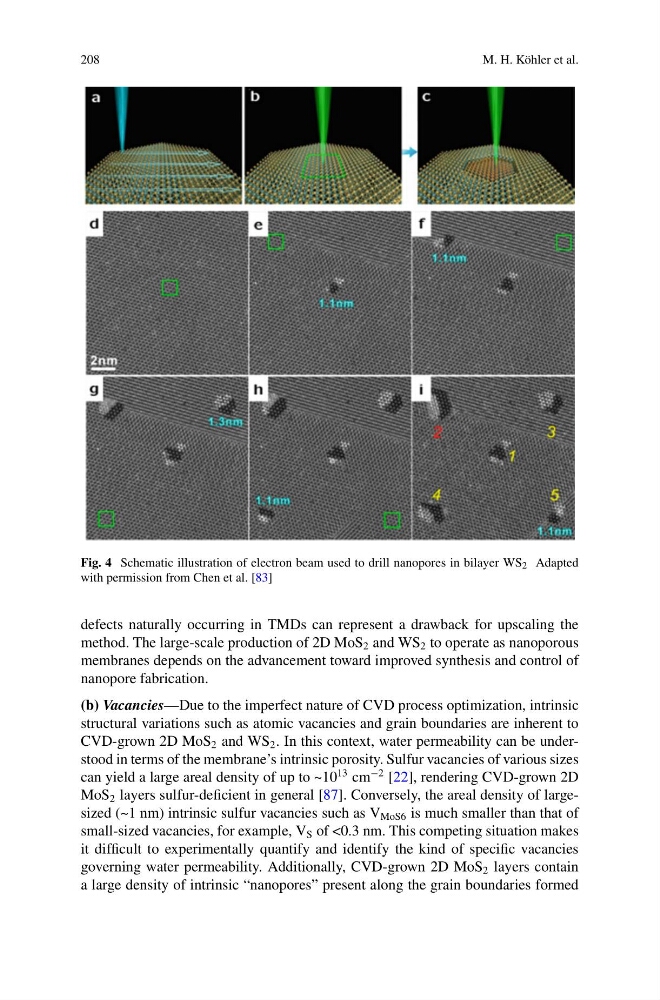
Fig. 4 Schematic illustration of electron beam used to drill nanopores in bilayer WS 2 Adapted
with permission from Chen et al. [83]
defects naturally occurring in TMDs can represent a drawback for upscaling the
method. The large-scale production of 2D MoS 2 and WS 2 to operate as nanoporous
membranes depends on the advancement toward improved synthesis and control of
nanopore fabrication.
(b) Vacancies—Due to the imperfect nature of CVD process optimization, intrinsic
structural variations such as atomic vacancies and grain boundaries are inherent to
CVD-grown 2D MoS 2 and WS 2 . In this context, water permeability can be understood in terms of the membrane’s intrinsic porosity. Sulfur vacancies of various sizes
can yield a large areal density of up to ~10
13 cm
−2 [22], rendering CVD-grown 2D
MoS 2 layers sulfur-deficient in general [87]. Conversely, the areal density of largesized (~1 nm) intrinsic sulfur vacancies such as V MoS6 is much smaller than that of
small-sized vacancies, for example, V S of <0.3 nm. This competing situation makes
it difficult to experimentally quantify and identify the kind of specific vacancies
governing water permeability. Additionally, CVD-grown 2D MoS 2 layers contain
a large density of intrinsic “nanopores” present along the grain boundaries formed
M. H. Köhler et al.
Fig. 4 Schematic illustration of electron beam used to drill nanopores in bilayer WS 2 Adapted
with permission from Chen et al. [83]
defects naturally occurring in TMDs can represent a drawback for upscaling the
method. The large-scale production of 2D MoS 2 and WS 2 to operate as nanoporous
membranes depends on the advancement toward improved synthesis and control of
nanopore fabrication.
(b) Vacancies—Due to the imperfect nature of CVD process optimization, intrinsic
structural variations such as atomic vacancies and grain boundaries are inherent to
CVD-grown 2D MoS 2 and WS 2 . In this context, water permeability can be understood in terms of the membrane’s intrinsic porosity. Sulfur vacancies of various sizes
can yield a large areal density of up to ~10
13 cm
−2 [22], rendering CVD-grown 2D
MoS 2 layers sulfur-deficient in general [87]. Conversely, the areal density of largesized (~1 nm) intrinsic sulfur vacancies such as V MoS6 is much smaller than that of
small-sized vacancies, for example, V S of <0.3 nm. This competing situation makes
it difficult to experimentally quantify and identify the kind of specific vacancies
governing water permeability. Additionally, CVD-grown 2D MoS 2 layers contain
a large density of intrinsic “nanopores” present along the grain boundaries formed