

204
M. H. Köhler et al.
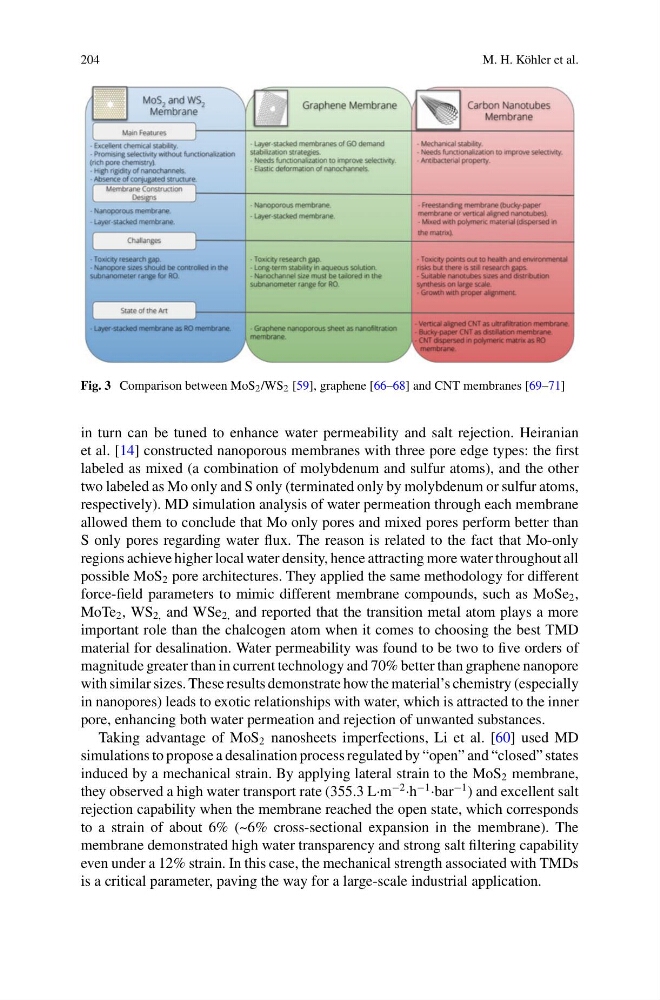
Fig. 3 Comparison between MoS 2 /WS 2 [59], graphene [66–68] and CNT membranes [69–71]
in turn can be tuned to enhance water permeability and salt rejection. Heiranian
et al. [14] constructed nanoporous membranes with three pore edge types: the first
labeled as mixed (a combination of molybdenum and sulfur atoms), and the other
two labeled as Mo only and S only (terminated only by molybdenum or sulfur atoms,
respectively). MD simulation analysis of water permeation through each membrane
allowed them to conclude that Mo only pores and mixed pores perform better than
S only pores regarding water flux. The reason is related to the fact that Mo-only
regions achieve higher local water density, hence attracting more water throughout all
possible MoS 2 pore architectures. They applied the same methodology for different
force-field parameters to mimic different membrane compounds, such as MoSe 2 ,
MoTe 2 , WS 2, and WSe 2, and reported that the transition metal atom plays a more
important role than the chalcogen atom when it comes to choosing the best TMD
material for desalination. Water permeability was found to be two to five orders of
magnitude greater than in current technology and 70% better than graphene nanopore
with similar sizes. These results demonstrate how the material’s chemistry (especially
in nanopores) leads to exotic relationships with water, which is attracted to the inner
pore, enhancing both water permeation and rejection of unwanted substances.
Taking advantage of MoS 2 nanosheets imperfections, Li et al. [60] used MD
simulations to propose a desalination process regulated by “open” and “closed” states
induced by a mechanical strain. By applying lateral strain to the MoS 2 membrane,
they observed a high water transport rate (355.3 L·m
−2 ·h
−1 ·bar
−1 ) and excellent salt
rejection capability when the membrane reached the open state, which corresponds
to a strain of about 6% (~6% cross-sectional expansion in the membrane). The
membrane demonstrated high water transparency and strong salt filtering capability
even under a 12% strain. In this case, the mechanical strength associated with TMDs
is a critical parameter, paving the way for a large-scale industrial application.
M. H. Köhler et al.
Fig. 3 Comparison between MoS 2 /WS 2 [59], graphene [66–68] and CNT membranes [69–71]
in turn can be tuned to enhance water permeability and salt rejection. Heiranian
et al. [14] constructed nanoporous membranes with three pore edge types: the first
labeled as mixed (a combination of molybdenum and sulfur atoms), and the other
two labeled as Mo only and S only (terminated only by molybdenum or sulfur atoms,
respectively). MD simulation analysis of water permeation through each membrane
allowed them to conclude that Mo only pores and mixed pores perform better than
S only pores regarding water flux. The reason is related to the fact that Mo-only
regions achieve higher local water density, hence attracting more water throughout all
possible MoS 2 pore architectures. They applied the same methodology for different
force-field parameters to mimic different membrane compounds, such as MoSe 2 ,
MoTe 2 , WS 2, and WSe 2, and reported that the transition metal atom plays a more
important role than the chalcogen atom when it comes to choosing the best TMD
material for desalination. Water permeability was found to be two to five orders of
magnitude greater than in current technology and 70% better than graphene nanopore
with similar sizes. These results demonstrate how the material’s chemistry (especially
in nanopores) leads to exotic relationships with water, which is attracted to the inner
pore, enhancing both water permeation and rejection of unwanted substances.
Taking advantage of MoS 2 nanosheets imperfections, Li et al. [60] used MD
simulations to propose a desalination process regulated by “open” and “closed” states
induced by a mechanical strain. By applying lateral strain to the MoS 2 membrane,
they observed a high water transport rate (355.3 L·m
−2 ·h
−1 ·bar
−1 ) and excellent salt
rejection capability when the membrane reached the open state, which corresponds
to a strain of about 6% (~6% cross-sectional expansion in the membrane). The
membrane demonstrated high water transparency and strong salt filtering capability
even under a 12% strain. In this case, the mechanical strength associated with TMDs
is a critical parameter, paving the way for a large-scale industrial application.