

198
M. H. Köhler et al.
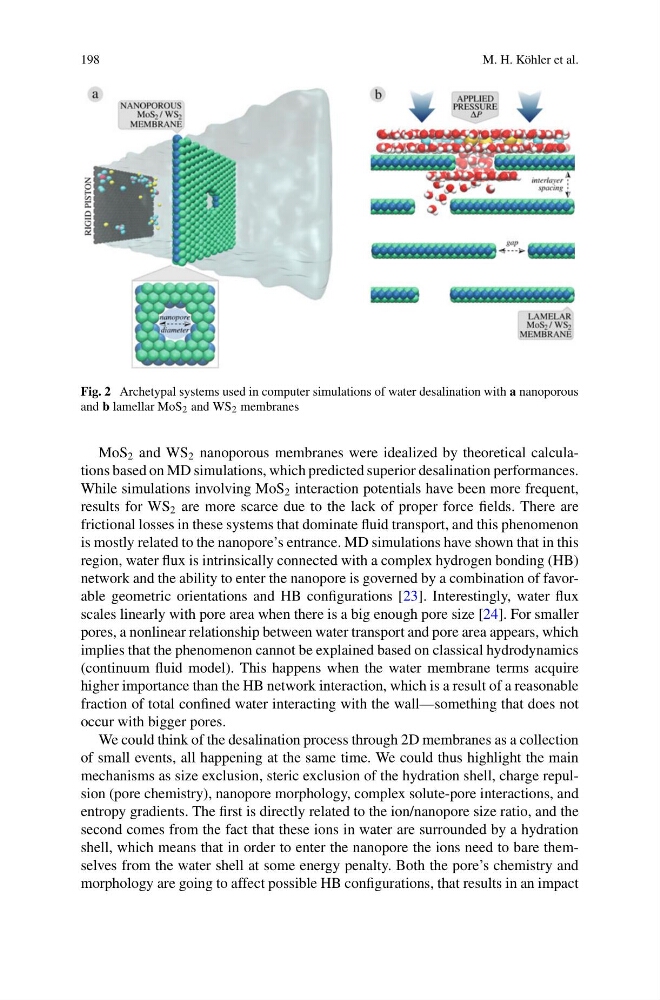
Fig. 2 Archetypal systems used in computer simulations of water desalination with a nanoporous
and b lamellar MoS 2 and WS 2 membranes
MoS 2 and WS 2 nanoporous membranes were idealized by theoretical calculations based on MD simulations, which predicted superior desalination performances.
While simulations involving MoS 2 interaction potentials have been more frequent,
results for WS 2 are more scarce due to the lack of proper force fields. There are
frictional losses in these systems that dominate fluid transport, and this phenomenon
is mostly related to the nanopore’s entrance. MD simulations have shown that in this
region, water flux is intrinsically connected with a complex hydrogen bonding (HB)
network and the ability to enter the nanopore is governed by a combination of favorable geometric orientations and HB configurations [23]. Interestingly, water flux
scales linearly with pore area when there is a big enough pore size [24]. For smaller
pores, a nonlinear relationship between water transport and pore area appears, which
implies that the phenomenon cannot be explained based on classical hydrodynamics
(continuum fluid model). This happens when the water membrane terms acquire
higher importance than the HB network interaction, which is a result of a reasonable
fraction of total confined water interacting with the wall—something that does not
occur with bigger pores.
We could think of the desalination process through 2D membranes as a collection
of small events, all happening at the same time. We could thus highlight the main
mechanisms as size exclusion, steric exclusion of the hydration shell, charge repulsion (pore chemistry), nanopore morphology, complex solute-pore interactions, and
entropy gradients. The first is directly related to the ion/nanopore size ratio, and the
second comes from the fact that these ions in water are surrounded by a hydration
shell, which means that in order to enter the nanopore the ions need to bare themselves from the water shell at some energy penalty. Both the pore’s chemistry and
morphology are going to affect possible HB configurations, that results in an impact
M. H. Köhler et al.
Fig. 2 Archetypal systems used in computer simulations of water desalination with a nanoporous
and b lamellar MoS 2 and WS 2 membranes
MoS 2 and WS 2 nanoporous membranes were idealized by theoretical calculations based on MD simulations, which predicted superior desalination performances.
While simulations involving MoS 2 interaction potentials have been more frequent,
results for WS 2 are more scarce due to the lack of proper force fields. There are
frictional losses in these systems that dominate fluid transport, and this phenomenon
is mostly related to the nanopore’s entrance. MD simulations have shown that in this
region, water flux is intrinsically connected with a complex hydrogen bonding (HB)
network and the ability to enter the nanopore is governed by a combination of favorable geometric orientations and HB configurations [23]. Interestingly, water flux
scales linearly with pore area when there is a big enough pore size [24]. For smaller
pores, a nonlinear relationship between water transport and pore area appears, which
implies that the phenomenon cannot be explained based on classical hydrodynamics
(continuum fluid model). This happens when the water membrane terms acquire
higher importance than the HB network interaction, which is a result of a reasonable
fraction of total confined water interacting with the wall—something that does not
occur with bigger pores.
We could think of the desalination process through 2D membranes as a collection
of small events, all happening at the same time. We could thus highlight the main
mechanisms as size exclusion, steric exclusion of the hydration shell, charge repulsion (pore chemistry), nanopore morphology, complex solute-pore interactions, and
entropy gradients. The first is directly related to the ion/nanopore size ratio, and the
second comes from the fact that these ions in water are surrounded by a hydration
shell, which means that in order to enter the nanopore the ions need to bare themselves from the water shell at some energy penalty. Both the pore’s chemistry and
morphology are going to affect possible HB configurations, that results in an impact