

194
M. H. Köhler et al.
of graphene, a one-carbon-atom-thick structure. The discovery of this fascinating
material and its exceptional properties [2, 3] completely changed the game.
While much research is still focused on carbon nanotubes (CNTs) [4], zeolites [5],
polymers [6], or ceramics [7] to act as membranes for ion separation, the fact is that
graphene and graphene-related materials have taken over the news with promising
nanofiltration results. More recently, van der Waals (vdW) assembly of 2D materials has been used to create artificial channels with sub-nanometer-scale precision
[8]. Two of these vdW structures, molybdenum disulfide (MoS 2 ) and tungsten disulfide (WS 2 ), stand as prominent alternatives to graphene, exhibiting many similar
characteristics as atomic thickness, large surface area, mechanical strength, extreme
durability, and also the most important: an exotic love-hate relationship with water
that leads to high permeation rates. MoS 2 is the most widely employed TMD in a
range of applications and has recently been investigated for its potential in separation
techniques. This prototypical TMD is made up of a middle layer of molybdenum
sandwiched between two sulfur layers with a thickness of ~1 nm and a robust Young’s
modulus of ~300 GPa [9] (comparable to Young’s modulus of steel). TMDs, a family
of over 40 materials, are represented by the generalized formula MX 2 and consist of a
transition metal (M), for example, Mo, W, or Ni packed between two chalcogens (X)
such as S, Se, or Te. The coordination of a transition metal by chalcogens in a TMD
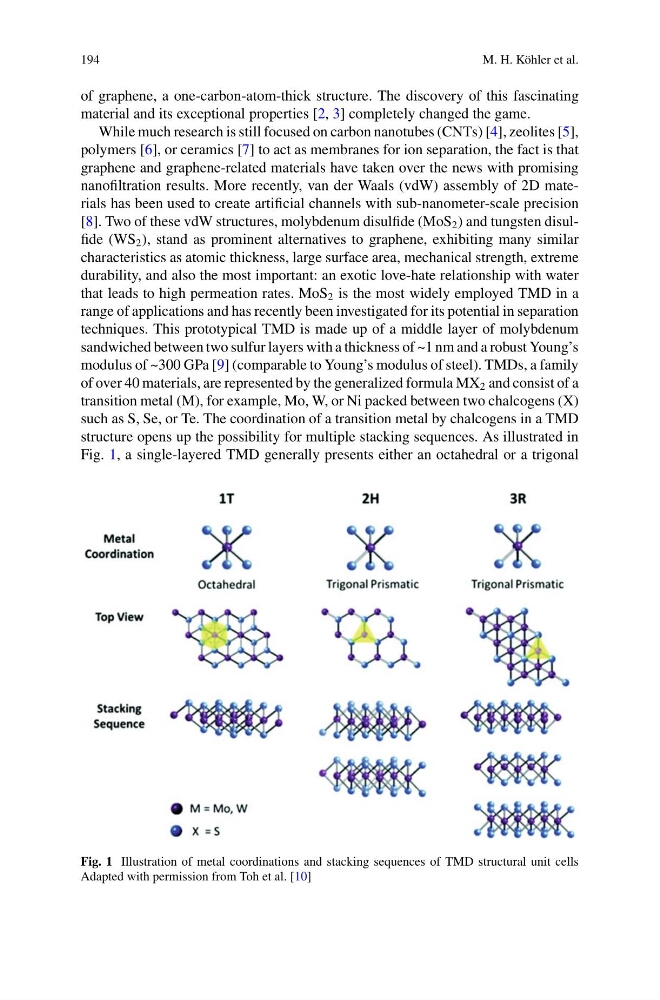
structure opens up the possibility for multiple stacking sequences. As illustrated in
Fig. 1, a single-layered TMD generally presents either an octahedral or a trigonal
Fig. 1 Illustration of metal coordinations and stacking sequences of TMD structural unit cells
Adapted with permission from Toh et al. [10]
M. H. Köhler et al.
of graphene, a one-carbon-atom-thick structure. The discovery of this fascinating
material and its exceptional properties [2, 3] completely changed the game.
While much research is still focused on carbon nanotubes (CNTs) [4], zeolites [5],
polymers [6], or ceramics [7] to act as membranes for ion separation, the fact is that
graphene and graphene-related materials have taken over the news with promising
nanofiltration results. More recently, van der Waals (vdW) assembly of 2D materials has been used to create artificial channels with sub-nanometer-scale precision
[8]. Two of these vdW structures, molybdenum disulfide (MoS 2 ) and tungsten disulfide (WS 2 ), stand as prominent alternatives to graphene, exhibiting many similar
characteristics as atomic thickness, large surface area, mechanical strength, extreme
durability, and also the most important: an exotic love-hate relationship with water
that leads to high permeation rates. MoS 2 is the most widely employed TMD in a
range of applications and has recently been investigated for its potential in separation
techniques. This prototypical TMD is made up of a middle layer of molybdenum
sandwiched between two sulfur layers with a thickness of ~1 nm and a robust Young’s
modulus of ~300 GPa [9] (comparable to Young’s modulus of steel). TMDs, a family
of over 40 materials, are represented by the generalized formula MX 2 and consist of a
transition metal (M), for example, Mo, W, or Ni packed between two chalcogens (X)
such as S, Se, or Te. The coordination of a transition metal by chalcogens in a TMD
structure opens up the possibility for multiple stacking sequences. As illustrated in
Fig. 1, a single-layered TMD generally presents either an octahedral or a trigonal
Fig. 1 Illustration of metal coordinations and stacking sequences of TMD structural unit cells
Adapted with permission from Toh et al. [10]