

Hexagonal Boron Nitride (h-BN) in Solutes Separation
181
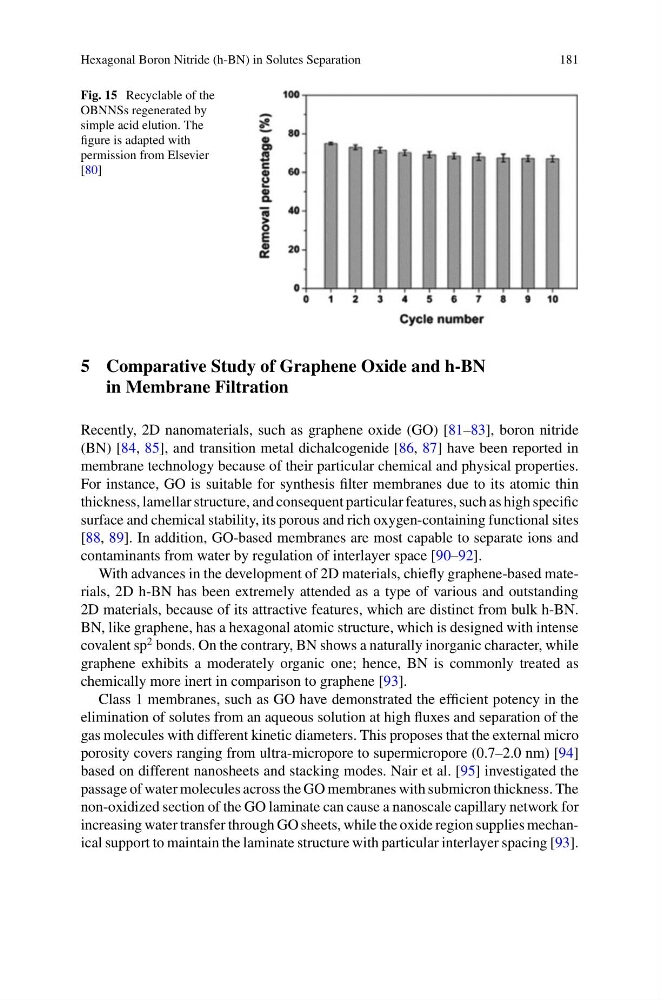
Fig. 15 Recyclable of the
OBNNSs regenerated by
simple acid elution. The
figure is adapted with
permission from Elsevier
[80]
5 Comparative Study of Graphene Oxide and h-BN
in Membrane Filtration
Recently, 2D nanomaterials, such as graphene oxide (GO) [81–83], boron nitride
(BN) [84, 85], and transition metal dichalcogenide [86, 87] have been reported in
membrane technology because of their particular chemical and physical properties.
For instance, GO is suitable for synthesis filter membranes due to its atomic thin
thickness, lamellar structure, and consequent particular features, such as high specific
surface and chemical stability, its porous and rich oxygen-containing functional sites
[88, 89]. In addition, GO-based membranes are most capable to separate ions and
contaminants from water by regulation of interlayer space [90–92].
With advances in the development of 2D materials, chiefly graphene-based materials, 2D h-BN has been extremely attended as a type of various and outstanding
2D materials, because of its attractive features, which are distinct from bulk h-BN.
BN, like graphene, has a hexagonal atomic structure, which is designed with intense
covalent sp
2 bonds. On the contrary, BN shows a naturally inorganic character, while
graphene exhibits a moderately organic one; hence, BN is commonly treated as
chemically more inert in comparison to graphene [93].
Class 1 membranes, such as GO have demonstrated the efficient potency in the
elimination of solutes from an aqueous solution at high fluxes and separation of the
gas molecules with different kinetic diameters. This proposes that the external micro
porosity covers ranging from ultra-micropore to supermicropore (0.7–2.0 nm) [94]
based on different nanosheets and stacking modes. Nair et al. [95] investigated the
passage of water molecules across the GO membranes with submicron thickness. The
non-oxidized section of the GO laminate can cause a nanoscale capillary network for
increasing water transfer through GO sheets, while the oxide region supplies mechanical support to maintain the laminate structure with particular interlayer spacing [93].
181
Fig. 15 Recyclable of the
OBNNSs regenerated by
simple acid elution. The
figure is adapted with
permission from Elsevier
[80]
5 Comparative Study of Graphene Oxide and h-BN
in Membrane Filtration
Recently, 2D nanomaterials, such as graphene oxide (GO) [81–83], boron nitride
(BN) [84, 85], and transition metal dichalcogenide [86, 87] have been reported in
membrane technology because of their particular chemical and physical properties.
For instance, GO is suitable for synthesis filter membranes due to its atomic thin
thickness, lamellar structure, and consequent particular features, such as high specific
surface and chemical stability, its porous and rich oxygen-containing functional sites
[88, 89]. In addition, GO-based membranes are most capable to separate ions and
contaminants from water by regulation of interlayer space [90–92].
With advances in the development of 2D materials, chiefly graphene-based materials, 2D h-BN has been extremely attended as a type of various and outstanding
2D materials, because of its attractive features, which are distinct from bulk h-BN.
BN, like graphene, has a hexagonal atomic structure, which is designed with intense
covalent sp
2 bonds. On the contrary, BN shows a naturally inorganic character, while
graphene exhibits a moderately organic one; hence, BN is commonly treated as
chemically more inert in comparison to graphene [93].
Class 1 membranes, such as GO have demonstrated the efficient potency in the
elimination of solutes from an aqueous solution at high fluxes and separation of the
gas molecules with different kinetic diameters. This proposes that the external micro
porosity covers ranging from ultra-micropore to supermicropore (0.7–2.0 nm) [94]
based on different nanosheets and stacking modes. Nair et al. [95] investigated the
passage of water molecules across the GO membranes with submicron thickness. The
non-oxidized section of the GO laminate can cause a nanoscale capillary network for
increasing water transfer through GO sheets, while the oxide region supplies mechanical support to maintain the laminate structure with particular interlayer spacing [93].