

Porous Graphene Membranes for Solute Separation …
153
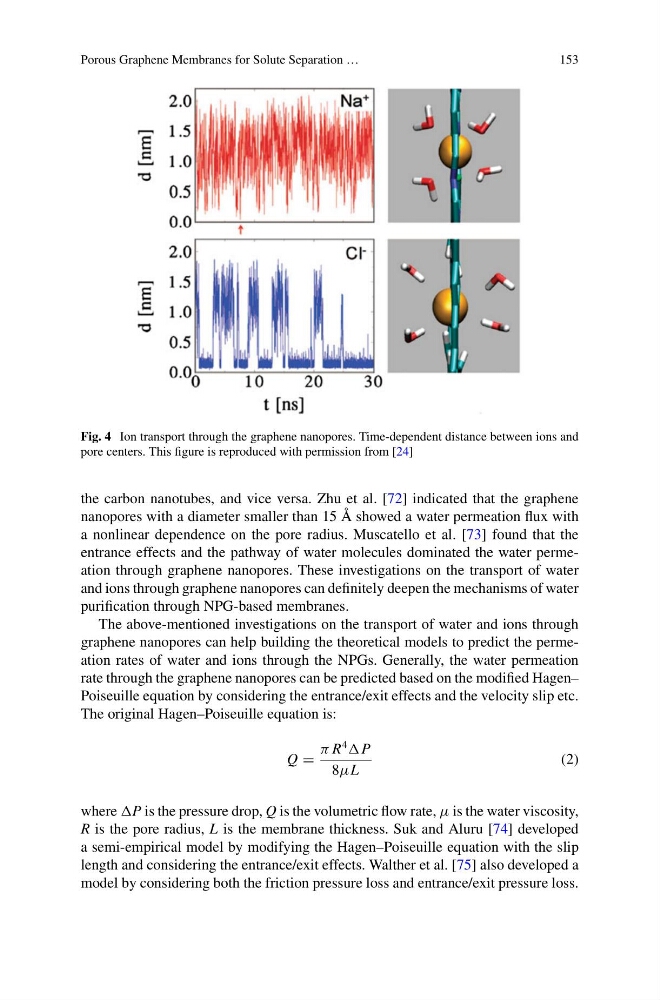
Fig. 4 Ion transport through the graphene nanopores. Time-dependent distance between ions and
pore centers. This figure is reproduced with permission from [24]
the carbon nanotubes, and vice versa. Zhu et al. [72] indicated that the graphene
nanopores with a diameter smaller than 15 Å showed a water permeation flux with
a nonlinear dependence on the pore radius. Muscatello et al. [73] found that the
entrance effects and the pathway of water molecules dominated the water permeation through graphene nanopores. These investigations on the transport of water
and ions through graphene nanopores can definitely deepen the mechanisms of water
purification through NPG-based membranes.
The above-mentioned investigations on the transport of water and ions through
graphene nanopores can help building the theoretical models to predict the permeation rates of water and ions through the NPGs. Generally, the water permeation
rate through the graphene nanopores can be predicted based on the modified Hagen–
Poiseuille equation by considering the entrance/exit effects and the velocity slip etc.
The original Hagen–Poiseuille equation is:
Q =
π R
4
P
8μL
(2)
where P is the pressure drop, Q is the volumetric flow rate, μ is the water viscosity,
R is the pore radius, L is the membrane thickness. Suk and Aluru [74] developed
a semi-empirical model by modifying the Hagen–Poiseuille equation with the slip
length and considering the entrance/exit effects. Walther et al. [75] also developed a
model by considering both the friction pressure loss and entrance/exit pressure loss.
153
Fig. 4 Ion transport through the graphene nanopores. Time-dependent distance between ions and
pore centers. This figure is reproduced with permission from [24]
the carbon nanotubes, and vice versa. Zhu et al. [72] indicated that the graphene
nanopores with a diameter smaller than 15 Å showed a water permeation flux with
a nonlinear dependence on the pore radius. Muscatello et al. [73] found that the
entrance effects and the pathway of water molecules dominated the water permeation through graphene nanopores. These investigations on the transport of water
and ions through graphene nanopores can definitely deepen the mechanisms of water
purification through NPG-based membranes.
The above-mentioned investigations on the transport of water and ions through
graphene nanopores can help building the theoretical models to predict the permeation rates of water and ions through the NPGs. Generally, the water permeation
rate through the graphene nanopores can be predicted based on the modified Hagen–
Poiseuille equation by considering the entrance/exit effects and the velocity slip etc.
The original Hagen–Poiseuille equation is:
Q =
π R
4
P
8μL
(2)
where P is the pressure drop, Q is the volumetric flow rate, μ is the water viscosity,
R is the pore radius, L is the membrane thickness. Suk and Aluru [74] developed
a semi-empirical model by modifying the Hagen–Poiseuille equation with the slip
length and considering the entrance/exit effects. Walther et al. [75] also developed a
model by considering both the friction pressure loss and entrance/exit pressure loss.