

148
C. Sun et al.
Following the first theoretical demonstration of NPG water purification membranes
by Cohen-Tanugi et al. [1] in 2012, several experimental works were successively
conducted by different groups. Surwade et al. [27] measured the water permeation and
ion rejection rate through a NPG membrane with tunable nanopores created via the
oxygen plasma etching process on the ambient-pressure CVD graphene and achieved
a nearly 100% salt rejection rate for the dissolved ions (e.g. K
+ , Na
+ , Li
+ and Cl
− ) and
a high water permeation rate. O’Hern et al. [33] investigated the salt rejection rates of
a defect-free NPG membrane and observed a high rejection rate of multivalent ions
and small molecules; and this membrane can achieve a high water permeation flux.
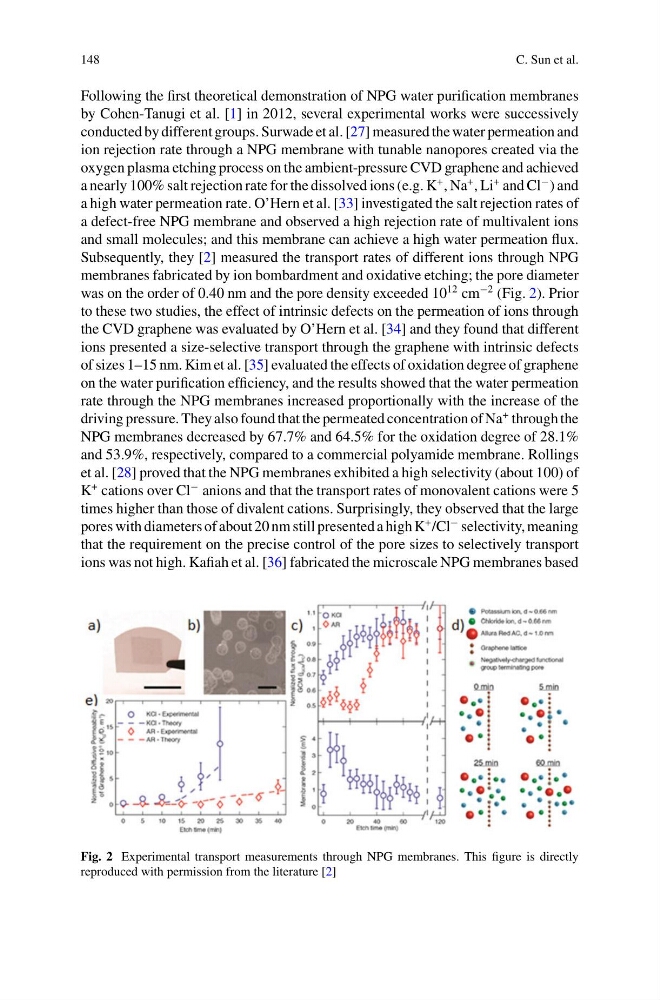
Subsequently, they [2] measured the transport rates of different ions through NPG
membranes fabricated by ion bombardment and oxidative etching; the pore diameter
was on the order of 0.40 nm and the pore density exceeded 10
12 cm
−2 (Fig. 2). Prior
to these two studies, the effect of intrinsic defects on the permeation of ions through
the CVD graphene was evaluated by O’Hern et al. [34] and they found that different
ions presented a size-selective transport through the graphene with intrinsic defects
of sizes 1–15 nm. Kim et al. [35] evaluated the effects of oxidation degree of graphene
on the water purification efficiency, and the results showed that the water permeation
rate through the NPG membranes increased proportionally with the increase of the
driving pressure. They also found that the permeated concentration of Na
+ through the
NPG membranes decreased by 67.7% and 64.5% for the oxidation degree of 28.1%
and 53.9%, respectively, compared to a commercial polyamide membrane. Rollings
et al. [28] proved that the NPG membranes exhibited a high selectivity (about 100) of
K
+ cations over Cl
− anions and that the transport rates of monovalent cations were 5
times higher than those of divalent cations. Surprisingly, they observed that the large
pores with diameters of about 20 nm still presented a high K
+ /Cl
− selectivity, meaning
that the requirement on the precise control of the pore sizes to selectively transport
ions was not high. Kafiah et al. [36] fabricated the microscale NPG membranes based
Fig. 2 Experimental transport measurements through NPG membranes. This figure is directly
reproduced with permission from the literature [2]
C. Sun et al.
Following the first theoretical demonstration of NPG water purification membranes
by Cohen-Tanugi et al. [1] in 2012, several experimental works were successively
conducted by different groups. Surwade et al. [27] measured the water permeation and
ion rejection rate through a NPG membrane with tunable nanopores created via the
oxygen plasma etching process on the ambient-pressure CVD graphene and achieved
a nearly 100% salt rejection rate for the dissolved ions (e.g. K
+ , Na
+ , Li
+ and Cl
− ) and
a high water permeation rate. O’Hern et al. [33] investigated the salt rejection rates of
a defect-free NPG membrane and observed a high rejection rate of multivalent ions
and small molecules; and this membrane can achieve a high water permeation flux.
Subsequently, they [2] measured the transport rates of different ions through NPG
membranes fabricated by ion bombardment and oxidative etching; the pore diameter
was on the order of 0.40 nm and the pore density exceeded 10
12 cm
−2 (Fig. 2). Prior
to these two studies, the effect of intrinsic defects on the permeation of ions through
the CVD graphene was evaluated by O’Hern et al. [34] and they found that different
ions presented a size-selective transport through the graphene with intrinsic defects
of sizes 1–15 nm. Kim et al. [35] evaluated the effects of oxidation degree of graphene
on the water purification efficiency, and the results showed that the water permeation
rate through the NPG membranes increased proportionally with the increase of the
driving pressure. They also found that the permeated concentration of Na
+ through the
NPG membranes decreased by 67.7% and 64.5% for the oxidation degree of 28.1%
and 53.9%, respectively, compared to a commercial polyamide membrane. Rollings
et al. [28] proved that the NPG membranes exhibited a high selectivity (about 100) of
K
+ cations over Cl
− anions and that the transport rates of monovalent cations were 5
times higher than those of divalent cations. Surprisingly, they observed that the large
pores with diameters of about 20 nm still presented a high K
+ /Cl
− selectivity, meaning
that the requirement on the precise control of the pore sizes to selectively transport
ions was not high. Kafiah et al. [36] fabricated the microscale NPG membranes based
Fig. 2 Experimental transport measurements through NPG membranes. This figure is directly
reproduced with permission from the literature [2]