

146
C. Sun et al.
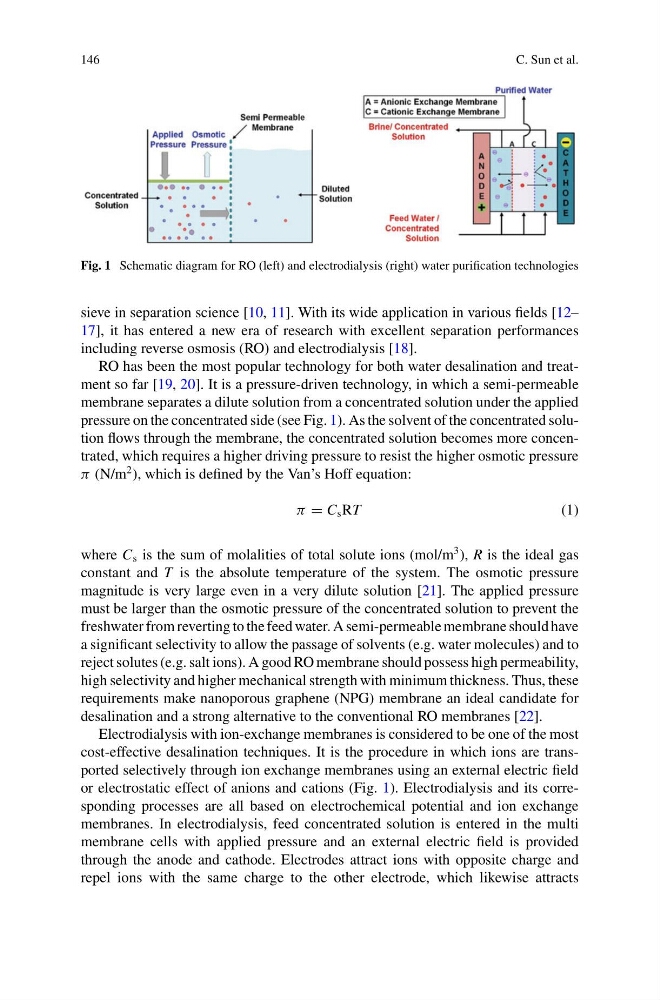
Fig. 1 Schematic diagram for RO (left) and electrodialysis (right) water purification technologies
sieve in separation science [10, 11]. With its wide application in various fields [12–
17], it has entered a new era of research with excellent separation performances
including reverse osmosis (RO) and electrodialysis [18].
RO has been the most popular technology for both water desalination and treatment so far [19, 20]. It is a pressure-driven technology, in which a semi-permeable
membrane separates a dilute solution from a concentrated solution under the applied
pressure on the concentrated side (see Fig. 1). As the solvent of the concentrated solution flows through the membrane, the concentrated solution becomes more concentrated, which requires a higher driving pressure to resist the higher osmotic pressure
π (N/m
2 ), which is defined by the Van’s Hoff equation:
π = C s RT
(1)
where C s is the sum of molalities of total solute ions (mol/m
3 ), R is the ideal gas
constant and T is the absolute temperature of the system. The osmotic pressure
magnitude is very large even in a very dilute solution [21]. The applied pressure
must be larger than the osmotic pressure of the concentrated solution to prevent the
freshwater from reverting to the feed water. A semi-permeable membrane should have
a significant selectivity to allow the passage of solvents (e.g. water molecules) and to
reject solutes (e.g. salt ions). A good RO membrane should possess high permeability,
high selectivity and higher mechanical strength with minimum thickness. Thus, these
requirements make nanoporous graphene (NPG) membrane an ideal candidate for
desalination and a strong alternative to the conventional RO membranes [22].
Electrodialysis with ion-exchange membranes is considered to be one of the most
cost-effective desalination techniques. It is the procedure in which ions are transported selectively through ion exchange membranes using an external electric field
or electrostatic effect of anions and cations (Fig. 1). Electrodialysis and its corresponding processes are all based on electrochemical potential and ion exchange
membranes. In electrodialysis, feed concentrated solution is entered in the multi
membrane cells with applied pressure and an external electric field is provided
through the anode and cathode. Electrodes attract ions with opposite charge and
repel ions with the same charge to the other electrode, which likewise attracts
C. Sun et al.
Fig. 1 Schematic diagram for RO (left) and electrodialysis (right) water purification technologies
sieve in separation science [10, 11]. With its wide application in various fields [12–
17], it has entered a new era of research with excellent separation performances
including reverse osmosis (RO) and electrodialysis [18].
RO has been the most popular technology for both water desalination and treatment so far [19, 20]. It is a pressure-driven technology, in which a semi-permeable
membrane separates a dilute solution from a concentrated solution under the applied
pressure on the concentrated side (see Fig. 1). As the solvent of the concentrated solution flows through the membrane, the concentrated solution becomes more concentrated, which requires a higher driving pressure to resist the higher osmotic pressure
π (N/m
2 ), which is defined by the Van’s Hoff equation:
π = C s RT
(1)
where C s is the sum of molalities of total solute ions (mol/m
3 ), R is the ideal gas
constant and T is the absolute temperature of the system. The osmotic pressure
magnitude is very large even in a very dilute solution [21]. The applied pressure
must be larger than the osmotic pressure of the concentrated solution to prevent the
freshwater from reverting to the feed water. A semi-permeable membrane should have
a significant selectivity to allow the passage of solvents (e.g. water molecules) and to
reject solutes (e.g. salt ions). A good RO membrane should possess high permeability,
high selectivity and higher mechanical strength with minimum thickness. Thus, these
requirements make nanoporous graphene (NPG) membrane an ideal candidate for
desalination and a strong alternative to the conventional RO membranes [22].
Electrodialysis with ion-exchange membranes is considered to be one of the most
cost-effective desalination techniques. It is the procedure in which ions are transported selectively through ion exchange membranes using an external electric field
or electrostatic effect of anions and cations (Fig. 1). Electrodialysis and its corresponding processes are all based on electrochemical potential and ion exchange
membranes. In electrodialysis, feed concentrated solution is entered in the multi
membrane cells with applied pressure and an external electric field is provided
through the anode and cathode. Electrodes attract ions with opposite charge and
repel ions with the same charge to the other electrode, which likewise attracts