

Graphene Oxide and Reduced Graphene Oxide as Nanofillers …
137
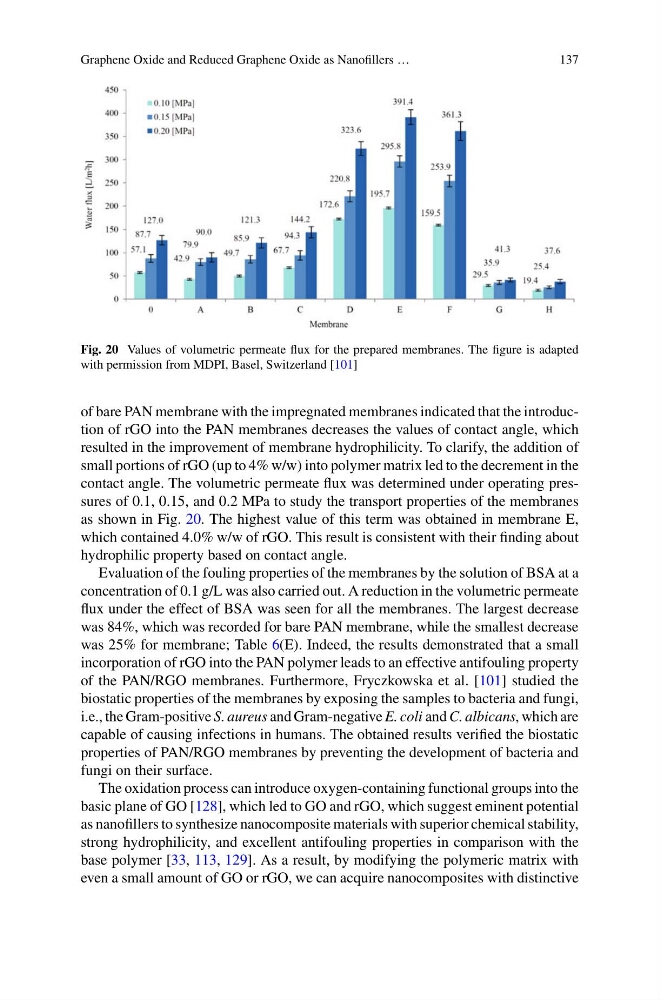
Fig. 20 Values of volumetric permeate flux for the prepared membranes. The figure is adapted
with permission from MDPI, Basel, Switzerland [101]
of bare PAN membrane with the impregnated membranes indicated that the introduction of rGO into the PAN membranes decreases the values of contact angle, which
resulted in the improvement of membrane hydrophilicity. To clarify, the addition of
small portions of rGO (up to 4% w/w) into polymer matrix led to the decrement in the
contact angle. The volumetric permeate flux was determined under operating pressures of 0.1, 0.15, and 0.2 MPa to study the transport properties of the membranes
as shown in Fig. 20. The highest value of this term was obtained in membrane E,
which contained 4.0% w/w of rGO. This result is consistent with their finding about
hydrophilic property based on contact angle.
Evaluation of the fouling properties of the membranes by the solution of BSA at a
concentration of 0.1 g/L was also carried out. A reduction in the volumetric permeate
flux under the effect of BSA was seen for all the membranes. The largest decrease
was 84%, which was recorded for bare PAN membrane, while the smallest decrease
was 25% for membrane; Table 6(E). Indeed, the results demonstrated that a small
incorporation of rGO into the PAN polymer leads to an effective antifouling property
of the PAN/RGO membranes. Furthermore, Fryczkowska et al. [101] studied the
biostatic properties of the membranes by exposing the samples to bacteria and fungi,
i.e., the Gram-positive S. aureus and Gram-negative E. coli and C. albicans, which are
capable of causing infections in humans. The obtained results verified the biostatic
properties of PAN/RGO membranes by preventing the development of bacteria and
fungi on their surface.
The oxidation process can introduce oxygen-containing functional groups into the
basic plane of GO [128], which led to GO and rGO, which suggest eminent potential
as nanofillers to synthesize nanocomposite materials with superior chemical stability,
strong hydrophilicity, and excellent antifouling properties in comparison with the
base polymer [33, 113, 129]. As a result, by modifying the polymeric matrix with
even a small amount of GO or rGO, we can acquire nanocomposites with distinctive
137
Fig. 20 Values of volumetric permeate flux for the prepared membranes. The figure is adapted
with permission from MDPI, Basel, Switzerland [101]
of bare PAN membrane with the impregnated membranes indicated that the introduction of rGO into the PAN membranes decreases the values of contact angle, which
resulted in the improvement of membrane hydrophilicity. To clarify, the addition of
small portions of rGO (up to 4% w/w) into polymer matrix led to the decrement in the
contact angle. The volumetric permeate flux was determined under operating pressures of 0.1, 0.15, and 0.2 MPa to study the transport properties of the membranes
as shown in Fig. 20. The highest value of this term was obtained in membrane E,
which contained 4.0% w/w of rGO. This result is consistent with their finding about
hydrophilic property based on contact angle.
Evaluation of the fouling properties of the membranes by the solution of BSA at a
concentration of 0.1 g/L was also carried out. A reduction in the volumetric permeate
flux under the effect of BSA was seen for all the membranes. The largest decrease
was 84%, which was recorded for bare PAN membrane, while the smallest decrease
was 25% for membrane; Table 6(E). Indeed, the results demonstrated that a small
incorporation of rGO into the PAN polymer leads to an effective antifouling property
of the PAN/RGO membranes. Furthermore, Fryczkowska et al. [101] studied the
biostatic properties of the membranes by exposing the samples to bacteria and fungi,
i.e., the Gram-positive S. aureus and Gram-negative E. coli and C. albicans, which are
capable of causing infections in humans. The obtained results verified the biostatic
properties of PAN/RGO membranes by preventing the development of bacteria and
fungi on their surface.
The oxidation process can introduce oxygen-containing functional groups into the
basic plane of GO [128], which led to GO and rGO, which suggest eminent potential
as nanofillers to synthesize nanocomposite materials with superior chemical stability,
strong hydrophilicity, and excellent antifouling properties in comparison with the
base polymer [33, 113, 129]. As a result, by modifying the polymeric matrix with
even a small amount of GO or rGO, we can acquire nanocomposites with distinctive