

Graphene Oxide and Reduced Graphene Oxide as Nanofillers …
133
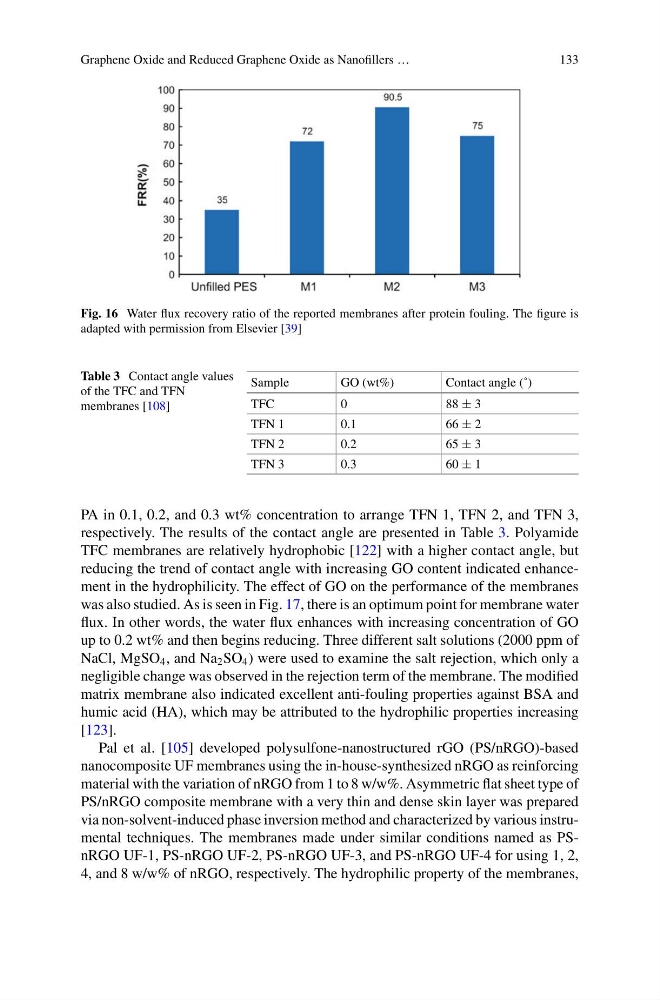
Fig. 16 Water flux recovery ratio of the reported membranes after protein fouling. The figure is
adapted with permission from Elsevier [39]
Table 3 Contact angle values
of the TFC and TFN
membranes [108]
Sample
GO (wt%)
Contact angle (˚)
TFC
0
88 ± 3
TFN 1
0.1
66 ± 2
TFN 2
0.2
65 ± 3
TFN 3
0.3
60 ± 1
PA in 0.1, 0.2, and 0.3 wt% concentration to arrange TFN 1, TFN 2, and TFN 3,
respectively. The results of the contact angle are presented in Table 3. Polyamide
TFC membranes are relatively hydrophobic [122] with a higher contact angle, but
reducing the trend of contact angle with increasing GO content indicated enhancement in the hydrophilicity. The effect of GO on the performance of the membranes
was also studied. As is seen in Fig. 17, there is an optimum point for membrane water
flux. In other words, the water flux enhances with increasing concentration of GO
up to 0.2 wt% and then begins reducing. Three different salt solutions (2000 ppm of
NaCl, MgSO 4 , and Na 2 SO 4 ) were used to examine the salt rejection, which only a
negligible change was observed in the rejection term of the membrane. The modified
matrix membrane also indicated excellent anti-fouling properties against BSA and
humic acid (HA), which may be attributed to the hydrophilic properties increasing
[123].
Pal et al. [105] developed polysulfone-nanostructured rGO (PS/nRGO)-based
nanocomposite UF membranes using the in-house-synthesized nRGO as reinforcing
material with the variation of nRGO from 1 to 8 w/w%. Asymmetric flat sheet type of
PS/nRGO composite membrane with a very thin and dense skin layer was prepared
via non-solvent-induced phase inversion method and characterized by various instrumental techniques. The membranes made under similar conditions named as PSnRGO UF-1, PS-nRGO UF-2, PS-nRGO UF-3, and PS-nRGO UF-4 for using 1, 2,
4, and 8 w/w% of nRGO, respectively. The hydrophilic property of the membranes,
133
Fig. 16 Water flux recovery ratio of the reported membranes after protein fouling. The figure is
adapted with permission from Elsevier [39]
Table 3 Contact angle values
of the TFC and TFN
membranes [108]
Sample
GO (wt%)
Contact angle (˚)
TFC
0
88 ± 3
TFN 1
0.1
66 ± 2
TFN 2
0.2
65 ± 3
TFN 3
0.3
60 ± 1
PA in 0.1, 0.2, and 0.3 wt% concentration to arrange TFN 1, TFN 2, and TFN 3,
respectively. The results of the contact angle are presented in Table 3. Polyamide
TFC membranes are relatively hydrophobic [122] with a higher contact angle, but
reducing the trend of contact angle with increasing GO content indicated enhancement in the hydrophilicity. The effect of GO on the performance of the membranes
was also studied. As is seen in Fig. 17, there is an optimum point for membrane water
flux. In other words, the water flux enhances with increasing concentration of GO
up to 0.2 wt% and then begins reducing. Three different salt solutions (2000 ppm of
NaCl, MgSO 4 , and Na 2 SO 4 ) were used to examine the salt rejection, which only a
negligible change was observed in the rejection term of the membrane. The modified
matrix membrane also indicated excellent anti-fouling properties against BSA and
humic acid (HA), which may be attributed to the hydrophilic properties increasing
[123].
Pal et al. [105] developed polysulfone-nanostructured rGO (PS/nRGO)-based
nanocomposite UF membranes using the in-house-synthesized nRGO as reinforcing
material with the variation of nRGO from 1 to 8 w/w%. Asymmetric flat sheet type of
PS/nRGO composite membrane with a very thin and dense skin layer was prepared
via non-solvent-induced phase inversion method and characterized by various instrumental techniques. The membranes made under similar conditions named as PSnRGO UF-1, PS-nRGO UF-2, PS-nRGO UF-3, and PS-nRGO UF-4 for using 1, 2,
4, and 8 w/w% of nRGO, respectively. The hydrophilic property of the membranes,