

124
S. Pakdel et al.
3.2 Functional Groups of Membrane Analyses
(a) FTIR Analysis
Fourier transform infrared (FTIR) spectroscopy is used to identify the presence of
GO or rGO and their interaction with polymer membrane matrix. In other words, the
attenuated total reflectance (ATR) FTIR spectra are applied to study the membrane
matrix surface morphology changes due to characteristic nanofiller content [100,
102, 106]. Bano et al. [108] used ATR FTIR spectra to confirm the interaction of GO
with the polyamide (PA) membrane and the developing of thin-film nanocomposite
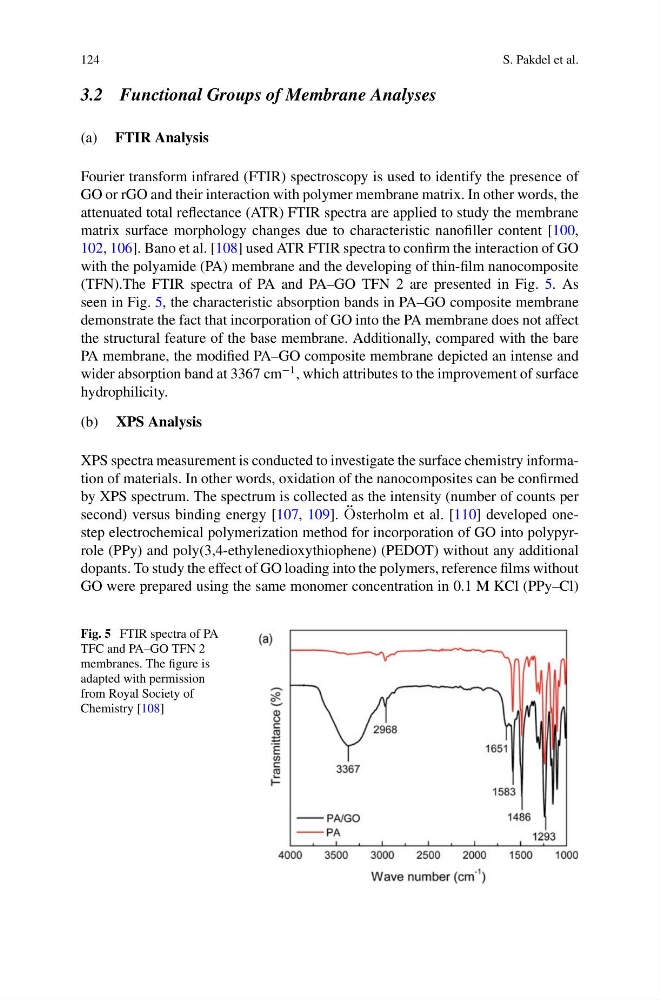
(TFN).The FTIR spectra of PA and PA–GO TFN 2 are presented in Fig. 5. As
seen in Fig. 5, the characteristic absorption bands in PA–GO composite membrane
demonstrate the fact that incorporation of GO into the PA membrane does not affect
the structural feature of the base membrane. Additionally, compared with the bare
PA membrane, the modified PA–GO composite membrane depicted an intense and
wider absorption band at 3367 cm
−1 , which attributes to the improvement of surface
hydrophilicity.
(b) XPS Analysis
XPS spectra measurement is conducted to investigate the surface chemistry information of materials. In other words, oxidation of the nanocomposites can be confirmed
by XPS spectrum. The spectrum is collected as the intensity (number of counts per
second) versus binding energy [107, 109]. ¨
Osterholm et al. [110] developed onestep electrochemical polymerization method for incorporation of GO into polypyrrole (PPy) and poly(3,4-ethylenedioxythiophene) (PEDOT) without any additional
dopants. To study the effect of GO loading into the polymers, reference films without
GO were prepared using the same monomer concentration in 0.1 M KCl (PPy–Cl)
Fig. 5 FTIR spectra of PA
TFC and PA–GO TFN 2
membranes. The figure is
adapted with permission
from Royal Society of
Chemistry [108]
S. Pakdel et al.
3.2 Functional Groups of Membrane Analyses
(a) FTIR Analysis
Fourier transform infrared (FTIR) spectroscopy is used to identify the presence of
GO or rGO and their interaction with polymer membrane matrix. In other words, the
attenuated total reflectance (ATR) FTIR spectra are applied to study the membrane
matrix surface morphology changes due to characteristic nanofiller content [100,
102, 106]. Bano et al. [108] used ATR FTIR spectra to confirm the interaction of GO
with the polyamide (PA) membrane and the developing of thin-film nanocomposite
(TFN).The FTIR spectra of PA and PA–GO TFN 2 are presented in Fig. 5. As
seen in Fig. 5, the characteristic absorption bands in PA–GO composite membrane
demonstrate the fact that incorporation of GO into the PA membrane does not affect
the structural feature of the base membrane. Additionally, compared with the bare
PA membrane, the modified PA–GO composite membrane depicted an intense and
wider absorption band at 3367 cm
−1 , which attributes to the improvement of surface
hydrophilicity.
(b) XPS Analysis
XPS spectra measurement is conducted to investigate the surface chemistry information of materials. In other words, oxidation of the nanocomposites can be confirmed
by XPS spectrum. The spectrum is collected as the intensity (number of counts per
second) versus binding energy [107, 109]. ¨
Osterholm et al. [110] developed onestep electrochemical polymerization method for incorporation of GO into polypyrrole (PPy) and poly(3,4-ethylenedioxythiophene) (PEDOT) without any additional
dopants. To study the effect of GO loading into the polymers, reference films without
GO were prepared using the same monomer concentration in 0.1 M KCl (PPy–Cl)
Fig. 5 FTIR spectra of PA
TFC and PA–GO TFN 2
membranes. The figure is
adapted with permission
from Royal Society of
Chemistry [108]