

6
R. Das
Metal-organic framework (MOF)—as the name implied, it is a combination of
metal ions/clusters and the organic linker. These combinations prepare secondary
building units that are then self-associated to polymeric architectures (structured
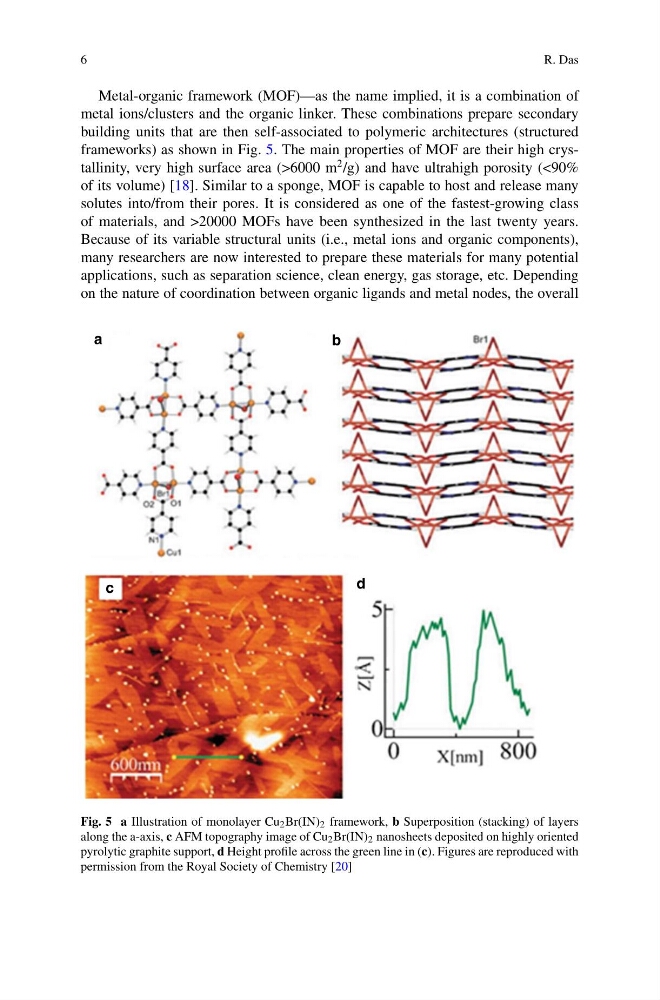
frameworks) as shown in Fig. 5. The main properties of MOF are their high crystallinity, very high surface area (>6000 m
2 /g) and have ultrahigh porosity (<90%
of its volume) [18]. Similar to a sponge, MOF is capable to host and release many
solutes into/from their pores. It is considered as one of the fastest-growing class
of materials, and >20000 MOFs have been synthesized in the last twenty years.
Because of its variable structural units (i.e., metal ions and organic components),
many researchers are now interested to prepare these materials for many potential
applications, such as separation science, clean energy, gas storage, etc. Depending
on the nature of coordination between organic ligands and metal nodes, the overall
a
b
c
d
Fig. 5 a Illustration of monolayer Cu 2 Br(IN) 2 framework, b Superposition (stacking) of layers
along the a-axis, c AFM topography image of Cu 2 Br(IN) 2 nanosheets deposited on highly oriented
pyrolytic graphite support, d Height profile across the green line in (c). Figures are reproduced with
permission from the Royal Society of Chemistry [20]
R. Das
Metal-organic framework (MOF)—as the name implied, it is a combination of
metal ions/clusters and the organic linker. These combinations prepare secondary
building units that are then self-associated to polymeric architectures (structured
frameworks) as shown in Fig. 5. The main properties of MOF are their high crystallinity, very high surface area (>6000 m
2 /g) and have ultrahigh porosity (<90%
of its volume) [18]. Similar to a sponge, MOF is capable to host and release many
solutes into/from their pores. It is considered as one of the fastest-growing class
of materials, and >20000 MOFs have been synthesized in the last twenty years.
Because of its variable structural units (i.e., metal ions and organic components),
many researchers are now interested to prepare these materials for many potential
applications, such as separation science, clean energy, gas storage, etc. Depending
on the nature of coordination between organic ligands and metal nodes, the overall
a
b
c
d
Fig. 5 a Illustration of monolayer Cu 2 Br(IN) 2 framework, b Superposition (stacking) of layers
along the a-axis, c AFM topography image of Cu 2 Br(IN) 2 nanosheets deposited on highly oriented
pyrolytic graphite support, d Height profile across the green line in (c). Figures are reproduced with
permission from the Royal Society of Chemistry [20]