

94
M. H. Köhler et al.
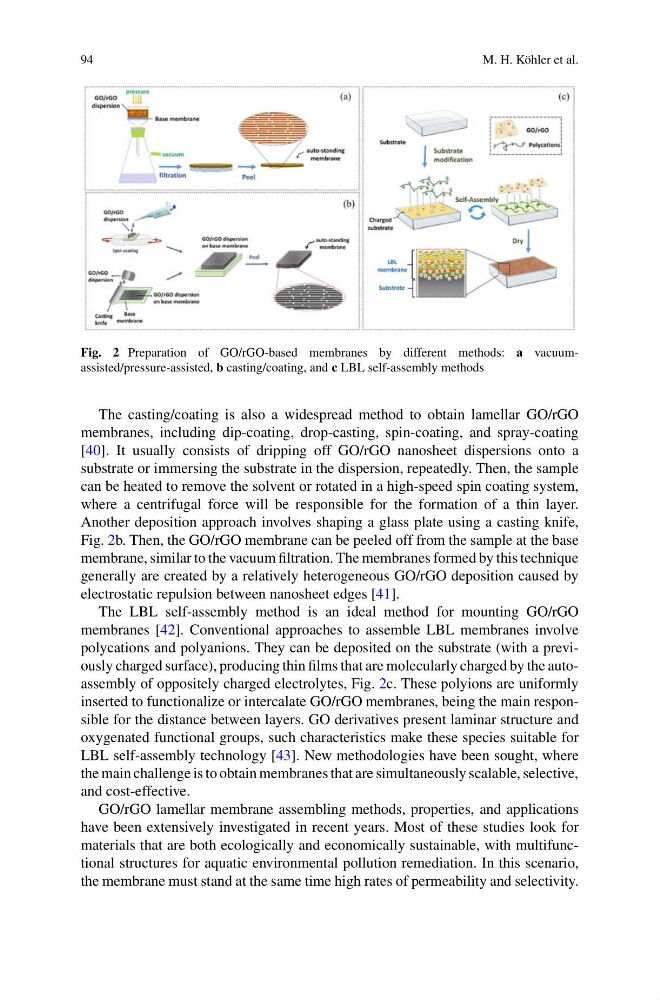
Fig. 2 Preparation of GO/rGO-based membranes by different methods: a vacuumassisted/pressure-assisted, b casting/coating, and c LBL self-assembly methods
The casting/coating is also a widespread method to obtain lamellar GO/rGO
membranes, including dip-coating, drop-casting, spin-coating, and spray-coating
[40]. It usually consists of dripping off GO/rGO nanosheet dispersions onto a
substrate or immersing the substrate in the dispersion, repeatedly. Then, the sample
can be heated to remove the solvent or rotated in a high-speed spin coating system,
where a centrifugal force will be responsible for the formation of a thin layer.
Another deposition approach involves shaping a glass plate using a casting knife,
Fig. 2b. Then, the GO/rGO membrane can be peeled off from the sample at the base
membrane, similar to the vacuum filtration. The membranes formed by this technique
generally are created by a relatively heterogeneous GO/rGO deposition caused by
electrostatic repulsion between nanosheet edges [41].
The LBL self-assembly method is an ideal method for mounting GO/rGO
membranes [42]. Conventional approaches to assemble LBL membranes involve
polycations and polyanions. They can be deposited on the substrate (with a previously charged surface), producing thin films that are molecularly charged by the autoassembly of oppositely charged electrolytes, Fig. 2c. These polyions are uniformly
inserted to functionalize or intercalate GO/rGO membranes, being the main responsible for the distance between layers. GO derivatives present laminar structure and
oxygenated functional groups, such characteristics make these species suitable for
LBL self-assembly technology [43]. New methodologies have been sought, where
the main challenge is to obtain membranes that are simultaneously scalable, selective,
and cost-effective.
GO/rGO lamellar membrane assembling methods, properties, and applications
have been extensively investigated in recent years. Most of these studies look for
materials that are both ecologically and economically sustainable, with multifunctional structures for aquatic environmental pollution remediation. In this scenario,
the membrane must stand at the same time high rates of permeability and selectivity.
M. H. Köhler et al.
Fig. 2 Preparation of GO/rGO-based membranes by different methods: a vacuumassisted/pressure-assisted, b casting/coating, and c LBL self-assembly methods
The casting/coating is also a widespread method to obtain lamellar GO/rGO
membranes, including dip-coating, drop-casting, spin-coating, and spray-coating
[40]. It usually consists of dripping off GO/rGO nanosheet dispersions onto a
substrate or immersing the substrate in the dispersion, repeatedly. Then, the sample
can be heated to remove the solvent or rotated in a high-speed spin coating system,
where a centrifugal force will be responsible for the formation of a thin layer.
Another deposition approach involves shaping a glass plate using a casting knife,
Fig. 2b. Then, the GO/rGO membrane can be peeled off from the sample at the base
membrane, similar to the vacuum filtration. The membranes formed by this technique
generally are created by a relatively heterogeneous GO/rGO deposition caused by
electrostatic repulsion between nanosheet edges [41].
The LBL self-assembly method is an ideal method for mounting GO/rGO
membranes [42]. Conventional approaches to assemble LBL membranes involve
polycations and polyanions. They can be deposited on the substrate (with a previously charged surface), producing thin films that are molecularly charged by the autoassembly of oppositely charged electrolytes, Fig. 2c. These polyions are uniformly
inserted to functionalize or intercalate GO/rGO membranes, being the main responsible for the distance between layers. GO derivatives present laminar structure and
oxygenated functional groups, such characteristics make these species suitable for
LBL self-assembly technology [43]. New methodologies have been sought, where
the main challenge is to obtain membranes that are simultaneously scalable, selective,
and cost-effective.
GO/rGO lamellar membrane assembling methods, properties, and applications
have been extensively investigated in recent years. Most of these studies look for
materials that are both ecologically and economically sustainable, with multifunctional structures for aquatic environmental pollution remediation. In this scenario,
the membrane must stand at the same time high rates of permeability and selectivity.