

90
M. Yamanaka
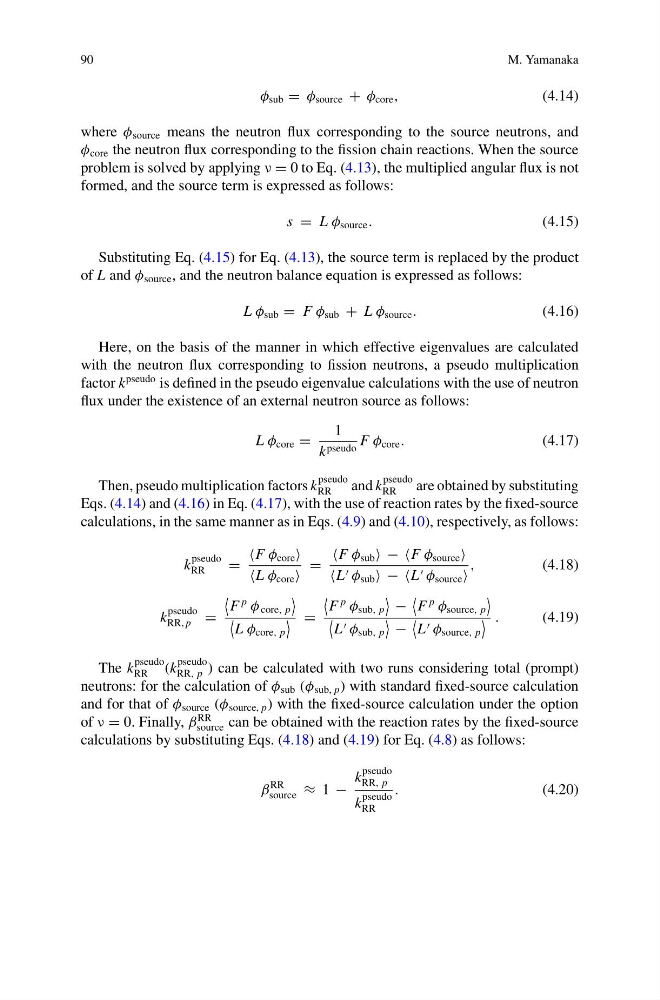
φ sub = φ source + φ core ,
(4.14)
where φ source means the neutron flux corresponding to the source neutrons, and
φ core the neutron flux corresponding to the fission chain reactions. When the source
problem is solved by applying ν = 0 to Eq. (4.13), the multiplied angular flux is not
formed, and the source term is expressed as follows:
s = L φ source .
(4.15)
Substituting Eq. (4.15) for Eq. (4.13), the source term is replaced by the product
of L and φ source , and the neutron balance equation is expressed as follows:
L φ sub = F φ sub + L φ source .
(4.16)
Here, on the basis of the manner in which effective eigenvalues are calculated
with the neutron flux corresponding to fission neutrons, a pseudo multiplication
factor k
pseudo is defined in the pseudo eigenvalue calculations with the use of neutron
flux under the existence of an external neutron source as follows:
L φ core =
1
k pseudo F φ core .
(4.17)
Then, pseudo multiplication factors k
pseudo
RR
and k
pseudo
RR
are obtained by substituting
Eqs. (4.14) and (4.16) in Eq. (4.17), with the use of reaction rates by the fixed-source
calculations, in the same manner as in Eqs. (4.9) and (4.10), respectively, as follows:
k
pseudo
RR
=
F φ core
L φ core
=
F φ sub − F φ source
L φ sub − L φ source
,
(4.18)
k
pseudo
RR, p =
F
p
φ core, p
L φ core, p
=
F
p
φ sub, p
−
F
p
φ source, p
L φ sub, p
−
L φ source, p
.
(4.19)
The k
pseudo
RR
(k
pseudo
RR, p ) can be calculated with two runs considering total (prompt)
neutrons: for the calculation of φ sub (φ sub, p ) with standard fixed-source calculation
and for that of φ source (φ source, p ) with the fixed-source calculation under the option
of ν = 0. Finally, β
RR
source can be obtained with the reaction rates by the fixed-source
calculations by substituting Eqs. (4.18) and (4.19) for Eq. (4.8) as follows:
β
RR
source ≈ 1 −
k
pseudo
RR, p
k
pseudo
RR
.
(4.20)
M. Yamanaka
φ sub = φ source + φ core ,
(4.14)
where φ source means the neutron flux corresponding to the source neutrons, and
φ core the neutron flux corresponding to the fission chain reactions. When the source
problem is solved by applying ν = 0 to Eq. (4.13), the multiplied angular flux is not
formed, and the source term is expressed as follows:
s = L φ source .
(4.15)
Substituting Eq. (4.15) for Eq. (4.13), the source term is replaced by the product
of L and φ source , and the neutron balance equation is expressed as follows:
L φ sub = F φ sub + L φ source .
(4.16)
Here, on the basis of the manner in which effective eigenvalues are calculated
with the neutron flux corresponding to fission neutrons, a pseudo multiplication
factor k
pseudo is defined in the pseudo eigenvalue calculations with the use of neutron
flux under the existence of an external neutron source as follows:
L φ core =
1
k pseudo F φ core .
(4.17)
Then, pseudo multiplication factors k
pseudo
RR
and k
pseudo
RR
are obtained by substituting
Eqs. (4.14) and (4.16) in Eq. (4.17), with the use of reaction rates by the fixed-source
calculations, in the same manner as in Eqs. (4.9) and (4.10), respectively, as follows:
k
pseudo
RR
=
F φ core
L φ core
=
F φ sub − F φ source
L φ sub − L φ source
,
(4.18)
k
pseudo
RR, p =
F
p
φ core, p
L φ core, p
=
F
p
φ sub, p
−
F
p
φ source, p
L φ sub, p
−
L φ source, p
.
(4.19)
The k
pseudo
RR
(k
pseudo
RR, p ) can be calculated with two runs considering total (prompt)
neutrons: for the calculation of φ sub (φ sub, p ) with standard fixed-source calculation
and for that of φ source (φ source, p ) with the fixed-source calculation under the option
of ν = 0. Finally, β
RR
source can be obtained with the reaction rates by the fixed-source
calculations by substituting Eqs. (4.18) and (4.19) for Eq. (4.8) as follows:
β
RR
source ≈ 1 −
k
pseudo
RR, p
k
pseudo
RR
.
(4.20)