

46
K. Hashimoto
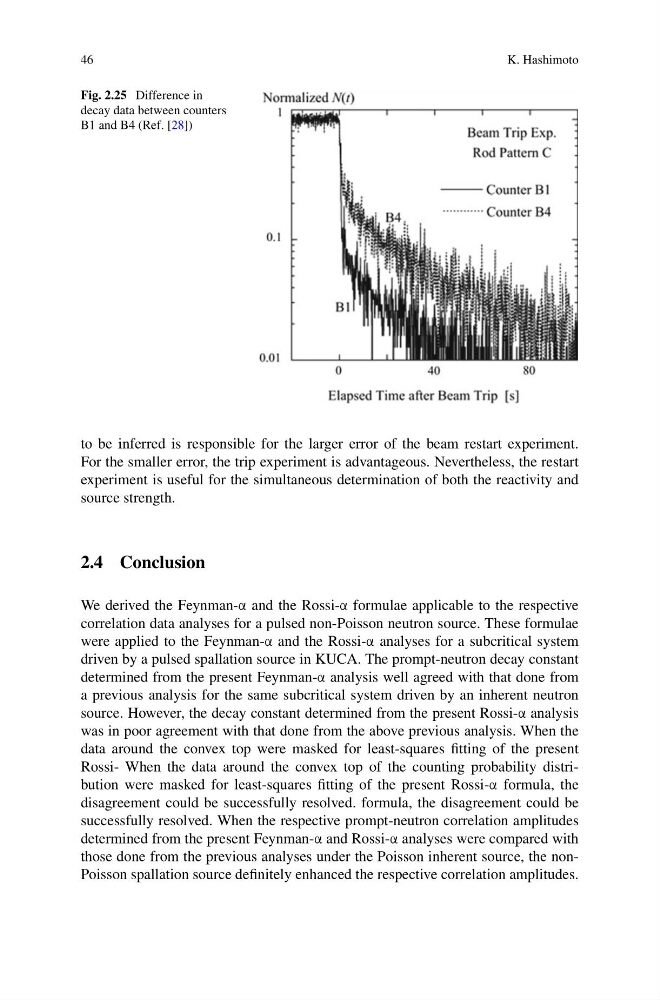
Fig. 2.25 Difference in
decay data between counters
B1 and B4 (Ref. [28])
to be inferred is responsible for the larger error of the beam restart experiment.
For the smaller error, the trip experiment is advantageous. Nevertheless, the restart
experiment is useful for the simultaneous determination of both the reactivity and
source strength.
2.4 Conclusion
We derived the Feynman-α and the Rossi-α formulae applicable to the respective
correlation data analyses for a pulsed non-Poisson neutron source. These formulae
were applied to the Feynman-α and the Rossi-α analyses for a subcritical system
driven by a pulsed spallation source in KUCA. The prompt-neutron decay constant
determined from the present Feynman-α analysis well agreed with that done from
a previous analysis for the same subcritical system driven by an inherent neutron
source. However, the decay constant determined from the present Rossi-α analysis
was in poor agreement with that done from the above previous analysis. When the
data around the convex top were masked for least-squares fitting of the present
Rossi- When the data around the convex top of the counting probability distribution were masked for least-squares fitting of the present Rossi-α formula, the
disagreement could be successfully resolved. formula, the disagreement could be
successfully resolved. When the respective prompt-neutron correlation amplitudes
determined from the present Feynman-α and Rossi-α analyses were compared with
those done from the previous analyses under the Poisson inherent source, the nonPoisson spallation source definitely enhanced the respective correlation amplitudes.
K. Hashimoto
Fig. 2.25 Difference in
decay data between counters
B1 and B4 (Ref. [28])
to be inferred is responsible for the larger error of the beam restart experiment.
For the smaller error, the trip experiment is advantageous. Nevertheless, the restart
experiment is useful for the simultaneous determination of both the reactivity and
source strength.
2.4 Conclusion
We derived the Feynman-α and the Rossi-α formulae applicable to the respective
correlation data analyses for a pulsed non-Poisson neutron source. These formulae
were applied to the Feynman-α and the Rossi-α analyses for a subcritical system
driven by a pulsed spallation source in KUCA. The prompt-neutron decay constant
determined from the present Feynman-α analysis well agreed with that done from
a previous analysis for the same subcritical system driven by an inherent neutron
source. However, the decay constant determined from the present Rossi-α analysis
was in poor agreement with that done from the above previous analysis. When the
data around the convex top were masked for least-squares fitting of the present
Rossi- When the data around the convex top of the counting probability distribution were masked for least-squares fitting of the present Rossi-α formula, the
disagreement could be successfully resolved. formula, the disagreement could be
successfully resolved. When the respective prompt-neutron correlation amplitudes
determined from the present Feynman-α and Rossi-α analyses were compared with
those done from the previous analyses under the Poisson inherent source, the nonPoisson spallation source definitely enhanced the respective correlation amplitudes.