

2 Subcriticality
31
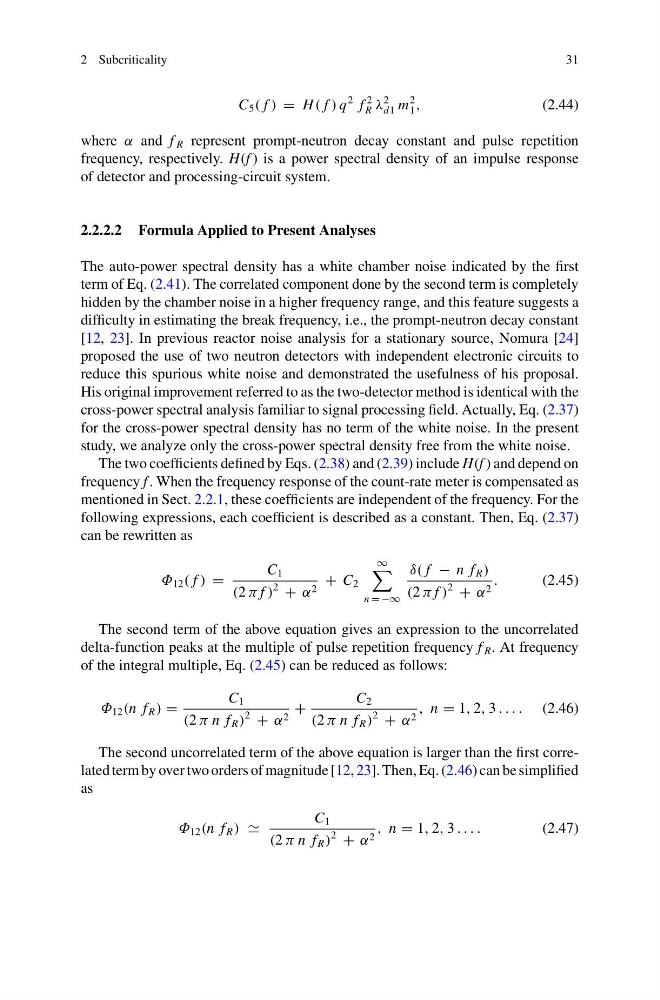
C 5 ( f ) = H ( f ) q
2 f
2
R λ
2
d1 m
2
1 ,
(2.44)
where α and f R represent prompt-neutron decay constant and pulse repetition
frequency, respectively. H(f ) is a power spectral density of an impulse response
of detector and processing-circuit system.
2.2.2.2 Formula Applied to Present Analyses
The auto-power spectral density has a white chamber noise indicated by the first
term of Eq. (2.41). The correlated component done by the second term is completely
hidden by the chamber noise in a higher frequency range, and this feature suggests a
difficulty in estimating the break frequency, i.e., the prompt-neutron decay constant
[12, 23]. In previous reactor noise analysis for a stationary source, Nomura [24]
proposed the use of two neutron detectors with independent electronic circuits to
reduce this spurious white noise and demonstrated the usefulness of his proposal.
His original improvement referred to as the two-detector method is identical with the
cross-power spectral analysis familiar to signal processing field. Actually, Eq. (2.37)
for the cross-power spectral density has no term of the white noise. In the present
study, we analyze only the cross-power spectral density free from the white noise.
The two coefficients defined by Eqs. (2.38) and (2.39) include H(f ) and depend on
frequency f . When the frequency response of the count-rate meter is compensated as
mentioned in Sect. 2.2.1, these coefficients are independent of the frequency. For the
following expressions, each coefficient is described as a constant. Then, Eq. (2.37)
can be rewritten as
Φ 12 ( f ) =
C 1
(2 π f )
2
+ α 2 + C 2
∞
n = −∞
δ( f − n f R )
(2 π f )
2
+ α 2 .
(2.45)
The second term of the above equation gives an expression to the uncorrelated
delta-function peaks at the multiple of pulse repetition frequency f R . At frequency
of the integral multiple, Eq. (2.45) can be reduced as follows:
Φ 12 (n f R ) =
C 1
(2 π n f R )
2
+ α 2 +
C 2
(2 π n f R )
2
+ α 2 , n = 1, 2, 3 . . . . (2.46)
The second uncorrelated term of the above equation is larger than the first correlated term by over two orders of magnitude [12, 23]. Then, Eq. (2.46) can be simplified
as
Φ 12 (n f R )
C 1
(2 π n f R )
2
+ α 2 , n = 1, 2, 3 . . . .
(2.47)
31
C 5 ( f ) = H ( f ) q
2 f
2
R λ
2
d1 m
2
1 ,
(2.44)
where α and f R represent prompt-neutron decay constant and pulse repetition
frequency, respectively. H(f ) is a power spectral density of an impulse response
of detector and processing-circuit system.
2.2.2.2 Formula Applied to Present Analyses
The auto-power spectral density has a white chamber noise indicated by the first
term of Eq. (2.41). The correlated component done by the second term is completely
hidden by the chamber noise in a higher frequency range, and this feature suggests a
difficulty in estimating the break frequency, i.e., the prompt-neutron decay constant
[12, 23]. In previous reactor noise analysis for a stationary source, Nomura [24]
proposed the use of two neutron detectors with independent electronic circuits to
reduce this spurious white noise and demonstrated the usefulness of his proposal.
His original improvement referred to as the two-detector method is identical with the
cross-power spectral analysis familiar to signal processing field. Actually, Eq. (2.37)
for the cross-power spectral density has no term of the white noise. In the present
study, we analyze only the cross-power spectral density free from the white noise.
The two coefficients defined by Eqs. (2.38) and (2.39) include H(f ) and depend on
frequency f . When the frequency response of the count-rate meter is compensated as
mentioned in Sect. 2.2.1, these coefficients are independent of the frequency. For the
following expressions, each coefficient is described as a constant. Then, Eq. (2.37)
can be rewritten as
Φ 12 ( f ) =
C 1
(2 π f )
2
+ α 2 + C 2
∞
n = −∞
δ( f − n f R )
(2 π f )
2
+ α 2 .
(2.45)
The second term of the above equation gives an expression to the uncorrelated
delta-function peaks at the multiple of pulse repetition frequency f R . At frequency
of the integral multiple, Eq. (2.45) can be reduced as follows:
Φ 12 (n f R ) =
C 1
(2 π n f R )
2
+ α 2 +
C 2
(2 π n f R )
2
+ α 2 , n = 1, 2, 3 . . . . (2.46)
The second uncorrelated term of the above equation is larger than the first correlated term by over two orders of magnitude [12, 23]. Then, Eq. (2.46) can be simplified
as
Φ 12 (n f R )
C 1
(2 π n f R )
2
+ α 2 , n = 1, 2, 3 . . . .
(2.47)