

16
K. Hashimoto
of active region of the fuel assembly. The present nuclear instrumentation system
consisted of conventional detector bias-supply, pre-amplifier, spectroscopy amplifier,
and discriminator modules. Finally, signal pulses from these BF 3 neutron counters
were fed to a time-sequence data acquisition system, which registered the arriving
time of the signal as digital data. The time length of the acquired data for each
subcritical pattern was about 30 min.
The pulsed proton beams were supplied by a fixed-field alternating gradient
(FFAG) accelerator. The proton beam intensity of the accelerator was set to 30 pA for
any subcritical patterns except for pattern A. For only pattern A, we necessarily made
the proton beam intensity fall to 12 pA, to reduce counting loss originated from the
dead-time effect of neutron counter. Throughout the present accelerator operations,
the pulsed repetition frequency and the beam width were set to 30 Hz and 100 ns,
respectively.
2.1.2 Formulae for Data Analyses
2.1.2.1 Feynman-α Formula
Rana and Degweker [6] derived the Feynman-α and the Rossi-α formulae for a
periodically pulsed non-Poisson source, where delayed neutron contribution was
considered and each pulse was assumed to be a delta function. Since the pulse width of
100 ns of our accelerator is much shorter than the time scale of the present correlation
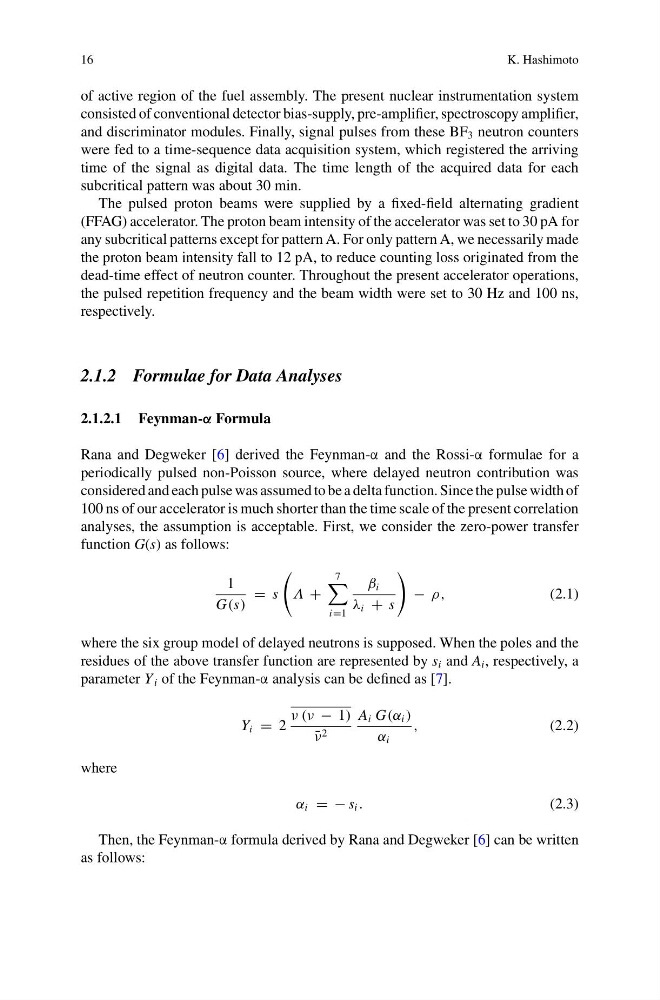
analyses, the assumption is acceptable. First, we consider the zero-power transfer
function G(s) as follows:
1
G(s)
= s
Λ +
7
i=1
β i
λ i + s
− ρ,
(2.1)
where the six group model of delayed neutrons is supposed. When the poles and the
residues of the above transfer function are represented by s i and A i , respectively, a
parameter Y i of the Feynman-α analysis can be defined as [7].
Y i = 2
ν (ν − 1)
¯
ν 2
A i G(α i )
α i
,
(2.2)
where
α i = − s i .
(2.3)
Then, the Feynman-α formula derived by Rana and Degweker [6] can be written
as follows:
K. Hashimoto
of active region of the fuel assembly. The present nuclear instrumentation system
consisted of conventional detector bias-supply, pre-amplifier, spectroscopy amplifier,
and discriminator modules. Finally, signal pulses from these BF 3 neutron counters
were fed to a time-sequence data acquisition system, which registered the arriving
time of the signal as digital data. The time length of the acquired data for each
subcritical pattern was about 30 min.
The pulsed proton beams were supplied by a fixed-field alternating gradient
(FFAG) accelerator. The proton beam intensity of the accelerator was set to 30 pA for
any subcritical patterns except for pattern A. For only pattern A, we necessarily made
the proton beam intensity fall to 12 pA, to reduce counting loss originated from the
dead-time effect of neutron counter. Throughout the present accelerator operations,
the pulsed repetition frequency and the beam width were set to 30 Hz and 100 ns,
respectively.
2.1.2 Formulae for Data Analyses
2.1.2.1 Feynman-α Formula
Rana and Degweker [6] derived the Feynman-α and the Rossi-α formulae for a
periodically pulsed non-Poisson source, where delayed neutron contribution was
considered and each pulse was assumed to be a delta function. Since the pulse width of
100 ns of our accelerator is much shorter than the time scale of the present correlation
analyses, the assumption is acceptable. First, we consider the zero-power transfer
function G(s) as follows:
1
G(s)
= s
Λ +
7
i=1
β i
λ i + s
− ρ,
(2.1)
where the six group model of delayed neutrons is supposed. When the poles and the
residues of the above transfer function are represented by s i and A i , respectively, a
parameter Y i of the Feynman-α analysis can be defined as [7].
Y i = 2
ν (ν − 1)
¯
ν 2
A i G(α i )
α i
,
(2.2)
where
α i = − s i .
(2.3)
Then, the Feynman-α formula derived by Rana and Degweker [6] can be written
as follows: