

230
M. Yamanaka
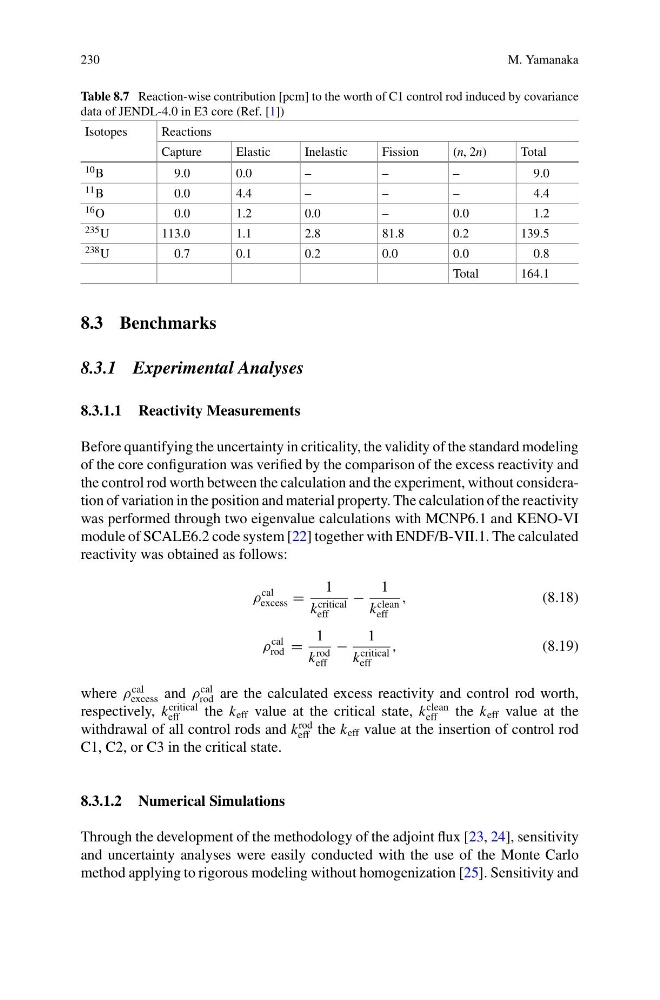
Table 8.7 Reaction-wise contribution [pcm] to the worth of C1 control rod induced by covariance
data of JENDL-4.0 in E3 core (Ref. [1])
Isotopes
Reactions
Capture
Elastic
Inelastic
Fission
(n, 2n)
Total
10 B
9.0
0.0
–
–
–
9.0
11 B
0.0
4.4
–
–
–
4.4
16 O
0.0
1.2
0.0
–
0.0
1.2
235 U
113.0
1.1
2.8
81.8
0.2
139.5
238 U
0.7
0.1
0.2
0.0
0.0
0.8
Total
164.1
8.3 Benchmarks
8.3.1 Experimental Analyses
8.3.1.1 Reactivity Measurements
Before quantifying the uncertainty in criticality, the validity of the standard modeling
of the core configuration was verified by the comparison of the excess reactivity and
the control rod worth between the calculation and the experiment, without consideration of variation in the position and material property. The calculation of the reactivity
was performed through two eigenvalue calculations with MCNP6.1 and KENO-VI
module of SCALE6.2 code system [22] together with ENDF/B-VII.1. The calculated
reactivity was obtained as follows:
ρ
cal
excess =
1
k
critical
eff
−
1
k
clean
eff
,
(8.18)
ρ
cal
rod =
1
k
rod
eff
−
1
k
critical
eff
,
(8.19)
where ρ
cal
excess and ρ
cal
rod are the calculated excess reactivity and control rod worth,
respectively, k
critical
eff
the k eff value at the critical state, k
clean
eff
the k eff value at the
withdrawal of all control rods and k
rod
eff the k eff value at the insertion of control rod
C1, C2, or C3 in the critical state.
8.3.1.2 Numerical Simulations
Through the development of the methodology of the adjoint flux [23, 24], sensitivity
and uncertainty analyses were easily conducted with the use of the Monte Carlo
method applying to rigorous modeling without homogenization [25]. Sensitivity and
M. Yamanaka
Table 8.7 Reaction-wise contribution [pcm] to the worth of C1 control rod induced by covariance
data of JENDL-4.0 in E3 core (Ref. [1])
Isotopes
Reactions
Capture
Elastic
Inelastic
Fission
(n, 2n)
Total
10 B
9.0
0.0
–
–
–
9.0
11 B
0.0
4.4
–
–
–
4.4
16 O
0.0
1.2
0.0
–
0.0
1.2
235 U
113.0
1.1
2.8
81.8
0.2
139.5
238 U
0.7
0.1
0.2
0.0
0.0
0.8
Total
164.1
8.3 Benchmarks
8.3.1 Experimental Analyses
8.3.1.1 Reactivity Measurements
Before quantifying the uncertainty in criticality, the validity of the standard modeling
of the core configuration was verified by the comparison of the excess reactivity and
the control rod worth between the calculation and the experiment, without consideration of variation in the position and material property. The calculation of the reactivity
was performed through two eigenvalue calculations with MCNP6.1 and KENO-VI
module of SCALE6.2 code system [22] together with ENDF/B-VII.1. The calculated
reactivity was obtained as follows:
ρ
cal
excess =
1
k
critical
eff
−
1
k
clean
eff
,
(8.18)
ρ
cal
rod =
1
k
rod
eff
−
1
k
critical
eff
,
(8.19)
where ρ
cal
excess and ρ
cal
rod are the calculated excess reactivity and control rod worth,
respectively, k
critical
eff
the k eff value at the critical state, k
clean
eff
the k eff value at the
withdrawal of all control rods and k
rod
eff the k eff value at the insertion of control rod
C1, C2, or C3 in the critical state.
8.3.1.2 Numerical Simulations
Through the development of the methodology of the adjoint flux [23, 24], sensitivity
and uncertainty analyses were easily conducted with the use of the Monte Carlo
method applying to rigorous modeling without homogenization [25]. Sensitivity and