

8 Sensitivity and Uncertainty of Criticality
221
ρ
MCNP
Excess =
1
k
MCNP
Critical
−
1
k
MCNP
Clean
,
(8.3)
−ρ
MCNP
Rod
=
1
k
MCNP
Critical
−
1
k
MCNP
Rod
.
(8.4)
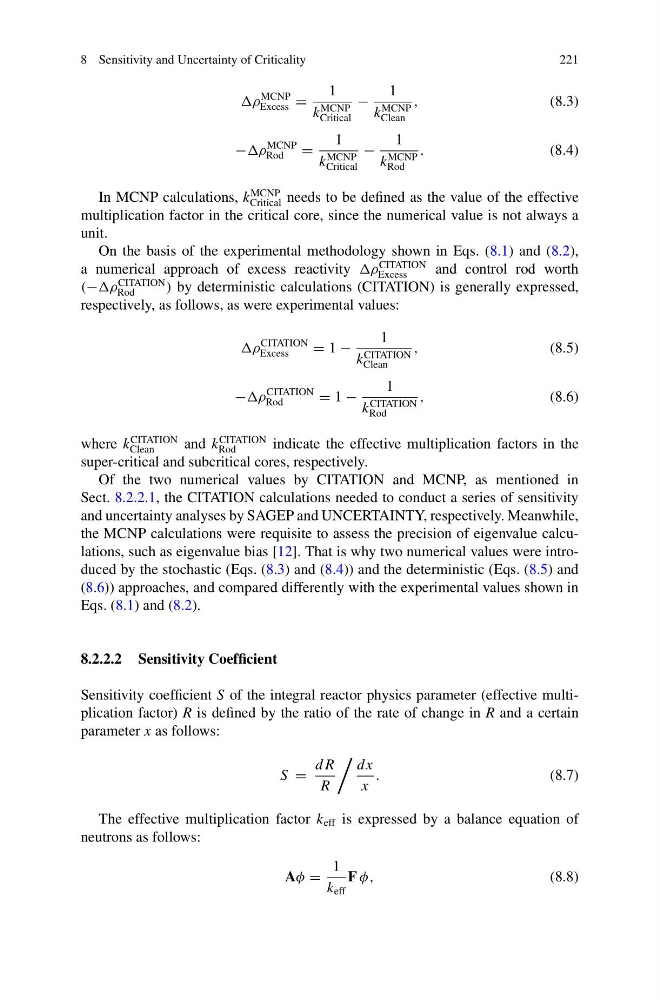
In MCNP calculations, k
MCNP
Critical needs to be defined as the value of the effective
multiplication factor in the critical core, since the numerical value is not always a
unit.
On the basis of the experimental methodology shown in Eqs. (8.1) and (8.2),
a numerical approach of excess reactivity ρ
CITATION
Excess
and control rod worth
(−ρ
CITATION
Rod
) by deterministic calculations (CITATION) is generally expressed,
respectively, as follows, as were experimental values:
ρ
CITATION
Excess
= 1 −
1
k
CITATION
Clean
,
(8.5)
−ρ
CITATION
Rod
= 1 −
1
k
CITATION
Rod
,
(8.6)
where k
CITATION
Clean
and k
CITATION
Rod
indicate the effective multiplication factors in the
super-critical and subcritical cores, respectively.
Of the two numerical values by CITATION and MCNP, as mentioned in
Sect. 8.2.2.1, the CITATION calculations needed to conduct a series of sensitivity
and uncertainty analyses by SAGEP and UNCERTAINTY, respectively. Meanwhile,
the MCNP calculations were requisite to assess the precision of eigenvalue calculations, such as eigenvalue bias [12]. That is why two numerical values were introduced by the stochastic (Eqs. (8.3) and (8.4)) and the deterministic (Eqs. (8.5) and
(8.6)) approaches, and compared differently with the experimental values shown in
Eqs. (8.1) and (8.2).
8.2.2.2 Sensitivity Coefficient
Sensitivity coefficient S of the integral reactor physics parameter (effective multiplication factor) R is defined by the ratio of the rate of change in R and a certain
parameter x as follows:
S =
d R
R
dx
x
.
(8.7)
The effective multiplication factor k eff is expressed by a balance equation of
neutrons as follows:
Aφ =
1
k eff
F φ,
(8.8)
221
ρ
MCNP
Excess =
1
k
MCNP
Critical
−
1
k
MCNP
Clean
,
(8.3)
−ρ
MCNP
Rod
=
1
k
MCNP
Critical
−
1
k
MCNP
Rod
.
(8.4)
In MCNP calculations, k
MCNP
Critical needs to be defined as the value of the effective
multiplication factor in the critical core, since the numerical value is not always a
unit.
On the basis of the experimental methodology shown in Eqs. (8.1) and (8.2),
a numerical approach of excess reactivity ρ
CITATION
Excess
and control rod worth
(−ρ
CITATION
Rod
) by deterministic calculations (CITATION) is generally expressed,
respectively, as follows, as were experimental values:
ρ
CITATION
Excess
= 1 −
1
k
CITATION
Clean
,
(8.5)
−ρ
CITATION
Rod
= 1 −
1
k
CITATION
Rod
,
(8.6)
where k
CITATION
Clean
and k
CITATION
Rod
indicate the effective multiplication factors in the
super-critical and subcritical cores, respectively.
Of the two numerical values by CITATION and MCNP, as mentioned in
Sect. 8.2.2.1, the CITATION calculations needed to conduct a series of sensitivity
and uncertainty analyses by SAGEP and UNCERTAINTY, respectively. Meanwhile,
the MCNP calculations were requisite to assess the precision of eigenvalue calculations, such as eigenvalue bias [12]. That is why two numerical values were introduced by the stochastic (Eqs. (8.3) and (8.4)) and the deterministic (Eqs. (8.5) and
(8.6)) approaches, and compared differently with the experimental values shown in
Eqs. (8.1) and (8.2).
8.2.2.2 Sensitivity Coefficient
Sensitivity coefficient S of the integral reactor physics parameter (effective multiplication factor) R is defined by the ratio of the rate of change in R and a certain
parameter x as follows:
S =
d R
R
dx
x
.
(8.7)
The effective multiplication factor k eff is expressed by a balance equation of
neutrons as follows:
Aφ =
1
k eff
F φ,
(8.8)