

198
C. H. Pyeon
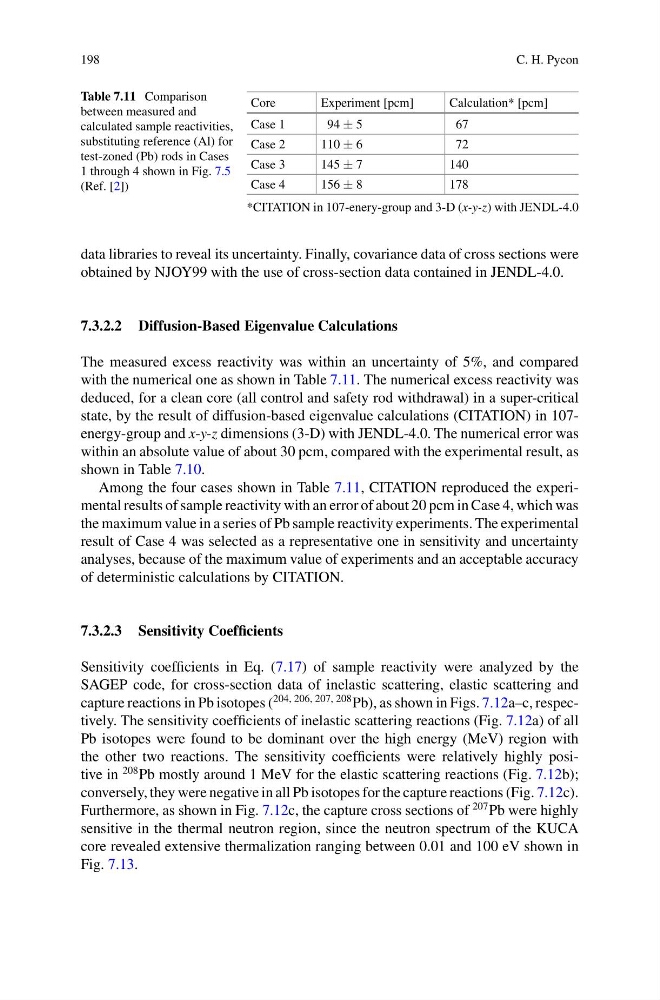
Table 7.11 Comparison
between measured and
calculated sample reactivities,
substituting reference (Al) for
test-zoned (Pb) rods in Cases
1 through 4 shown in Fig. 7.5
(Ref. [2])
Core
Experiment [pcm]
Calculation* [pcm]
Case 1
94 ± 5
67
Case 2
110 ± 6
72
Case 3
145 ± 7
140
Case 4
156 ± 8
178
*CITATION in 107-enery-group and 3-D (x-y-z) with JENDL-4.0
data libraries to reveal its uncertainty. Finally, covariance data of cross sections were
obtained by NJOY99 with the use of cross-section data contained in JENDL-4.0.
7.3.2.2 Diffusion-Based Eigenvalue Calculations
The measured excess reactivity was within an uncertainty of 5%, and compared
with the numerical one as shown in Table 7.11. The numerical excess reactivity was
deduced, for a clean core (all control and safety rod withdrawal) in a super-critical
state, by the result of diffusion-based eigenvalue calculations (CITATION) in 107energy-group and x-y-z dimensions (3-D) with JENDL-4.0. The numerical error was
within an absolute value of about 30 pcm, compared with the experimental result, as
shown in Table 7.10.
Among the four cases shown in Table 7.11, CITATION reproduced the experimental results of sample reactivity with an error of about 20 pcm in Case 4, which was
the maximum value in a series of Pb sample reactivity experiments. The experimental
result of Case 4 was selected as a representative one in sensitivity and uncertainty
analyses, because of the maximum value of experiments and an acceptable accuracy
of deterministic calculations by CITATION.
7.3.2.3 Sensitivity Coefficients
Sensitivity coefficients in Eq. (7.17) of sample reactivity were analyzed by the
SAGEP code, for cross-section data of inelastic scattering, elastic scattering and
capture reactions in Pb isotopes (
204, 206, 207, 208 Pb), as shown in Figs. 7.12a–c, respectively. The sensitivity coefficients of inelastic scattering reactions (Fig. 7.12a) of all
Pb isotopes were found to be dominant over the high energy (MeV) region with
the other two reactions. The sensitivity coefficients were relatively highly positive in
208 Pb mostly around 1 MeV for the elastic scattering reactions (Fig. 7.12b);
conversely, they were negative in all Pb isotopes for the capture reactions (Fig. 7.12c).
Furthermore, as shown in Fig. 7.12c, the capture cross sections of
207 Pb were highly
sensitive in the thermal neutron region, since the neutron spectrum of the KUCA
core revealed extensive thermalization ranging between 0.01 and 100 eV shown in
Fig. 7.13.
C. H. Pyeon
Table 7.11 Comparison
between measured and
calculated sample reactivities,
substituting reference (Al) for
test-zoned (Pb) rods in Cases
1 through 4 shown in Fig. 7.5
(Ref. [2])
Core
Experiment [pcm]
Calculation* [pcm]
Case 1
94 ± 5
67
Case 2
110 ± 6
72
Case 3
145 ± 7
140
Case 4
156 ± 8
178
*CITATION in 107-enery-group and 3-D (x-y-z) with JENDL-4.0
data libraries to reveal its uncertainty. Finally, covariance data of cross sections were
obtained by NJOY99 with the use of cross-section data contained in JENDL-4.0.
7.3.2.2 Diffusion-Based Eigenvalue Calculations
The measured excess reactivity was within an uncertainty of 5%, and compared
with the numerical one as shown in Table 7.11. The numerical excess reactivity was
deduced, for a clean core (all control and safety rod withdrawal) in a super-critical
state, by the result of diffusion-based eigenvalue calculations (CITATION) in 107energy-group and x-y-z dimensions (3-D) with JENDL-4.0. The numerical error was
within an absolute value of about 30 pcm, compared with the experimental result, as
shown in Table 7.10.
Among the four cases shown in Table 7.11, CITATION reproduced the experimental results of sample reactivity with an error of about 20 pcm in Case 4, which was
the maximum value in a series of Pb sample reactivity experiments. The experimental
result of Case 4 was selected as a representative one in sensitivity and uncertainty
analyses, because of the maximum value of experiments and an acceptable accuracy
of deterministic calculations by CITATION.
7.3.2.3 Sensitivity Coefficients
Sensitivity coefficients in Eq. (7.17) of sample reactivity were analyzed by the
SAGEP code, for cross-section data of inelastic scattering, elastic scattering and
capture reactions in Pb isotopes (
204, 206, 207, 208 Pb), as shown in Figs. 7.12a–c, respectively. The sensitivity coefficients of inelastic scattering reactions (Fig. 7.12a) of all
Pb isotopes were found to be dominant over the high energy (MeV) region with
the other two reactions. The sensitivity coefficients were relatively highly positive in
208 Pb mostly around 1 MeV for the elastic scattering reactions (Fig. 7.12b);
conversely, they were negative in all Pb isotopes for the capture reactions (Fig. 7.12c).
Furthermore, as shown in Fig. 7.12c, the capture cross sections of
207 Pb were highly
sensitive in the thermal neutron region, since the neutron spectrum of the KUCA
core revealed extensive thermalization ranging between 0.01 and 100 eV shown in
Fig. 7.13.