

5 Neutron Spectrum
129
eigenvalue calculations was attained within the relative difference of 5% between
the experimental and the numerical results.
The measured reaction rates of
115 In(n, γ)
116m In (wire: 1 mm diameter and 800 mm
long) in the core were normalized by those of
115 In(n, n
)
115m In (foil: 10 × 10 × 1 mm)
at the location of the target. The experimental errors in the activation wire and foil
were estimated within 15% and 5%, respectively, including the statistical error of
γ-ray counts and the full width at half maximum (FWHM) of the γ-ray spectrum
peak. The calculated reaction rates of the
115 In wire and foil in the core were included
in the simulated geometry and transport calculations, and deduced from tallies taken
in the fixed source calculations. Also, the calculated reaction rates of the In foil at
the target were obtained by the previously fixed source calculations, modeling the
proton injection on the solid target.
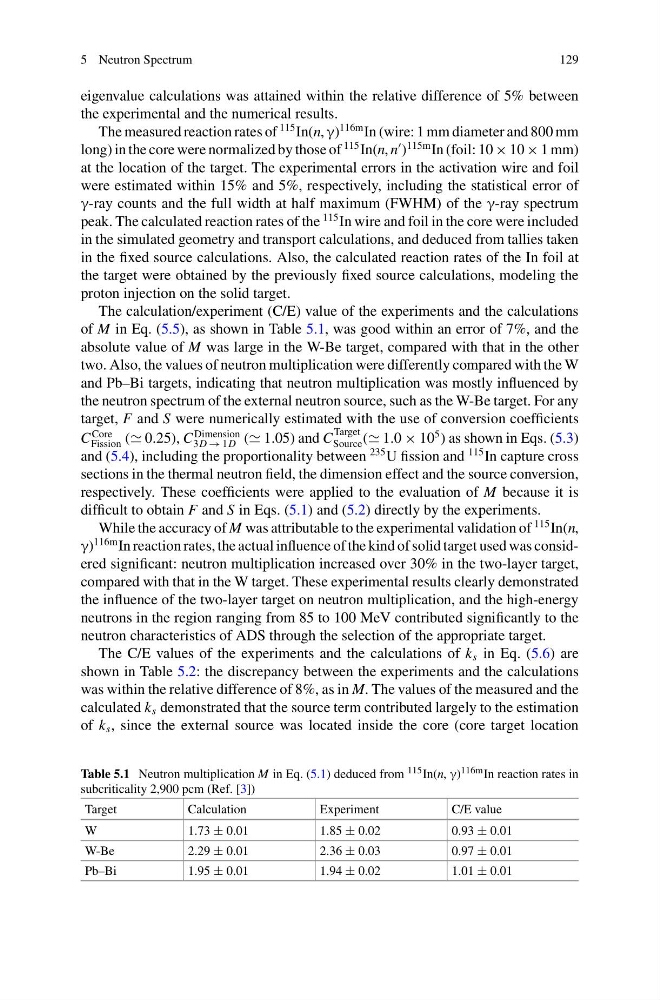
The calculation/experiment (C/E) value of the experiments and the calculations
of M in Eq. (5.5), as shown in Table 5.1, was good within an error of 7%, and the
absolute value of M was large in the W-Be target, compared with that in the other
two. Also, the values of neutron multiplication were differently compared with the W
and Pb–Bi targets, indicating that neutron multiplication was mostly influenced by
the neutron spectrum of the external neutron source, such as the W-Be target. For any
target, F and S were numerically estimated with the use of conversion coefficients
C
Core
Fission ( 0.25), C
Dimension
3D → 1D ( 1.05) and C
Target
Source ( 1.0 × 10
5 ) as shown in Eqs. (5.3)
and (5.4), including the proportionality between
235 U fission and
115 In capture cross
sections in the thermal neutron field, the dimension effect and the source conversion,
respectively. These coefficients were applied to the evaluation of M because it is
difficult to obtain F and S in Eqs. (5.1) and (5.2) directly by the experiments.
While the accuracy of M was attributable to the experimental validation of
115 In(n,
γ)
116m In reaction rates, the actual influence of the kind of solid target used was considered significant: neutron multiplication increased over 30% in the two-layer target,
compared with that in the W target. These experimental results clearly demonstrated
the influence of the two-layer target on neutron multiplication, and the high-energy
neutrons in the region ranging from 85 to 100 MeV contributed significantly to the
neutron characteristics of ADS through the selection of the appropriate target.
The C/E values of the experiments and the calculations of k s in Eq. (5.6) are
shown in Table 5.2: the discrepancy between the experiments and the calculations
was within the relative difference of 8%, as in M. The values of the measured and the
calculated k s demonstrated that the source term contributed largely to the estimation
of k s , since the external source was located inside the core (core target location
Table 5.1 Neutron multiplication M in Eq. (5.1) deduced from 115 In(n, γ) 116m In reaction rates in
subcriticality 2,900 pcm (Ref. [3])
Target
Calculation
Experiment
C/E value
W
1.73 ± 0.01
1.85 ± 0.02
0.93 ± 0.01
W-Be
2.29 ± 0.01
2.36 ± 0.03
0.97 ± 0.01
Pb–Bi
1.95 ± 0.01
1.94 ± 0.02
1.01 ± 0.01
129
eigenvalue calculations was attained within the relative difference of 5% between
the experimental and the numerical results.
The measured reaction rates of
115 In(n, γ)
116m In (wire: 1 mm diameter and 800 mm
long) in the core were normalized by those of
115 In(n, n
)
115m In (foil: 10 × 10 × 1 mm)
at the location of the target. The experimental errors in the activation wire and foil
were estimated within 15% and 5%, respectively, including the statistical error of
γ-ray counts and the full width at half maximum (FWHM) of the γ-ray spectrum
peak. The calculated reaction rates of the
115 In wire and foil in the core were included
in the simulated geometry and transport calculations, and deduced from tallies taken
in the fixed source calculations. Also, the calculated reaction rates of the In foil at
the target were obtained by the previously fixed source calculations, modeling the
proton injection on the solid target.
The calculation/experiment (C/E) value of the experiments and the calculations
of M in Eq. (5.5), as shown in Table 5.1, was good within an error of 7%, and the
absolute value of M was large in the W-Be target, compared with that in the other
two. Also, the values of neutron multiplication were differently compared with the W
and Pb–Bi targets, indicating that neutron multiplication was mostly influenced by
the neutron spectrum of the external neutron source, such as the W-Be target. For any
target, F and S were numerically estimated with the use of conversion coefficients
C
Core
Fission ( 0.25), C
Dimension
3D → 1D ( 1.05) and C
Target
Source ( 1.0 × 10
5 ) as shown in Eqs. (5.3)
and (5.4), including the proportionality between
235 U fission and
115 In capture cross
sections in the thermal neutron field, the dimension effect and the source conversion,
respectively. These coefficients were applied to the evaluation of M because it is
difficult to obtain F and S in Eqs. (5.1) and (5.2) directly by the experiments.
While the accuracy of M was attributable to the experimental validation of
115 In(n,
γ)
116m In reaction rates, the actual influence of the kind of solid target used was considered significant: neutron multiplication increased over 30% in the two-layer target,
compared with that in the W target. These experimental results clearly demonstrated
the influence of the two-layer target on neutron multiplication, and the high-energy
neutrons in the region ranging from 85 to 100 MeV contributed significantly to the
neutron characteristics of ADS through the selection of the appropriate target.
The C/E values of the experiments and the calculations of k s in Eq. (5.6) are
shown in Table 5.2: the discrepancy between the experiments and the calculations
was within the relative difference of 8%, as in M. The values of the measured and the
calculated k s demonstrated that the source term contributed largely to the estimation
of k s , since the external source was located inside the core (core target location
Table 5.1 Neutron multiplication M in Eq. (5.1) deduced from 115 In(n, γ) 116m In reaction rates in
subcriticality 2,900 pcm (Ref. [3])
Target
Calculation
Experiment
C/E value
W
1.73 ± 0.01
1.85 ± 0.02
0.93 ± 0.01
W-Be
2.29 ± 0.01
2.36 ± 0.03
0.97 ± 0.01
Pb–Bi
1.95 ± 0.01
1.94 ± 0.02
1.01 ± 0.01