

126
C. H. Pyeon
M =
F + S
S
,
(5.1)
k s =
F
F + S
.
(5.2)
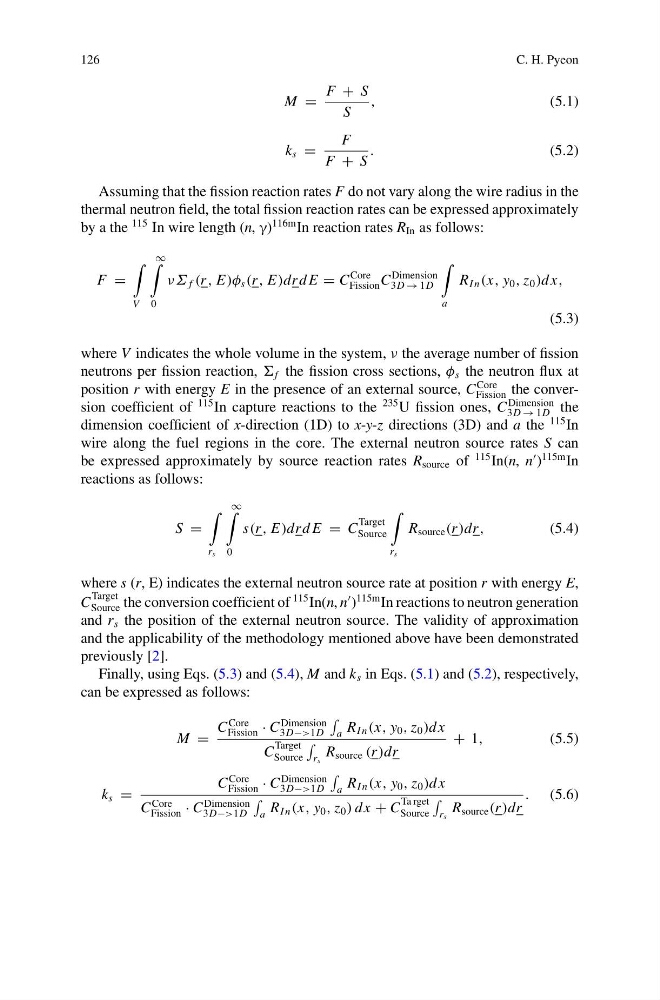
Assuming that the fission reaction rates F do not vary along the wire radius in the
thermal neutron field, the total fission reaction rates can be expressed approximately
by a the
115 In wire length (n, γ)
116m In reaction rates R In as follows:
F =
V
∞
0
νΣ f (r , E)φ s (r , E)drd E = C
Core
Fission C
Dimension
3D → 1D
a
R I n (x, y 0 , z 0 )dx,
(5.3)
where V indicates the whole volume in the system, ν the average number of fission
neutrons per fission reaction, f the fission cross sections, φ s the neutron flux at
position r with energy E in the presence of an external source, C
Core
Fission the conversion coefficient of
115 In capture reactions to the
235 U fission ones, C
Dimension
3D → 1D the
dimension coefficient of x-direction (1D) to x-y-z directions (3D) and a the
115 In
wire along the fuel regions in the core. The external neutron source rates S can
be expressed approximately by source reaction rates R source of
115 In(n, n
)
115m In
reactions as follows:
S =
r s
∞
0
s(r , E)drd E = C
Target
Source
r s
R source (r )dr,
(5.4)
where s (r, E) indicates the external neutron source rate at position r with energy E,
C
Target
Source the conversion coefficient of
115 In(n, n
)
115m In reactions to neutron generation
and r s the position of the external neutron source. The validity of approximation
and the applicability of the methodology mentioned above have been demonstrated
previously [2].
Finally, using Eqs. (5.3) and (5.4), M and k s in Eqs. (5.1) and (5.2), respectively,
can be expressed as follows:
M =
C
Core
Fission · C
Dimension
3D−>1D
a R I n (x, y 0 , z 0 )dx
C
Target
Source
r s
R source (r )dr
+ 1,
(5.5)
k s =
C
Core
Fission · C
Dimension
3D−>1D
a R I n (x, y 0 , z 0 )dx
C
Core
Fission · C
Dimension
3D−>1D
a R I n (x, y 0 , z 0 ) dx + C
Ta rget
Source
r s
R source (r )dr
. (5.6)
C. H. Pyeon
M =
F + S
S
,
(5.1)
k s =
F
F + S
.
(5.2)
Assuming that the fission reaction rates F do not vary along the wire radius in the
thermal neutron field, the total fission reaction rates can be expressed approximately
by a the
115 In wire length (n, γ)
116m In reaction rates R In as follows:
F =
V
∞
0
νΣ f (r , E)φ s (r , E)drd E = C
Core
Fission C
Dimension
3D → 1D
a
R I n (x, y 0 , z 0 )dx,
(5.3)
where V indicates the whole volume in the system, ν the average number of fission
neutrons per fission reaction, f the fission cross sections, φ s the neutron flux at
position r with energy E in the presence of an external source, C
Core
Fission the conversion coefficient of
115 In capture reactions to the
235 U fission ones, C
Dimension
3D → 1D the
dimension coefficient of x-direction (1D) to x-y-z directions (3D) and a the
115 In
wire along the fuel regions in the core. The external neutron source rates S can
be expressed approximately by source reaction rates R source of
115 In(n, n
)
115m In
reactions as follows:
S =
r s
∞
0
s(r , E)drd E = C
Target
Source
r s
R source (r )dr,
(5.4)
where s (r, E) indicates the external neutron source rate at position r with energy E,
C
Target
Source the conversion coefficient of
115 In(n, n
)
115m In reactions to neutron generation
and r s the position of the external neutron source. The validity of approximation
and the applicability of the methodology mentioned above have been demonstrated
previously [2].
Finally, using Eqs. (5.3) and (5.4), M and k s in Eqs. (5.1) and (5.2), respectively,
can be expressed as follows:
M =
C
Core
Fission · C
Dimension
3D−>1D
a R I n (x, y 0 , z 0 )dx
C
Target
Source
r s
R source (r )dr
+ 1,
(5.5)
k s =
C
Core
Fission · C
Dimension
3D−>1D
a R I n (x, y 0 , z 0 )dx
C
Core
Fission · C
Dimension
3D−>1D
a R I n (x, y 0 , z 0 ) dx + C
Ta rget
Source
r s
R source (r )dr
. (5.6)