

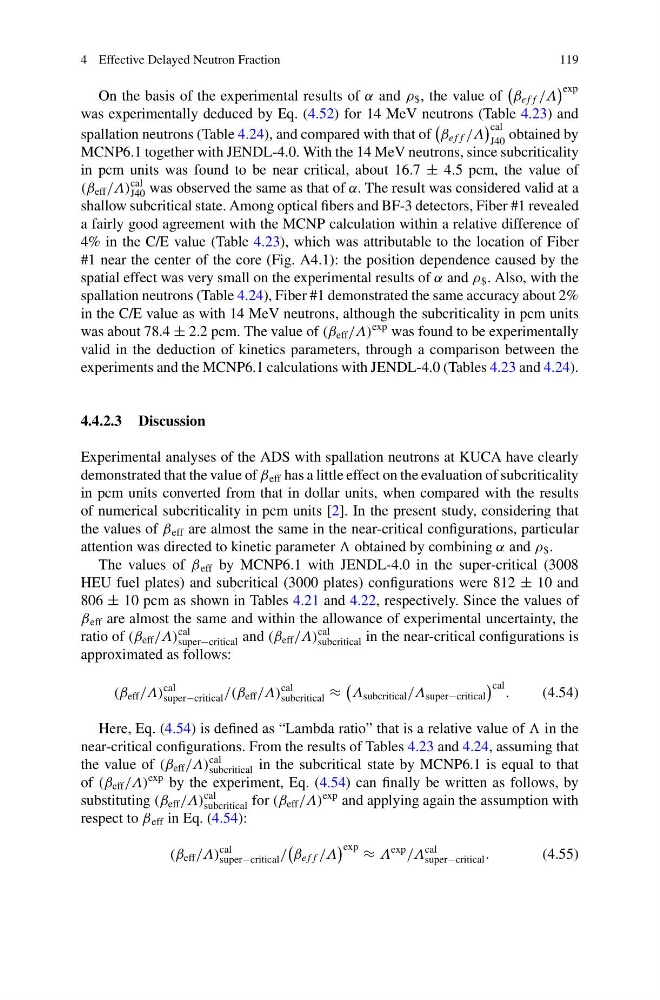
4 Effective Delayed Neutron Fraction
119
On the basis of the experimental results of α and ρ $ , the value of
β e f f /Λ
exp
was experimentally deduced by Eq. (4.52) for 14 MeV neutrons (Table 4.23) and
spallation neutrons (Table 4.24), and compared with that of
β e f f /Λ
cal
J40
obtained by
MCNP6.1 together with JENDL-4.0. With the 14 MeV neutrons, since subcriticality
in pcm units was found to be near critical, about 16.7 ± 4.5 pcm, the value of
(β eff /Λ)
cal
J40 was observed the same as that of α. The result was considered valid at a
shallow subcritical state. Among optical fibers and BF-3 detectors, Fiber #1 revealed
a fairly good agreement with the MCNP calculation within a relative difference of
4% in the C/E value (Table 4.23), which was attributable to the location of Fiber
#1 near the center of the core (Fig. A4.1): the position dependence caused by the
spatial effect was very small on the experimental results of α and ρ $ . Also, with the
spallation neutrons (Table 4.24), Fiber #1 demonstrated the same accuracy about 2%
in the C/E value as with 14 MeV neutrons, although the subcriticality in pcm units
was about 78.4 ± 2.2 pcm. The value of (β eff /Λ)
exp was found to be experimentally
valid in the deduction of kinetics parameters, through a comparison between the
experiments and the MCNP6.1 calculations with JENDL-4.0 (Tables 4.23 and 4.24).
4.4.2.3 Discussion
Experimental analyses of the ADS with spallation neutrons at KUCA have clearly
demonstrated that the value of β eff has a little effect on the evaluation of subcriticality
in pcm units converted from that in dollar units, when compared with the results
of numerical subcriticality in pcm units [2]. In the present study, considering that
the values of β eff are almost the same in the near-critical configurations, particular
attention was directed to kinetic parameter obtained by combining α and ρ $ .
The values of β eff by MCNP6.1 with JENDL-4.0 in the super-critical (3008
HEU fuel plates) and subcritical (3000 plates) configurations were 812 ± 10 and
806 ± 10 pcm as shown in Tables 4.21 and 4.22, respectively. Since the values of
β eff are almost the same and within the allowance of experimental uncertainty, the
ratio of (β eff /Λ)
cal
super−critical and (β eff /Λ)
cal
subcritical in the near-critical configurations is
approximated as follows:
(β eff /Λ)
cal
super−critical /(β eff /Λ)
cal
subcritical ≈
Λ subcritical /Λ super−critical
cal .
(4.54)
Here, Eq. (4.54) is defined as “Lambda ratio” that is a relative value of in the
near-critical configurations. From the results of Tables 4.23 and 4.24, assuming that
the value of (β eff /Λ)
cal
subcritical in the subcritical state by MCNP6.1 is equal to that
of (β eff /Λ)
exp by the experiment, Eq. (4.54) can finally be written as follows, by
substituting (β eff /Λ)
cal
subcritical for (β eff /Λ)
exp and applying again the assumption with
respect to β eff in Eq. (4.54):
(β eff /Λ)
cal
super−critical /
β e f f /Λ
exp ≈ Λ
exp
/Λ
cal
super−critical .
(4.55)
119
On the basis of the experimental results of α and ρ $ , the value of
β e f f /Λ
exp
was experimentally deduced by Eq. (4.52) for 14 MeV neutrons (Table 4.23) and
spallation neutrons (Table 4.24), and compared with that of
β e f f /Λ
cal
J40
obtained by
MCNP6.1 together with JENDL-4.0. With the 14 MeV neutrons, since subcriticality
in pcm units was found to be near critical, about 16.7 ± 4.5 pcm, the value of
(β eff /Λ)
cal
J40 was observed the same as that of α. The result was considered valid at a
shallow subcritical state. Among optical fibers and BF-3 detectors, Fiber #1 revealed
a fairly good agreement with the MCNP calculation within a relative difference of
4% in the C/E value (Table 4.23), which was attributable to the location of Fiber
#1 near the center of the core (Fig. A4.1): the position dependence caused by the
spatial effect was very small on the experimental results of α and ρ $ . Also, with the
spallation neutrons (Table 4.24), Fiber #1 demonstrated the same accuracy about 2%
in the C/E value as with 14 MeV neutrons, although the subcriticality in pcm units
was about 78.4 ± 2.2 pcm. The value of (β eff /Λ)
exp was found to be experimentally
valid in the deduction of kinetics parameters, through a comparison between the
experiments and the MCNP6.1 calculations with JENDL-4.0 (Tables 4.23 and 4.24).
4.4.2.3 Discussion
Experimental analyses of the ADS with spallation neutrons at KUCA have clearly
demonstrated that the value of β eff has a little effect on the evaluation of subcriticality
in pcm units converted from that in dollar units, when compared with the results
of numerical subcriticality in pcm units [2]. In the present study, considering that
the values of β eff are almost the same in the near-critical configurations, particular
attention was directed to kinetic parameter obtained by combining α and ρ $ .
The values of β eff by MCNP6.1 with JENDL-4.0 in the super-critical (3008
HEU fuel plates) and subcritical (3000 plates) configurations were 812 ± 10 and
806 ± 10 pcm as shown in Tables 4.21 and 4.22, respectively. Since the values of
β eff are almost the same and within the allowance of experimental uncertainty, the
ratio of (β eff /Λ)
cal
super−critical and (β eff /Λ)
cal
subcritical in the near-critical configurations is
approximated as follows:
(β eff /Λ)
cal
super−critical /(β eff /Λ)
cal
subcritical ≈
Λ subcritical /Λ super−critical
cal .
(4.54)
Here, Eq. (4.54) is defined as “Lambda ratio” that is a relative value of in the
near-critical configurations. From the results of Tables 4.23 and 4.24, assuming that
the value of (β eff /Λ)
cal
subcritical in the subcritical state by MCNP6.1 is equal to that
of (β eff /Λ)
exp by the experiment, Eq. (4.54) can finally be written as follows, by
substituting (β eff /Λ)
cal
subcritical for (β eff /Λ)
exp and applying again the assumption with
respect to β eff in Eq. (4.54):
(β eff /Λ)
cal
super−critical /
β e f f /Λ
exp ≈ Λ
exp
/Λ
cal
super−critical .
(4.55)