

4 Effective Delayed Neutron Fraction
101
Table 4.9 Calculated
correction factors g and g* by
Eqs. (4.30) and (4.31) with
JENDL-4.0 and
JENDL/HE-2007 (or
ENDF/B-VII.0 and
JENDL/HE-2007),
respectively (Ref. [12])
Case
g
g*
1
1.03 ± 0.01
(1.03 ± 0.01)
(4.29 ± 0.01)E-03
((4.32 ± 0.01)E-03)
2
1.03 ± 0.01
(1.03 ± 0.01)
(4.28 ± 0.01)E-03
((4.31 ± 0.01)E-03)
3
1.04 ± 0.01
(1.04 ± 0.01)
(4.18 ± 0.01)E-03
((4.19 ± 0.01)E-03)
4
1.03 ± 0.01
(1.03 ± 0.01)
(3.84 ± 0.01)E-03
((3.83 ± 0.01)E-03)
5
1.03 ± 0.01
(1.03 ± 0.01)
(3.74 ± 0.01)E-03
((3.78 ± 0.01)E-03)
6
1.03 ± 0.01
(1.03 ± 0.01)
(2.84 ± 0.02)E-03
((2.84 ± 0 .01)E-03)
7
1.03 ± 0.01
(1.03 ± 0.01)
(2.75 ± 0.01)E-03
((2.76 ± 0 .01)E-03)
with JENDL-4.0 [13] or ENDF/B-VII.0 (uranium and boron) and JENDL/HE-2007
(all nuclides except uranium and boron); total histories for adjoint flux and reaction
rates were 1E + 07 and 1E + 06, respectively; the statistical error of the calculations
was less than 1%. The adjoint flux was manually obtained for three-dimensional
calculations as follows: an external neutron source in the Watt spectrum of
235 U
was set inside an HEU plate; the reaction rates for the response of ν f , which
is discussed as more appropriate than f [14] to estimate the adjoint flux, were
tallied over the core with NONU option to avoid the neutron multiplication; these
reaction rates approximately corresponded to the adjoint flux at the position of the
HEU plate; this fixed-source problem was repeated by changing the position of the
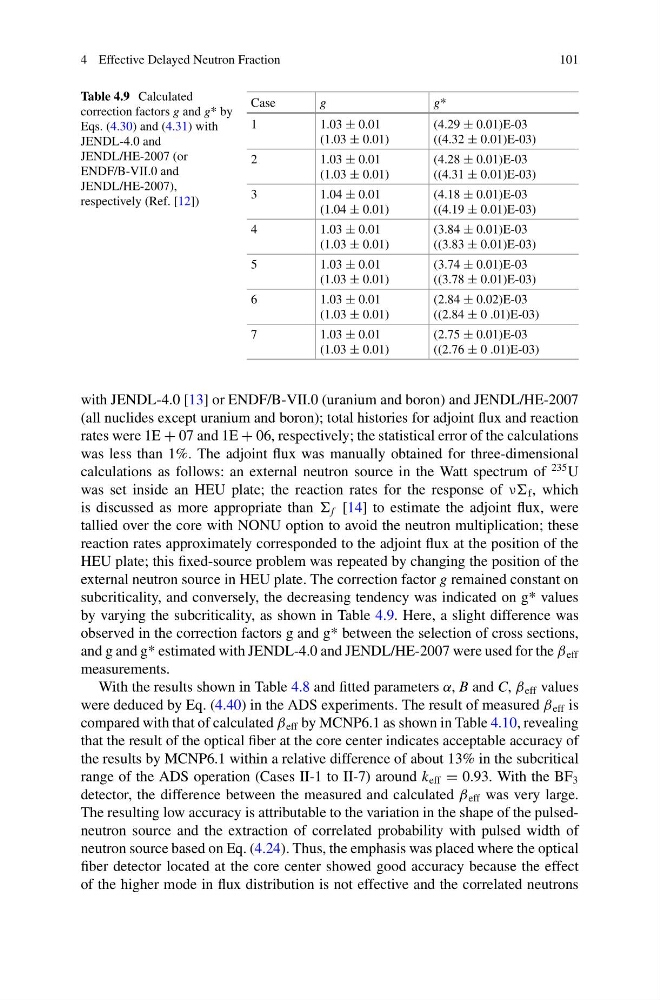
external neutron source in HEU plate. The correction factor g remained constant on
subcriticality, and conversely, the decreasing tendency was indicated on g* values
by varying the subcriticality, as shown in Table 4.9. Here, a slight difference was
observed in the correction factors g and g* between the selection of cross sections,
and g and g* estimated with JENDL-4.0 and JENDL/HE-2007 were used for the β eff
measurements.
With the results shown in Table 4.8 and fitted parameters α, B and C, β eff values
were deduced by Eq. (4.40) in the ADS experiments. The result of measured β eff is
compared with that of calculated β eff by MCNP6.1 as shown in Table 4.10, revealing
that the result of the optical fiber at the core center indicates acceptable accuracy of
the results by MCNP6.1 within a relative difference of about 13% in the subcritical
range of the ADS operation (Cases II-1 to II-7) around k eff = 0.93. With the BF 3
detector, the difference between the measured and calculated β eff was very large.
The resulting low accuracy is attributable to the variation in the shape of the pulsedneutron source and the extraction of correlated probability with pulsed width of
neutron source based on Eq. (4.24). Thus, the emphasis was placed where the optical
fiber detector located at the core center showed good accuracy because the effect
of the higher mode in flux distribution is not effective and the correlated neutrons
101
Table 4.9 Calculated
correction factors g and g* by
Eqs. (4.30) and (4.31) with
JENDL-4.0 and
JENDL/HE-2007 (or
ENDF/B-VII.0 and
JENDL/HE-2007),
respectively (Ref. [12])
Case
g
g*
1
1.03 ± 0.01
(1.03 ± 0.01)
(4.29 ± 0.01)E-03
((4.32 ± 0.01)E-03)
2
1.03 ± 0.01
(1.03 ± 0.01)
(4.28 ± 0.01)E-03
((4.31 ± 0.01)E-03)
3
1.04 ± 0.01
(1.04 ± 0.01)
(4.18 ± 0.01)E-03
((4.19 ± 0.01)E-03)
4
1.03 ± 0.01
(1.03 ± 0.01)
(3.84 ± 0.01)E-03
((3.83 ± 0.01)E-03)
5
1.03 ± 0.01
(1.03 ± 0.01)
(3.74 ± 0.01)E-03
((3.78 ± 0.01)E-03)
6
1.03 ± 0.01
(1.03 ± 0.01)
(2.84 ± 0.02)E-03
((2.84 ± 0 .01)E-03)
7
1.03 ± 0.01
(1.03 ± 0.01)
(2.75 ± 0.01)E-03
((2.76 ± 0 .01)E-03)
with JENDL-4.0 [13] or ENDF/B-VII.0 (uranium and boron) and JENDL/HE-2007
(all nuclides except uranium and boron); total histories for adjoint flux and reaction
rates were 1E + 07 and 1E + 06, respectively; the statistical error of the calculations
was less than 1%. The adjoint flux was manually obtained for three-dimensional
calculations as follows: an external neutron source in the Watt spectrum of
235 U
was set inside an HEU plate; the reaction rates for the response of ν f , which
is discussed as more appropriate than f [14] to estimate the adjoint flux, were
tallied over the core with NONU option to avoid the neutron multiplication; these
reaction rates approximately corresponded to the adjoint flux at the position of the
HEU plate; this fixed-source problem was repeated by changing the position of the
external neutron source in HEU plate. The correction factor g remained constant on
subcriticality, and conversely, the decreasing tendency was indicated on g* values
by varying the subcriticality, as shown in Table 4.9. Here, a slight difference was
observed in the correction factors g and g* between the selection of cross sections,
and g and g* estimated with JENDL-4.0 and JENDL/HE-2007 were used for the β eff
measurements.
With the results shown in Table 4.8 and fitted parameters α, B and C, β eff values
were deduced by Eq. (4.40) in the ADS experiments. The result of measured β eff is
compared with that of calculated β eff by MCNP6.1 as shown in Table 4.10, revealing
that the result of the optical fiber at the core center indicates acceptable accuracy of
the results by MCNP6.1 within a relative difference of about 13% in the subcritical
range of the ADS operation (Cases II-1 to II-7) around k eff = 0.93. With the BF 3
detector, the difference between the measured and calculated β eff was very large.
The resulting low accuracy is attributable to the variation in the shape of the pulsedneutron source and the extraction of correlated probability with pulsed width of
neutron source based on Eq. (4.24). Thus, the emphasis was placed where the optical
fiber detector located at the core center showed good accuracy because the effect
of the higher mode in flux distribution is not effective and the correlated neutrons