

211
market (www.spglobal.com 2020a, b, c, d, e). The more cooperation between Iran
and Venezuela was heightened when Iran’s president Ahmadinejad strengthened
Iran’s bilateral relations with Venezuela. Since then, the relations between these two
countries have extended to the energy sectors, which in some cases there was fuel
export and on some other occasions, there were technical consultancy and executions. Since January 2019, Venezuela has encountered hardship to supply the
250,000 bbl/day of fuel to the consumers as US sanctions have targeted PDVSA
(usip.org 2020).
The sanctions are covering a range of actions including the export of fuel and
diluents to Venezuela. The outcome of these sanctions and the mismanagement of
the oil fields and refinery facilities have led to a fuel shortage across the country
particularly outside of Caracas. The country under severe sanctions soon lost its
friends but there was only one other buddy country which was in the same situation
as Venezuela, and that was Iran. U.S. Sanctions against Iran has opened an opportunity for the Iranian derivative suppliers to export to the domestic oversupplied market. With three times increase, the new fuel pricing in Iran enforced Iranian
consumers to use less amount of fuel, which lowered the fuel consumption from 90
million liters per day to 65 million liters per day in the first quarter of 2020 (www.
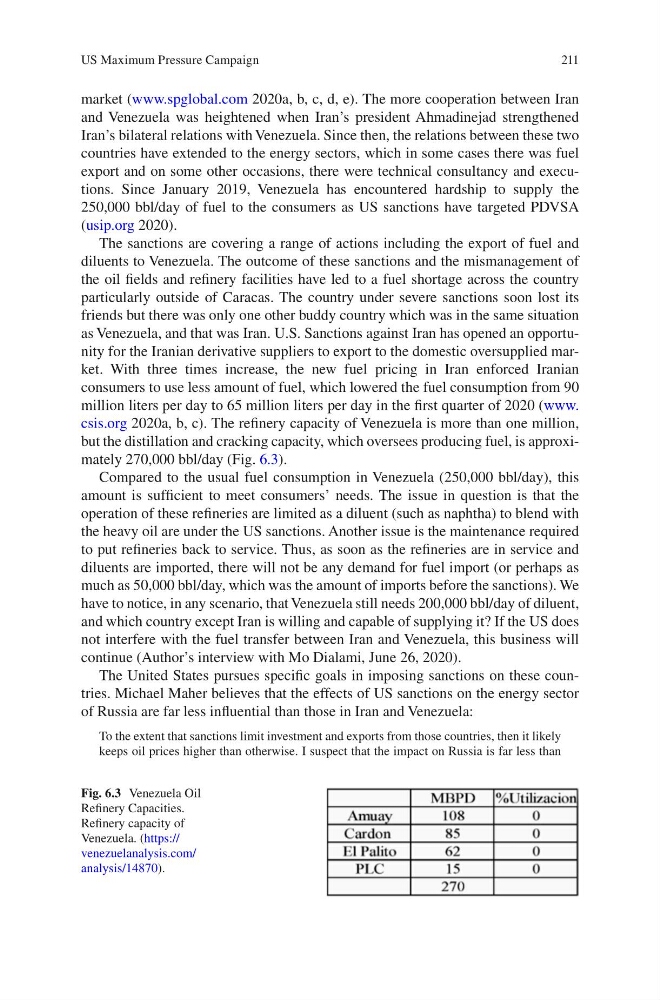
csis.org 2020a, b, c). The refinery capacity of Venezuela is more than one million,
but the distillation and cracking capacity, which oversees producing fuel, is approximately 270,000 bbl/day (Fig. 6.3).
Compared to the usual fuel consumption in Venezuela (250,000 bbl/day), this
amount is sufficient to meet consumers’ needs. The issue in question is that the
operation of these refineries are limited as a diluent (such as naphtha) to blend with
the heavy oil are under the US sanctions. Another issue is the maintenance required
to put refineries back to service. Thus, as soon as the refineries are in service and
diluents are imported, there will not be any demand for fuel import (or perhaps as
much as 50,000 bbl/day, which was the amount of imports before the sanctions). We
have to notice, in any scenario, that Venezuela still needs 200,000 bbl/day of diluent,
and which country except Iran is willing and capable of supplying it? If the US does
not interfere with the fuel transfer between Iran and Venezuela, this business will
continue (Author’s interview with Mo Dialami, June 26, 2020).
The United States pursues specific goals in imposing sanctions on these countries. Michael Maher believes that the effects of US sanctions on the energy sector
of Russia are far less influential than those in Iran and Venezuela:
To the extent that sanctions limit investment and exports from those countries, then it likely
keeps oil prices higher than otherwise. I suspect that the impact on Russia is far less than
Fig. 6.3 Venezuela Oil
Refinery Capacities.
Refinery capacity of
Venezuela. (https://
venezuelanalysis.com/
analysis/14870).
US Maximum Pressure Campaign
market (www.spglobal.com 2020a, b, c, d, e). The more cooperation between Iran
and Venezuela was heightened when Iran’s president Ahmadinejad strengthened
Iran’s bilateral relations with Venezuela. Since then, the relations between these two
countries have extended to the energy sectors, which in some cases there was fuel
export and on some other occasions, there were technical consultancy and executions. Since January 2019, Venezuela has encountered hardship to supply the
250,000 bbl/day of fuel to the consumers as US sanctions have targeted PDVSA
(usip.org 2020).
The sanctions are covering a range of actions including the export of fuel and
diluents to Venezuela. The outcome of these sanctions and the mismanagement of
the oil fields and refinery facilities have led to a fuel shortage across the country
particularly outside of Caracas. The country under severe sanctions soon lost its
friends but there was only one other buddy country which was in the same situation
as Venezuela, and that was Iran. U.S. Sanctions against Iran has opened an opportunity for the Iranian derivative suppliers to export to the domestic oversupplied market. With three times increase, the new fuel pricing in Iran enforced Iranian
consumers to use less amount of fuel, which lowered the fuel consumption from 90
million liters per day to 65 million liters per day in the first quarter of 2020 (www.
csis.org 2020a, b, c). The refinery capacity of Venezuela is more than one million,
but the distillation and cracking capacity, which oversees producing fuel, is approximately 270,000 bbl/day (Fig. 6.3).
Compared to the usual fuel consumption in Venezuela (250,000 bbl/day), this
amount is sufficient to meet consumers’ needs. The issue in question is that the
operation of these refineries are limited as a diluent (such as naphtha) to blend with
the heavy oil are under the US sanctions. Another issue is the maintenance required
to put refineries back to service. Thus, as soon as the refineries are in service and
diluents are imported, there will not be any demand for fuel import (or perhaps as
much as 50,000 bbl/day, which was the amount of imports before the sanctions). We
have to notice, in any scenario, that Venezuela still needs 200,000 bbl/day of diluent,
and which country except Iran is willing and capable of supplying it? If the US does
not interfere with the fuel transfer between Iran and Venezuela, this business will
continue (Author’s interview with Mo Dialami, June 26, 2020).
The United States pursues specific goals in imposing sanctions on these countries. Michael Maher believes that the effects of US sanctions on the energy sector
of Russia are far less influential than those in Iran and Venezuela:
To the extent that sanctions limit investment and exports from those countries, then it likely
keeps oil prices higher than otherwise. I suspect that the impact on Russia is far less than
Fig. 6.3 Venezuela Oil
Refinery Capacities.
Refinery capacity of
Venezuela. (https://
venezuelanalysis.com/
analysis/14870).
US Maximum Pressure Campaign