

202
objectives,” Verrastro said. “We’ve always operated in that space. If we’re going to
use energy dominance to persuade other countries to do things this seems like a
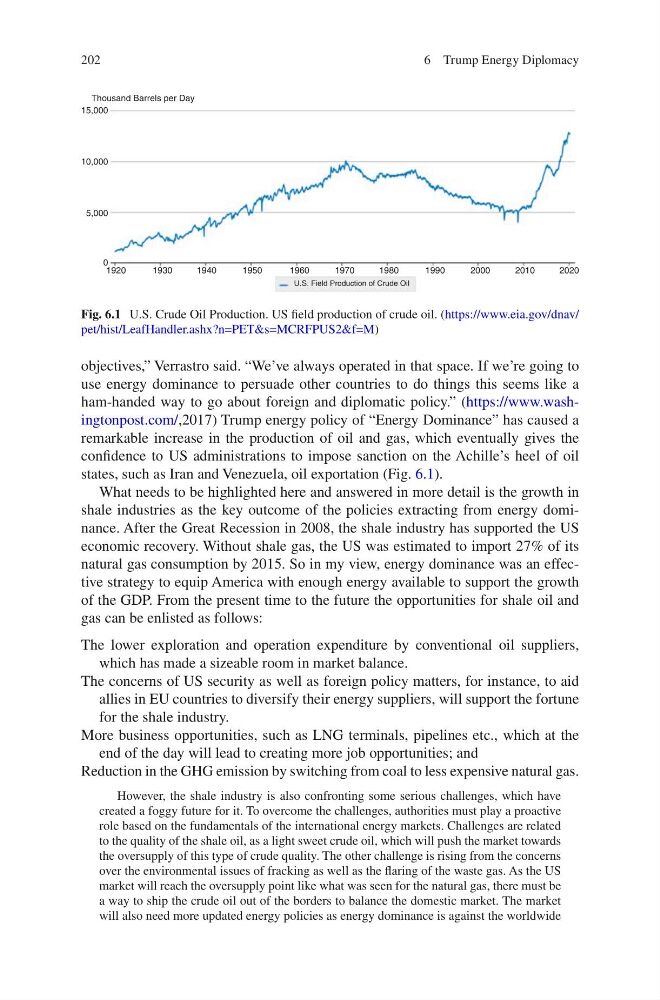
ham-handed way to go about foreign and diplomatic policy.” (https://www.washingtonpost.com/,2017) Trump energy policy of “Energy Dominance” has caused a
remarkable increase in the production of oil and gas, which eventually gives the
confidence to US administrations to impose sanction on the Achille’s heel of oil
states, such as Iran and Venezuela, oil exportation (Fig. 6.1).
What needs to be highlighted here and answered in more detail is the growth in
shale industries as the key outcome of the policies extracting from energy dominance. After the Great Recession in 2008, the shale industry has supported the US
economic recovery. Without shale gas, the US was estimated to import 27% of its
natural gas consumption by 2015. So in my view, energy dominance was an effective strategy to equip America with enough energy available to support the growth
of the GDP. From the present time to the future the opportunities for shale oil and
gas can be enlisted as follows:
The lower exploration and operation expenditure by conventional oil suppliers,
which has made a sizeable room in market balance.
The concerns of US security as well as foreign policy matters, for instance, to aid
allies in EU countries to diversify their energy suppliers, will support the fortune
for the shale industry.
More business opportunities, such as LNG terminals, pipelines etc., which at the
end of the day will lead to creating more job opportunities; and
Reduction in the GHG emission by switching from coal to less expensive natural gas.
However, the shale industry is also confronting some serious challenges, which have
created a foggy future for it. To overcome the challenges, authorities must play a proactive
role based on the fundamentals of the international energy markets. Challenges are related
to the quality of the shale oil, as a light sweet crude oil, which will push the market towards
the oversupply of this type of crude quality. The other challenge is rising from the concerns
over the environmental issues of fracking as well as the flaring of the waste gas. As the US
market will reach the oversupply point like what was seen for the natural gas, there must be
a way to ship the crude oil out of the borders to balance the domestic market. The market
will also need more updated energy policies as energy dominance is against the worldwide
15,000
Thousand Barrels per Day
10,000
5,000
0
1920
1930
1940
1950
1960
1970
U.S. Field Production of Crude Oil
1980
1990
2000
2 010
2020
Fig. 6.1 U.S. Crude Oil Production. US field production of crude oil. (https://www.eia.gov/dnav/
pet/hist/LeafHandler.ashx?n=PET&s=MCRFPUS2&f=M)
6 Trump Energy Diplomacy
objectives,” Verrastro said. “We’ve always operated in that space. If we’re going to
use energy dominance to persuade other countries to do things this seems like a
ham-handed way to go about foreign and diplomatic policy.” (https://www.washingtonpost.com/,2017) Trump energy policy of “Energy Dominance” has caused a
remarkable increase in the production of oil and gas, which eventually gives the
confidence to US administrations to impose sanction on the Achille’s heel of oil
states, such as Iran and Venezuela, oil exportation (Fig. 6.1).
What needs to be highlighted here and answered in more detail is the growth in
shale industries as the key outcome of the policies extracting from energy dominance. After the Great Recession in 2008, the shale industry has supported the US
economic recovery. Without shale gas, the US was estimated to import 27% of its
natural gas consumption by 2015. So in my view, energy dominance was an effective strategy to equip America with enough energy available to support the growth
of the GDP. From the present time to the future the opportunities for shale oil and
gas can be enlisted as follows:
The lower exploration and operation expenditure by conventional oil suppliers,
which has made a sizeable room in market balance.
The concerns of US security as well as foreign policy matters, for instance, to aid
allies in EU countries to diversify their energy suppliers, will support the fortune
for the shale industry.
More business opportunities, such as LNG terminals, pipelines etc., which at the
end of the day will lead to creating more job opportunities; and
Reduction in the GHG emission by switching from coal to less expensive natural gas.
However, the shale industry is also confronting some serious challenges, which have
created a foggy future for it. To overcome the challenges, authorities must play a proactive
role based on the fundamentals of the international energy markets. Challenges are related
to the quality of the shale oil, as a light sweet crude oil, which will push the market towards
the oversupply of this type of crude quality. The other challenge is rising from the concerns
over the environmental issues of fracking as well as the flaring of the waste gas. As the US
market will reach the oversupply point like what was seen for the natural gas, there must be
a way to ship the crude oil out of the borders to balance the domestic market. The market
will also need more updated energy policies as energy dominance is against the worldwide
15,000
Thousand Barrels per Day
10,000
5,000
0
1920
1930
1940
1950
1960
1970
U.S. Field Production of Crude Oil
1980
1990
2000
2 010
2020
Fig. 6.1 U.S. Crude Oil Production. US field production of crude oil. (https://www.eia.gov/dnav/
pet/hist/LeafHandler.ashx?n=PET&s=MCRFPUS2&f=M)
6 Trump Energy Diplomacy