

bond on the surface of spent grains in studies of hydrolysis of a-LA and b-LG [53].
These authors also observed high retention of the activity by multipoint covalent
enzyme immobilization to support functionalized with glycidol groups. Other
authors also tested this functional group in agarose gel in the immobilization of
trypsin, chymotrypsin, and carboxypeptidase A in casein hydrolysis [54].
Remarkably, Pedroche et al. [55] observed an increase in stability of about 4,700
times of trypsin immobilized on the same support in comparison to free enzyme.
Preparations of immobilized proteases were used in the hydrolysis of whey
proteins in agitated reactors as well as in packed in columns, which allows operating in continuous flow. This operation mode decreases large-scale operating costs,
rapid hydrolysis process, and increased yield of bioactive peptide compared to
conventional protein digestion processes in discontinuous mode [56]. The same
authors also tested the immobilization of trypsin in a small-scale polymethacrylate
monolith with 18-folds reuse, even with greater efficiency in the DH of b-LG in
comparison to the reaction system with free trypsin in solution. Szymańska et al.
[57] proposed the use of siliceous monoliths with macropores to ensure access of
protein substrates to immobilized proteases.
Emerging new processes of immobilization of enzymes include cross-linking of
insoluble proteins. These new immobilization processes were applied to the
immobilization of proteases, in particular as cross-linked enzyme aggregates
(CLEA) and cross-linked enzyme crystals (CLEC). The CLEC proved to be a more
robust method in the immobilization of subtilisin and more efficient in protein
hydrolysis [58].
3.4 Synthesis of Peptides—The “Rational” Approach
An alternative to the release of bioactive peptides by hydrolysis of the protein
parent molecules mainly from milk or whey proteins is the design and rational
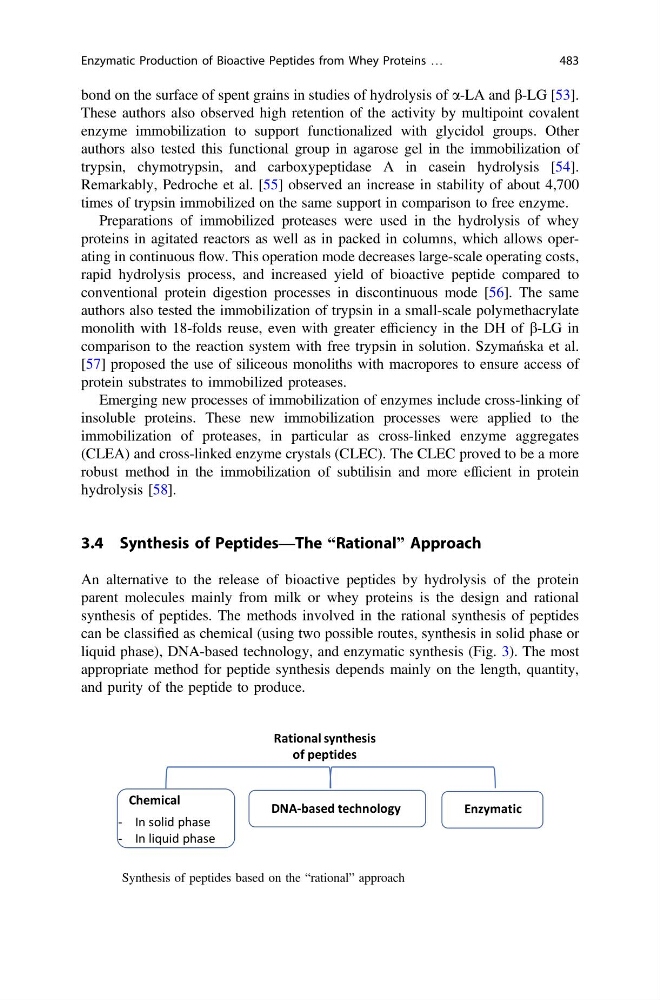
synthesis of peptides. The methods involved in the rational synthesis of peptides
can be classified as chemical (using two possible routes, synthesis in solid phase or
liquid phase), DNA-based technology, and enzymatic synthesis (Fig. 3). The most
appropriate method for peptide synthesis depends mainly on the length, quantity,
and purity of the peptide to produce.
Rational synthesis
of peptides
DNA-based technology
Enzymatic
- In solid phase
- In liquid phase
Chemical
Fig. 3 Synthesis of peptides based on the “rational” approach
Enzymatic Production of Bioactive Peptides from Whey Proteins …
483
These authors also observed high retention of the activity by multipoint covalent
enzyme immobilization to support functionalized with glycidol groups. Other
authors also tested this functional group in agarose gel in the immobilization of
trypsin, chymotrypsin, and carboxypeptidase A in casein hydrolysis [54].
Remarkably, Pedroche et al. [55] observed an increase in stability of about 4,700
times of trypsin immobilized on the same support in comparison to free enzyme.
Preparations of immobilized proteases were used in the hydrolysis of whey
proteins in agitated reactors as well as in packed in columns, which allows operating in continuous flow. This operation mode decreases large-scale operating costs,
rapid hydrolysis process, and increased yield of bioactive peptide compared to
conventional protein digestion processes in discontinuous mode [56]. The same
authors also tested the immobilization of trypsin in a small-scale polymethacrylate
monolith with 18-folds reuse, even with greater efficiency in the DH of b-LG in
comparison to the reaction system with free trypsin in solution. Szymańska et al.
[57] proposed the use of siliceous monoliths with macropores to ensure access of
protein substrates to immobilized proteases.
Emerging new processes of immobilization of enzymes include cross-linking of
insoluble proteins. These new immobilization processes were applied to the
immobilization of proteases, in particular as cross-linked enzyme aggregates
(CLEA) and cross-linked enzyme crystals (CLEC). The CLEC proved to be a more
robust method in the immobilization of subtilisin and more efficient in protein
hydrolysis [58].
3.4 Synthesis of Peptides—The “Rational” Approach
An alternative to the release of bioactive peptides by hydrolysis of the protein
parent molecules mainly from milk or whey proteins is the design and rational
synthesis of peptides. The methods involved in the rational synthesis of peptides
can be classified as chemical (using two possible routes, synthesis in solid phase or
liquid phase), DNA-based technology, and enzymatic synthesis (Fig. 3). The most
appropriate method for peptide synthesis depends mainly on the length, quantity,
and purity of the peptide to produce.
Rational synthesis
of peptides
DNA-based technology
Enzymatic
- In solid phase
- In liquid phase
Chemical
Fig. 3 Synthesis of peptides based on the “rational” approach
Enzymatic Production of Bioactive Peptides from Whey Proteins …
483