

1 Bioactive Peptides
Peptides are a chain of amino acids covalently linked to each other by peptide
bonds. Peptides have shown to have a broad spectrum of activities, such as regulation and biological functions that bring benefits to human health, as well as
applications at the level of research, clinical diagnosis, and even at the industrial
scale.
Several synthetic peptides have been designed and today are used as antigens,
substrates or enzyme inhibitors, in vitro diagnostic probes, affinity ligands of solid
supports, and components of molecular electronic devices. Other peptides are
released from natural proteins or synthesized by chemical or enzymatic processes,
playing an important role in applications in the areas of health and nutrition and
medicinal therapy. Peptides that show biological activities are bioactive peptides.
When compared to synthetic drugs, peptides with therapeutic or nutraceutical
functions have several advantages, such as high activity and specificity, low toxicity, and lower accumulation in human tissues [1].
A large number of bioactive peptides contain peptide chains composed of 2–30
amino acids. For example, aspartame, a dipeptide constituted by one L-aspartic
acid and an L-phenylalanine, is mostly used as an artificial sweetener in food and
beverages. Other longer peptides show an extensive range of biological activities
such as in the regulation of metabolism, cell proliferation, cellular communication,
immune system response, hormonal secretion, cell defense, among many others
[2]. These bioactive peptides that represent a specific fragment of the primary
sequence of animal or vegetable proteins revealed to be suitable as food additives
due to their properties as antihypertensive, antioxidant, antimicrobial, among many
others.
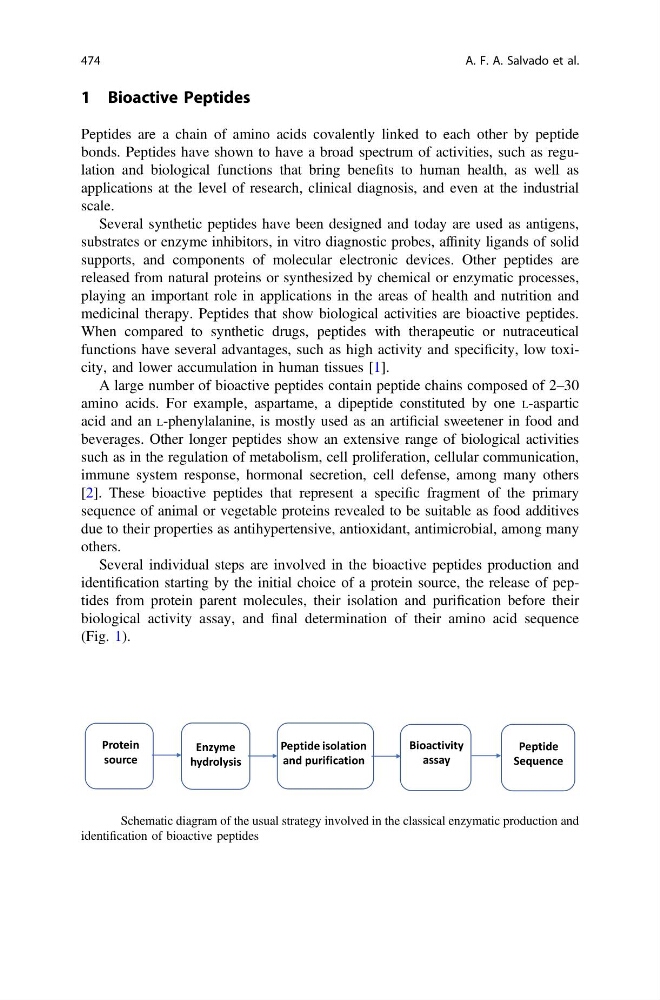
Several individual steps are involved in the bioactive peptides production and
identification starting by the initial choice of a protein source, the release of peptides from protein parent molecules, their isolation and purification before their
biological activity assay, and final determination of their amino acid sequence
(Fig. 1).
Protein
source
Enzyme
hydrolysis
Peptide isolation
and purification
Bioactivity
assay
Peptide
Sequence
Fig. 1 Schematic diagram of the usual strategy involved in the classical enzymatic production and
identification of bioactive peptides
474
A. F. A. Salvado et al.
Peptides are a chain of amino acids covalently linked to each other by peptide
bonds. Peptides have shown to have a broad spectrum of activities, such as regulation and biological functions that bring benefits to human health, as well as
applications at the level of research, clinical diagnosis, and even at the industrial
scale.
Several synthetic peptides have been designed and today are used as antigens,
substrates or enzyme inhibitors, in vitro diagnostic probes, affinity ligands of solid
supports, and components of molecular electronic devices. Other peptides are
released from natural proteins or synthesized by chemical or enzymatic processes,
playing an important role in applications in the areas of health and nutrition and
medicinal therapy. Peptides that show biological activities are bioactive peptides.
When compared to synthetic drugs, peptides with therapeutic or nutraceutical
functions have several advantages, such as high activity and specificity, low toxicity, and lower accumulation in human tissues [1].
A large number of bioactive peptides contain peptide chains composed of 2–30
amino acids. For example, aspartame, a dipeptide constituted by one L-aspartic
acid and an L-phenylalanine, is mostly used as an artificial sweetener in food and
beverages. Other longer peptides show an extensive range of biological activities
such as in the regulation of metabolism, cell proliferation, cellular communication,
immune system response, hormonal secretion, cell defense, among many others
[2]. These bioactive peptides that represent a specific fragment of the primary
sequence of animal or vegetable proteins revealed to be suitable as food additives
due to their properties as antihypertensive, antioxidant, antimicrobial, among many
others.
Several individual steps are involved in the bioactive peptides production and
identification starting by the initial choice of a protein source, the release of peptides from protein parent molecules, their isolation and purification before their
biological activity assay, and final determination of their amino acid sequence
(Fig. 1).
Protein
source
Enzyme
hydrolysis
Peptide isolation
and purification
Bioactivity
assay
Peptide
Sequence
Fig. 1 Schematic diagram of the usual strategy involved in the classical enzymatic production and
identification of bioactive peptides
474
A. F. A. Salvado et al.