

generate an oxo-ferryl intermediate [Fe(IV) = O
+
] (compound I). In two consecutive steps of reduction of compound I, firstly compound II [Fe(IV) = O] is formed
from compound I, receiving one electron from a reducing compound such as
veratryl alcohol (VA). Then, compound II is reduced with another electron from the
electron donor, regenerating the native enzyme and completing the catalytic cycle.
The substrate scope of LiPs is broad, including phenolic aromatic compounds and
non-phenolic lignin model compounds. VA, a non-phenolic compound, has been
known to act as a redox mediator for LiPs due to its high redox potential and
enables LiPs to act on substrates that normally cannot be oxidized by LiPs alone
[36, 38].
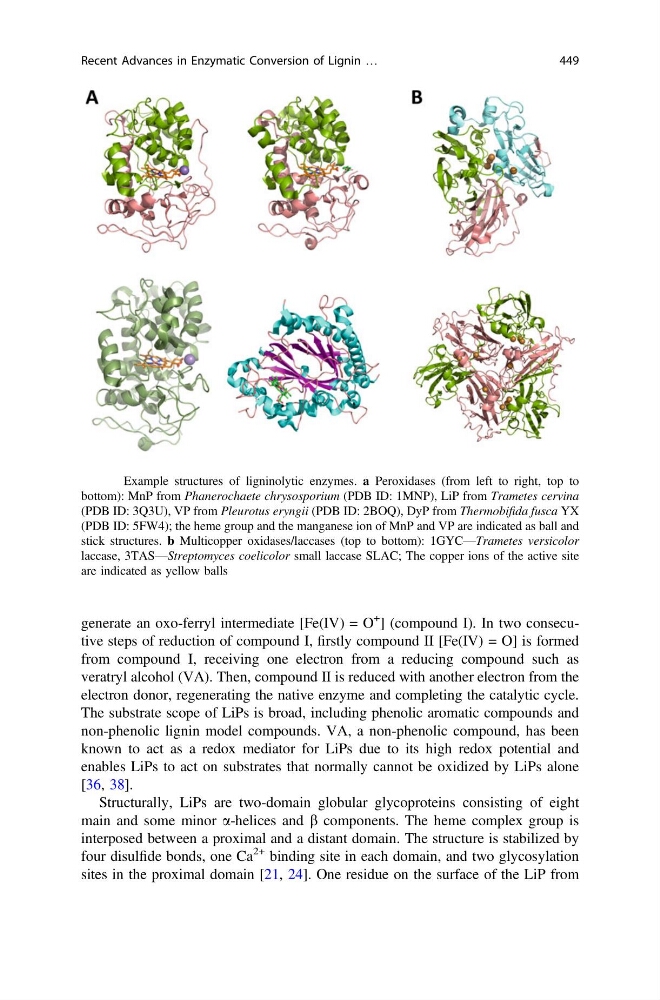
Structurally, LiPs are two-domain globular glycoproteins consisting of eight
main and some minor a-helices and b components. The heme complex group is
interposed between a proximal and a distant domain. The structure is stabilized by
four disulfide bonds, one Ca
2+ binding site in each domain, and two glycosylation
sites in the proximal domain [21, 24]. One residue on the surface of the LiP from
Fig. 3 Example structures of ligninolytic enzymes. a Peroxidases (from left to right, top to
bottom): MnP from Phanerochaete chrysosporium (PDB ID: 1MNP), LiP from Trametes cervina
(PDB ID: 3Q3U), VP from Pleurotus eryngii (PDB ID: 2BOQ), DyP from Thermobifida fusca YX
(PDB ID: 5FW4); the heme group and the manganese ion of MnP and VP are indicated as ball and
stick structures. b Multicopper oxidases/laccases (top to bottom): 1GYC—Trametes versicolor
laccase, 3TAS—Streptomyces coelicolor small laccase SLAC; The copper ions of the active site
are indicated as yellow balls
Recent Advances in Enzymatic Conversion of Lignin …
449
+
] (compound I). In two consecutive steps of reduction of compound I, firstly compound II [Fe(IV) = O] is formed
from compound I, receiving one electron from a reducing compound such as
veratryl alcohol (VA). Then, compound II is reduced with another electron from the
electron donor, regenerating the native enzyme and completing the catalytic cycle.
The substrate scope of LiPs is broad, including phenolic aromatic compounds and
non-phenolic lignin model compounds. VA, a non-phenolic compound, has been
known to act as a redox mediator for LiPs due to its high redox potential and
enables LiPs to act on substrates that normally cannot be oxidized by LiPs alone
[36, 38].
Structurally, LiPs are two-domain globular glycoproteins consisting of eight
main and some minor a-helices and b components. The heme complex group is
interposed between a proximal and a distant domain. The structure is stabilized by
four disulfide bonds, one Ca
2+ binding site in each domain, and two glycosylation
sites in the proximal domain [21, 24]. One residue on the surface of the LiP from
Fig. 3 Example structures of ligninolytic enzymes. a Peroxidases (from left to right, top to
bottom): MnP from Phanerochaete chrysosporium (PDB ID: 1MNP), LiP from Trametes cervina
(PDB ID: 3Q3U), VP from Pleurotus eryngii (PDB ID: 2BOQ), DyP from Thermobifida fusca YX
(PDB ID: 5FW4); the heme group and the manganese ion of MnP and VP are indicated as ball and
stick structures. b Multicopper oxidases/laccases (top to bottom): 1GYC—Trametes versicolor
laccase, 3TAS—Streptomyces coelicolor small laccase SLAC; The copper ions of the active site
are indicated as yellow balls
Recent Advances in Enzymatic Conversion of Lignin …
449