

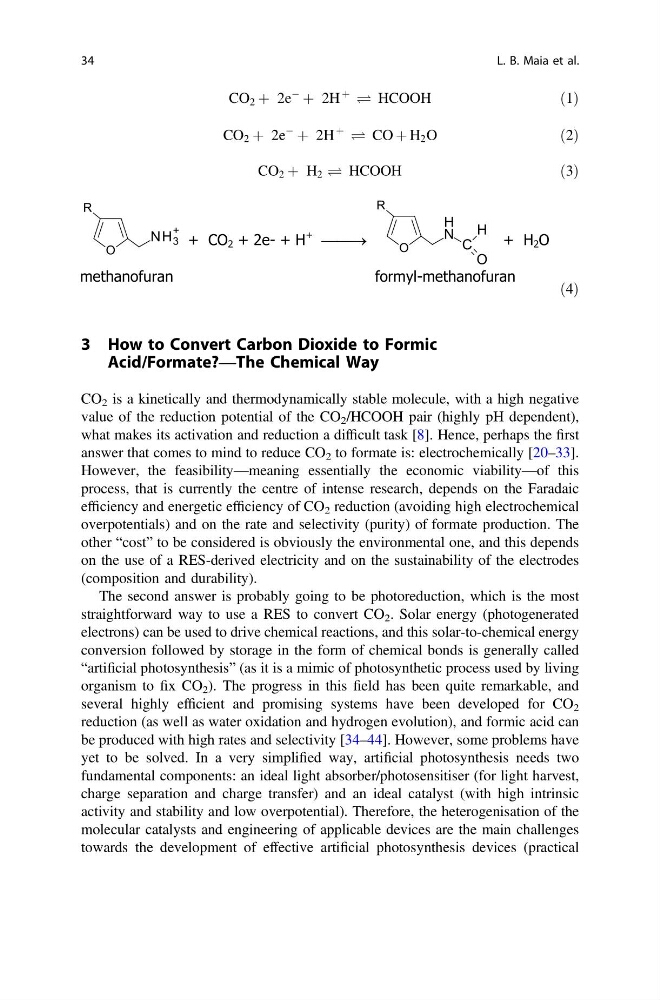
CO 2 þ 2e
À
þ 2H
þ
HCOOH
ð1Þ
CO 2 þ 2e
À
þ 2H
þ
CO þ H 2 O
ð2Þ
CO 2 þ H 2 HCOOH
ð3Þ
ð4Þ
3 How to Convert Carbon Dioxide to Formic
Acid/Formate?—The Chemical Way
CO 2 is a kinetically and thermodynamically stable molecule, with a high negative
value of the reduction potential of the CO 2 /HCOOH pair (highly pH dependent),
what makes its activation and reduction a difficult task [8]. Hence, perhaps the first
answer that comes to mind to reduce CO 2 to formate is: electrochemically [20–33].
However, the feasibility—meaning essentially the economic viability—of this
process, that is currently the centre of intense research, depends on the Faradaic
efficiency and energetic efficiency of CO 2 reduction (avoiding high electrochemical
overpotentials) and on the rate and selectivity (purity) of formate production. The
other “cost” to be considered is obviously the environmental one, and this depends
on the use of a RES-derived electricity and on the sustainability of the electrodes
(composition and durability).
The second answer is probably going to be photoreduction, which is the most
straightforward way to use a RES to convert CO 2 . Solar energy (photogenerated
electrons) can be used to drive chemical reactions, and this solar-to-chemical energy
conversion followed by storage in the form of chemical bonds is generally called
“artificial photosynthesis” (as it is a mimic of photosynthetic process used by living
organism to fix CO 2 ). The progress in this field has been quite remarkable, and
several highly efficient and promising systems have been developed for CO 2
reduction (as well as water oxidation and hydrogen evolution), and formic acid can
be produced with high rates and selectivity [34–44]. However, some problems have
yet to be solved. In a very simplified way, artificial photosynthesis needs two
fundamental components: an ideal light absorber/photosensitiser (for light harvest,
charge separation and charge transfer) and an ideal catalyst (with high intrinsic
activity and stability and low overpotential). Therefore, the heterogenisation of the
molecular catalysts and engineering of applicable devices are the main challenges
towards the development of effective artificial photosynthesis devices (practical
34
L. B. Maia et al.
À
þ 2H
þ
HCOOH
ð1Þ
CO 2 þ 2e
À
þ 2H
þ
CO þ H 2 O
ð2Þ
CO 2 þ H 2 HCOOH
ð3Þ
ð4Þ
3 How to Convert Carbon Dioxide to Formic
Acid/Formate?—The Chemical Way
CO 2 is a kinetically and thermodynamically stable molecule, with a high negative
value of the reduction potential of the CO 2 /HCOOH pair (highly pH dependent),
what makes its activation and reduction a difficult task [8]. Hence, perhaps the first
answer that comes to mind to reduce CO 2 to formate is: electrochemically [20–33].
However, the feasibility—meaning essentially the economic viability—of this
process, that is currently the centre of intense research, depends on the Faradaic
efficiency and energetic efficiency of CO 2 reduction (avoiding high electrochemical
overpotentials) and on the rate and selectivity (purity) of formate production. The
other “cost” to be considered is obviously the environmental one, and this depends
on the use of a RES-derived electricity and on the sustainability of the electrodes
(composition and durability).
The second answer is probably going to be photoreduction, which is the most
straightforward way to use a RES to convert CO 2 . Solar energy (photogenerated
electrons) can be used to drive chemical reactions, and this solar-to-chemical energy
conversion followed by storage in the form of chemical bonds is generally called
“artificial photosynthesis” (as it is a mimic of photosynthetic process used by living
organism to fix CO 2 ). The progress in this field has been quite remarkable, and
several highly efficient and promising systems have been developed for CO 2
reduction (as well as water oxidation and hydrogen evolution), and formic acid can
be produced with high rates and selectivity [34–44]. However, some problems have
yet to be solved. In a very simplified way, artificial photosynthesis needs two
fundamental components: an ideal light absorber/photosensitiser (for light harvest,
charge separation and charge transfer) and an ideal catalyst (with high intrinsic
activity and stability and low overpotential). Therefore, the heterogenisation of the
molecular catalysts and engineering of applicable devices are the main challenges
towards the development of effective artificial photosynthesis devices (practical
34
L. B. Maia et al.