

4 Conclusions
To sum up, ArMs are powerful biohybrids capable of catalyzing a wide range of
reactions under eco-compatible conditions. The construction of such catalysts is
typically designed through different strategies including the host/guest interaction,
the “Trojan horse” strategy, the covalent binding of the metallic complex into the
protein scaffold, or de novo design of metal-binding peptides. In terms of oxidation
reactions, sulfide oxidation has been the most studied reaction and one of the best
results was obtained by Ward et al. with vanadate-loaded streptavidin, which catalyzed the enantioselective thioether sulfoxidation with up to 93% ee and 96%
conversion [24]. Other oxidation reactions were successfully catalyzed by ArMs,
including alcohol oxidation, amine oxidation, catechol oxidation, epoxidation, and
dihydroxylation. However, C–H activation remains one of the biggest challenges to
tackle, with only one example of oxygen insertion into a C–H bond described so far
[36, 42]. Concerning reduction reactions, a lot of efforts have been devoted to
mimic the activity of [FeFe]-hydrogenases by taking advantage of the second
coordination sphere surrounding handmade metallic complexes in ArMs. Yet, the
stability of the systems still needs to be improved to reach the high activity required
for future hydrogen production applications. Another active field for ArMs is the
CO 2 reduction catalysis, but the most successful reduction reaction catalyzed by
ArMs is the enantioselective reduction of cyclic imines catalyzed by Ir or Ru
complexes incorporated in various protein scaffolds with up to 94% ee and a TON
of 98. ArMs have also been designed for the catalysis of polymerization reactions
such as phenylacetylene polymerization, as well as ring-opening Metathesis Polymerization which have both been performed with good conversion rates and high
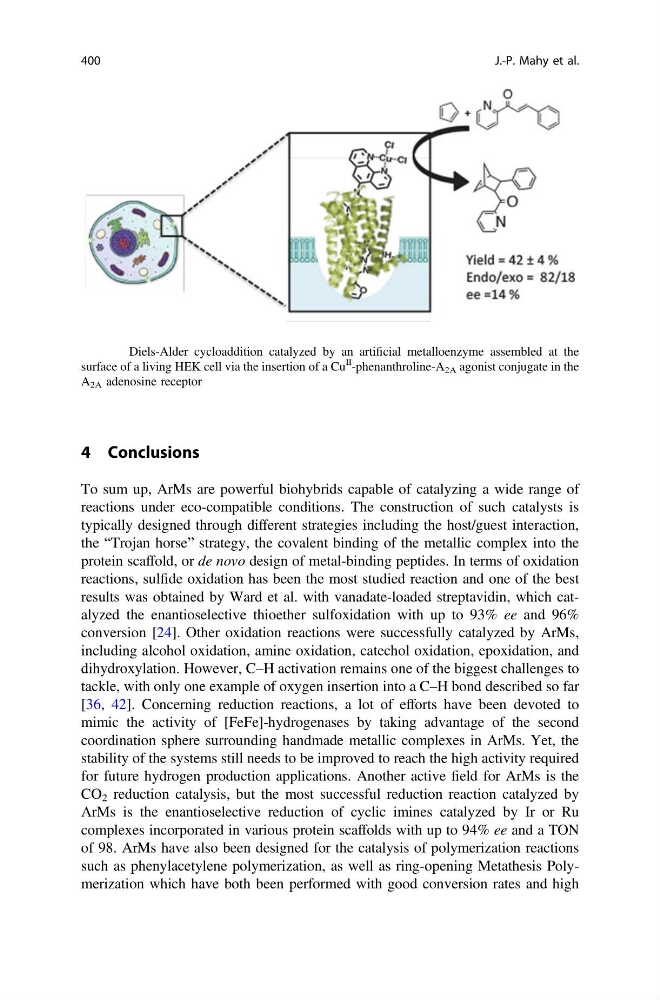
Fig. 27 Diels-Alder cycloaddition catalyzed by an artificial metalloenzyme assembled at the
surface of a living HEK cell via the insertion of a Cu
II
-phenanthroline-A 2A agonist conjugate in the
A 2A adenosine receptor
400
J.-P. Mahy et al.
To sum up, ArMs are powerful biohybrids capable of catalyzing a wide range of
reactions under eco-compatible conditions. The construction of such catalysts is
typically designed through different strategies including the host/guest interaction,
the “Trojan horse” strategy, the covalent binding of the metallic complex into the
protein scaffold, or de novo design of metal-binding peptides. In terms of oxidation
reactions, sulfide oxidation has been the most studied reaction and one of the best
results was obtained by Ward et al. with vanadate-loaded streptavidin, which catalyzed the enantioselective thioether sulfoxidation with up to 93% ee and 96%
conversion [24]. Other oxidation reactions were successfully catalyzed by ArMs,
including alcohol oxidation, amine oxidation, catechol oxidation, epoxidation, and
dihydroxylation. However, C–H activation remains one of the biggest challenges to
tackle, with only one example of oxygen insertion into a C–H bond described so far
[36, 42]. Concerning reduction reactions, a lot of efforts have been devoted to
mimic the activity of [FeFe]-hydrogenases by taking advantage of the second
coordination sphere surrounding handmade metallic complexes in ArMs. Yet, the
stability of the systems still needs to be improved to reach the high activity required
for future hydrogen production applications. Another active field for ArMs is the
CO 2 reduction catalysis, but the most successful reduction reaction catalyzed by
ArMs is the enantioselective reduction of cyclic imines catalyzed by Ir or Ru
complexes incorporated in various protein scaffolds with up to 94% ee and a TON
of 98. ArMs have also been designed for the catalysis of polymerization reactions
such as phenylacetylene polymerization, as well as ring-opening Metathesis Polymerization which have both been performed with good conversion rates and high
Fig. 27 Diels-Alder cycloaddition catalyzed by an artificial metalloenzyme assembled at the
surface of a living HEK cell via the insertion of a Cu
II
-phenanthroline-A 2A agonist conjugate in the
A 2A adenosine receptor
400
J.-P. Mahy et al.