

2018 [1]) and land (3.5Gt of carbon in 2018 [1]). To break this largely unfavourable
imbalance (more than 5Gt in 2018), we must actively reduce the CO 2 emissions and
develop new and more efficient “CO 2 sinks”—new individual actions and political
decisions are needed, as reviewed by Seixas and Ferreira in this book [3].
Until recently, the debate often focused only on “passive CO 2 mitigation”,
searching for strategies for CO 2 capture and sequestration (CCS). Instead, we
should be looking at the opportunities for the energy and chemical industries
provided by exploiting this novel and huge carbon feedstock (Fig. 2), such as
(a) storage of “intermittent” renewable energy sources (RES) (wind, solar and
hydropower energy, which are now rapidly growing and becoming economically
viable), (b) conversion of RES-derived electricity into fuels (mainly for mobility
and transport sector, in particular aviation and heavy freight over long distances, the
major polluters), (c) production of added-value compounds (VC) and feedstock
chemicals for making all the modern-world chemical commodities (from bulk
chemicals to plastics, fertilisers and even pharmaceuticals). Regarding atmospheric
CO 2 reduction, points (a) and (b) (energy industry) are of major relevance, as the
different scales of energy and chemical industries impede the VC production to
function as a quantitative “sink” for the massive fossil fuels-dependent CO 2
emissions. Together, these three axes, storage/conversion/production, will certainly
provide a straightforward way to actively reduce the CO 2 emissions, while actively
consuming the CO 2 already released—”two-in-one solution”.
But, how to direct CO 2 into the storage/conversion/production axes? Formic
acid/formate
1 offers key advantages (Fig. 2)!
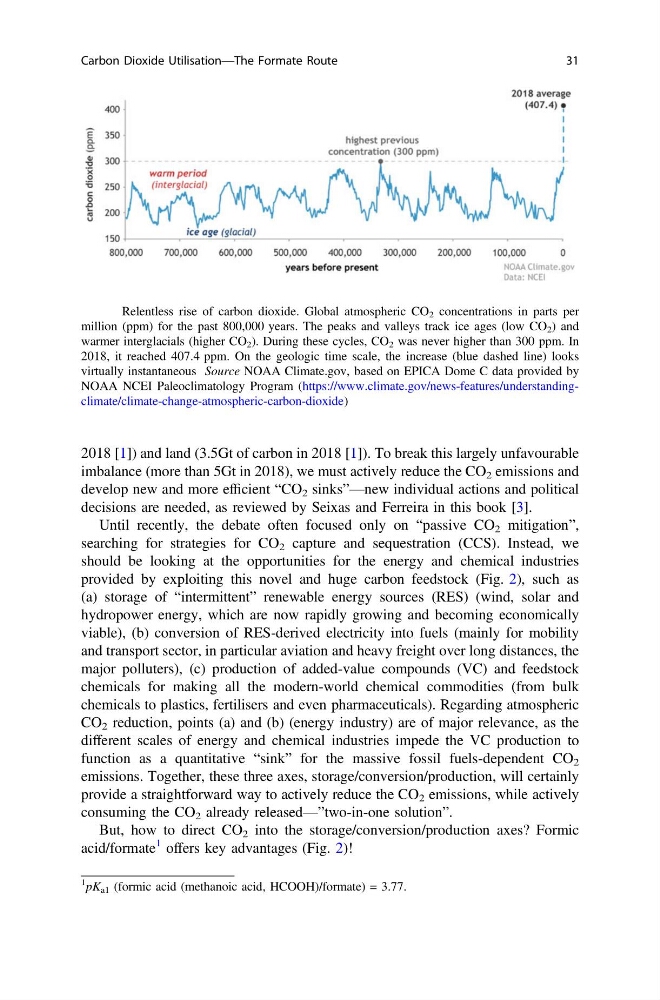
Fig. 1 Relentless rise of carbon dioxide. Global atmospheric CO 2 concentrations in parts per
million (ppm) for the past 800,000 years. The peaks and valleys track ice ages (low CO 2 ) and
warmer interglacials (higher CO 2 ). During these cycles, CO 2 was never higher than 300 ppm. In
2018, it reached 407.4 ppm. On the geologic time scale, the increase (blue dashed line) looks
virtually instantaneous Source NOAA Climate.gov, based on EPICA Dome C data provided by
NOAA NCEI Paleoclimatology Program (https://www.climate.gov/news-features/understandingclimate/climate-change-atmospheric-carbon-dioxide)
1
pK a1 (formic acid (methanoic acid, HCOOH)/formate) = 3.77.
Carbon Dioxide Utilisation—The Formate Route
31
imbalance (more than 5Gt in 2018), we must actively reduce the CO 2 emissions and
develop new and more efficient “CO 2 sinks”—new individual actions and political
decisions are needed, as reviewed by Seixas and Ferreira in this book [3].
Until recently, the debate often focused only on “passive CO 2 mitigation”,
searching for strategies for CO 2 capture and sequestration (CCS). Instead, we
should be looking at the opportunities for the energy and chemical industries
provided by exploiting this novel and huge carbon feedstock (Fig. 2), such as
(a) storage of “intermittent” renewable energy sources (RES) (wind, solar and
hydropower energy, which are now rapidly growing and becoming economically
viable), (b) conversion of RES-derived electricity into fuels (mainly for mobility
and transport sector, in particular aviation and heavy freight over long distances, the
major polluters), (c) production of added-value compounds (VC) and feedstock
chemicals for making all the modern-world chemical commodities (from bulk
chemicals to plastics, fertilisers and even pharmaceuticals). Regarding atmospheric
CO 2 reduction, points (a) and (b) (energy industry) are of major relevance, as the
different scales of energy and chemical industries impede the VC production to
function as a quantitative “sink” for the massive fossil fuels-dependent CO 2
emissions. Together, these three axes, storage/conversion/production, will certainly
provide a straightforward way to actively reduce the CO 2 emissions, while actively
consuming the CO 2 already released—”two-in-one solution”.
But, how to direct CO 2 into the storage/conversion/production axes? Formic
acid/formate
1 offers key advantages (Fig. 2)!
Fig. 1 Relentless rise of carbon dioxide. Global atmospheric CO 2 concentrations in parts per
million (ppm) for the past 800,000 years. The peaks and valleys track ice ages (low CO 2 ) and
warmer interglacials (higher CO 2 ). During these cycles, CO 2 was never higher than 300 ppm. In
2018, it reached 407.4 ppm. On the geologic time scale, the increase (blue dashed line) looks
virtually instantaneous Source NOAA Climate.gov, based on EPICA Dome C data provided by
NOAA NCEI Paleoclimatology Program (https://www.climate.gov/news-features/understandingclimate/climate-change-atmospheric-carbon-dioxide)
1
pK a1 (formic acid (methanoic acid, HCOOH)/formate) = 3.77.
Carbon Dioxide Utilisation—The Formate Route
31