

originally designed by a computational method that not only considered the stabilization of the desired fold, but also the destabilization of likely alternatives [15].
Combinations of different monomer units and the introduction of mutations at the
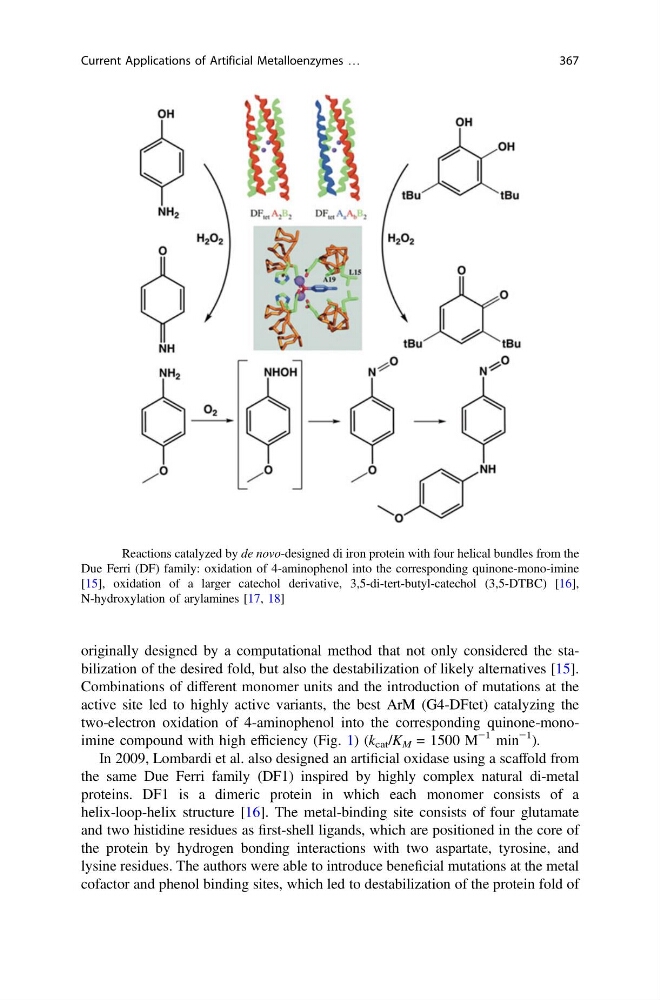
active site led to highly active variants, the best ArM (G4-DFtet) catalyzing the
two-electron oxidation of 4-aminophenol into the corresponding quinone-monoimine compound with high efficiency (Fig. 1) (k cat /K M = 1500 M
−1 min
−1 ).
In 2009, Lombardi et al. also designed an artificial oxidase using a scaffold from
the same Due Ferri family (DF1) inspired by highly complex natural di-metal
proteins. DF1 is a dimeric protein in which each monomer consists of a
helix-loop-helix structure [16]. The metal-binding site consists of four glutamate
and two histidine residues as first-shell ligands, which are positioned in the core of
the protein by hydrogen bonding interactions with two aspartate, tyrosine, and
lysine residues. The authors were able to introduce beneficial mutations at the metal
cofactor and phenol binding sites, which led to destabilization of the protein fold of
Fig. 1 Reactions catalyzed by de novo-designed di iron protein with four helical bundles from the
Due Ferri (DF) family: oxidation of 4-aminophenol into the corresponding quinone-mono-imine
[15], oxidation of a larger catechol derivative, 3,5-di-tert-butyl-catechol (3,5-DTBC) [16],
N-hydroxylation of arylamines [17, 18]
Current Applications of Artificial Metalloenzymes …
367
Combinations of different monomer units and the introduction of mutations at the
active site led to highly active variants, the best ArM (G4-DFtet) catalyzing the
two-electron oxidation of 4-aminophenol into the corresponding quinone-monoimine compound with high efficiency (Fig. 1) (k cat /K M = 1500 M
−1 min
−1 ).
In 2009, Lombardi et al. also designed an artificial oxidase using a scaffold from
the same Due Ferri family (DF1) inspired by highly complex natural di-metal
proteins. DF1 is a dimeric protein in which each monomer consists of a
helix-loop-helix structure [16]. The metal-binding site consists of four glutamate
and two histidine residues as first-shell ligands, which are positioned in the core of
the protein by hydrogen bonding interactions with two aspartate, tyrosine, and
lysine residues. The authors were able to introduce beneficial mutations at the metal
cofactor and phenol binding sites, which led to destabilization of the protein fold of
Fig. 1 Reactions catalyzed by de novo-designed di iron protein with four helical bundles from the
Due Ferri (DF) family: oxidation of 4-aminophenol into the corresponding quinone-mono-imine
[15], oxidation of a larger catechol derivative, 3,5-di-tert-butyl-catechol (3,5-DTBC) [16],
N-hydroxylation of arylamines [17, 18]
Current Applications of Artificial Metalloenzymes …
367