

For the direct detection of pesticides, bacterial organophosphorus hydrolase
(OPH) has been vastly researched [262–266]. This enzyme is a phosphotriesterase
with a broad substrate specificity that catalyzes the hydrolysis of P–O, P–S, P–F,
and P–CN bonds in organophosphate pesticides, producing p-nitrophenol [262,
267, 268]. This hydrolysis product is redox-active and its oxidation above 700 mV
(vs. Ag/AgCl reference system) is used for the amperometric/voltammetric detection of the precursor analyte [263, 264, 266]. Also, since two protons are released
per parent molecule during hydrolysis, pH electrodes can be used to measure the
localized decrease in pH as a function of the analyte concentration (potentiometric
devices) [261, 263].
Mammalian paraoxonase 1 is another interesting candidate for the development
of hydrolytic biosensors for organophosphorus compounds monitoring. This
enzyme belongs to a family of highly conserved enzymes in mammals and that is
comprised of three isoforms: PON1, PON2, and PON3. The nomenclature is a
purely historical one since this family has one of the broadest specificities known
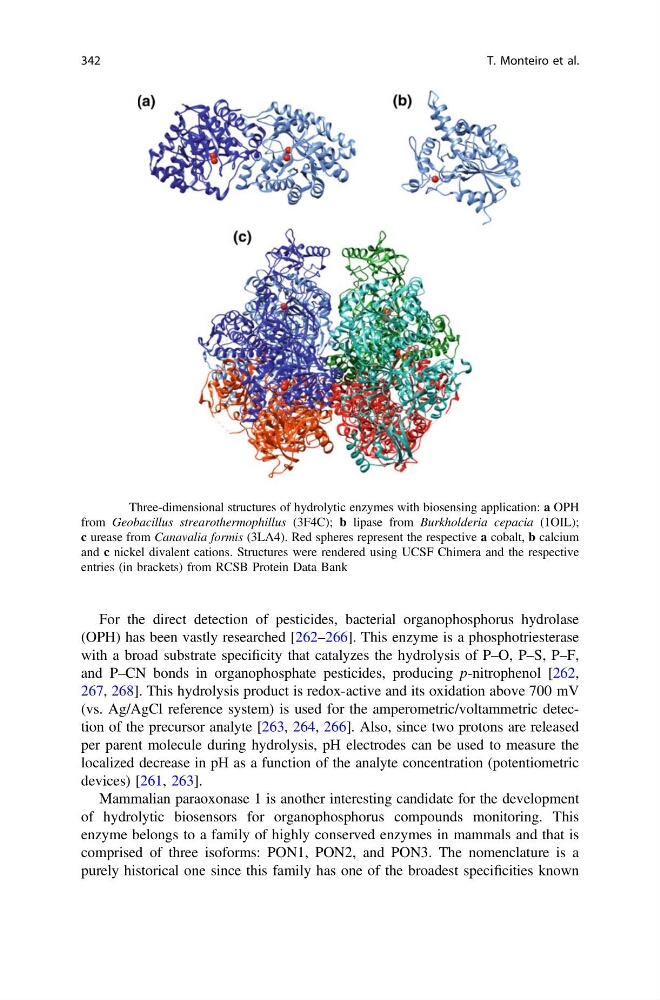
Fig. 12 Three-dimensional structures of hydrolytic enzymes with biosensing application: a OPH
from Geobacillus strearothermophillus (3F4C); b lipase from Burkholderia cepacia (1OIL);
c urease from Canavalia formis (3LA4). Red spheres represent the respective a cobalt, b calcium
and c nickel divalent cations. Structures were rendered using UCSF Chimera and the respective
entries (in brackets) from RCSB Protein Data Bank
342
T. Monteiro et al.
(OPH) has been vastly researched [262–266]. This enzyme is a phosphotriesterase
with a broad substrate specificity that catalyzes the hydrolysis of P–O, P–S, P–F,
and P–CN bonds in organophosphate pesticides, producing p-nitrophenol [262,
267, 268]. This hydrolysis product is redox-active and its oxidation above 700 mV
(vs. Ag/AgCl reference system) is used for the amperometric/voltammetric detection of the precursor analyte [263, 264, 266]. Also, since two protons are released
per parent molecule during hydrolysis, pH electrodes can be used to measure the
localized decrease in pH as a function of the analyte concentration (potentiometric
devices) [261, 263].
Mammalian paraoxonase 1 is another interesting candidate for the development
of hydrolytic biosensors for organophosphorus compounds monitoring. This
enzyme belongs to a family of highly conserved enzymes in mammals and that is
comprised of three isoforms: PON1, PON2, and PON3. The nomenclature is a
purely historical one since this family has one of the broadest specificities known
Fig. 12 Three-dimensional structures of hydrolytic enzymes with biosensing application: a OPH
from Geobacillus strearothermophillus (3F4C); b lipase from Burkholderia cepacia (1OIL);
c urease from Canavalia formis (3LA4). Red spheres represent the respective a cobalt, b calcium
and c nickel divalent cations. Structures were rendered using UCSF Chimera and the respective
entries (in brackets) from RCSB Protein Data Bank
342
T. Monteiro et al.