

food industries) due to its commercial availability, low-cost, stability, high activity,
and substrate specificity [8, 12]. Also, the need for (bio)devices capable of monitoring glucose levels in patients suffering from diabetes mellitus has vastly contributed to the notoriety and widespread use of GOx in clinical bioelectrochemical
applications [6, 13].
AOD (or methanol oxidase) catalyzes the oxidation of methanol (physiological
substrate) and other short aliphatic alcohols, such as ethanol, propanol, and butanol,
to the corresponding aldehyde [14–17]. This FAD-dependent enzyme is expressed
in methylotrophic organisms that metabolize short primary alcohols as their main
carbon and energy source, being identified in various yeast and filamentous fungi
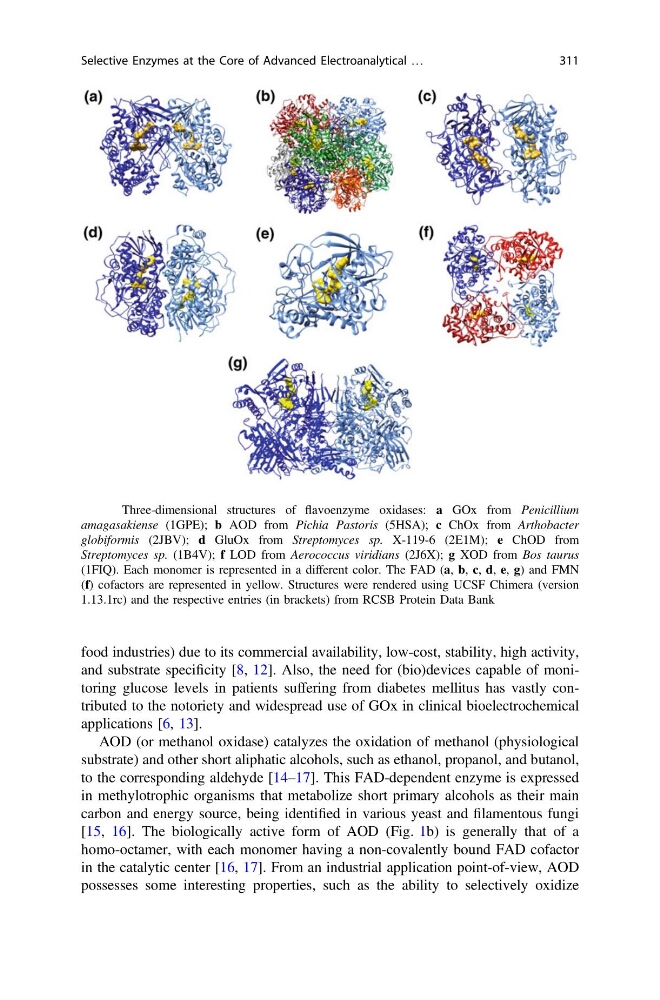
[15, 16]. The biologically active form of AOD (Fig. 1b) is generally that of a
homo-octamer, with each monomer having a non-covalently bound FAD cofactor
in the catalytic center [16, 17]. From an industrial application point-of-view, AOD
possesses some interesting properties, such as the ability to selectively oxidize
Fig. 1 Three-dimensional structures of flavoenzyme oxidases: a GOx from Penicillium
amagasakiense (1GPE); b AOD from Pichia Pastoris (5HSA); c ChOx from Arthobacter
globiformis (2JBV); d GluOx from Streptomyces sp. X-119-6 (2E1M); e ChOD from
Streptomyces sp. (1B4V); f LOD from Aerococcus viridians (2J6X); g XOD from Bos taurus
(1FIQ). Each monomer is represented in a different color. The FAD (a, b, c, d, e, g) and FMN
(f) cofactors are represented in yellow. Structures were rendered using UCSF Chimera (version
1.13.1rc) and the respective entries (in brackets) from RCSB Protein Data Bank
Selective Enzymes at the Core of Advanced Electroanalytical …
311
and substrate specificity [8, 12]. Also, the need for (bio)devices capable of monitoring glucose levels in patients suffering from diabetes mellitus has vastly contributed to the notoriety and widespread use of GOx in clinical bioelectrochemical
applications [6, 13].
AOD (or methanol oxidase) catalyzes the oxidation of methanol (physiological
substrate) and other short aliphatic alcohols, such as ethanol, propanol, and butanol,
to the corresponding aldehyde [14–17]. This FAD-dependent enzyme is expressed
in methylotrophic organisms that metabolize short primary alcohols as their main
carbon and energy source, being identified in various yeast and filamentous fungi
[15, 16]. The biologically active form of AOD (Fig. 1b) is generally that of a
homo-octamer, with each monomer having a non-covalently bound FAD cofactor
in the catalytic center [16, 17]. From an industrial application point-of-view, AOD
possesses some interesting properties, such as the ability to selectively oxidize
Fig. 1 Three-dimensional structures of flavoenzyme oxidases: a GOx from Penicillium
amagasakiense (1GPE); b AOD from Pichia Pastoris (5HSA); c ChOx from Arthobacter
globiformis (2JBV); d GluOx from Streptomyces sp. X-119-6 (2E1M); e ChOD from
Streptomyces sp. (1B4V); f LOD from Aerococcus viridians (2J6X); g XOD from Bos taurus
(1FIQ). Each monomer is represented in a different color. The FAD (a, b, c, d, e, g) and FMN
(f) cofactors are represented in yellow. Structures were rendered using UCSF Chimera (version
1.13.1rc) and the respective entries (in brackets) from RCSB Protein Data Bank
Selective Enzymes at the Core of Advanced Electroanalytical …
311